

BHRT vs HRT | Bioidentical and Conventional Hormone Therapy Compared, Ann Arbor
Key takeaways
- BHRT is not a rival to HRT. It is a subset of HRT, defined by molecule shape, not by what it does.
- Estradiol patches, gels and oral micronized progesterone are bioidentical and FDA-approved; you rarely must choose between bioidentical and well studied.
- The WHI tested one older oral combination. Its extra risk was about 8 breast cancers per 10,000 women per year.
- Starting near menopause, using estradiol through the skin, and pairing it with progesterone each shift the risk picture.
- Candidates include women in perimenopause or menopause and men with confirmed low testosterone. Your $35 first visit starts with a full panel.
"BHRT" and "HRT" are not rival treatments. BHRT (bioidentical hormone replacement therapy) means hormone molecules that are an exact match for the ones your ovaries made. HRT (hormone replacement therapy) is the umbrella term. It covers those molecules and others whose structure has been changed on purpose. What changes your outcome is which molecule you take, by which route, and how soon after your final period you begin.
The short version. Estradiol (the strongest form of estrogen) and progesterone (the hormone that balances estrogen) prescribed for menopause are bioidentical. Many are FDA-approved products stocked at any pharmacy. "Bioidentical" describes the shape of a molecule. It does not say where a prescription was filled, and it is not another word for "compounded." Separate those ideas and the real questions appear. Estradiol or a horse-derived estrogen mix? Patch or pill? Progesterone or a synthetic progestin? And when do you start?
Why "BHRT vs HRT" Is the Wrong Comparison
HRT, which clinicians now call menopausal hormone therapy, is defined by what a treatment does. BHRT is defined by what the molecule looks like. Those are different kinds of statement, so one cannot stand in for the other. A 17-beta-estradiol patch is both HRT and bioidentical at the same time.
The confusion is not an accident. An ACOG Clinical Consensus document is direct about where it came from. Many compounding pharmacies use "bioidentical hormone" as a marketing term. The aim is to imply their products are safer than FDA-approved menopause drugs. Yet those approved drugs may themselves use bioidentical hormones, synthetic hormones, or both (ACOG Clinical Consensus No. 6, Obstet Gynecol, 2023, DOI).
That comparison, and everything that follows from it, is on this page. Your next question may be which labs get drawn before and during treatment, what each marker means, and how often it is repeated. That is covered in our guide to hormone testing and monitoring for bioidentical hormone therapy.
What "Bioidentical" Means at the Molecular Level
A bioidentical hormone has the same structure as the one your body makes (Borda et al., Dermatol Online J, 2019, PubMed). Here that means 17-beta-estradiol, progesterone and testosterone (the main male sex hormone, which women also make in smaller amounts). Most are made from plant sources, often soy or yams, and match your own hormones exactly. Its estradiol is the same molecule as the one from your ovaries.
The non-identical options are conjugated equine estrogens (CEE, sold as Premarin, a mix drawn from pregnant mare urine) and synthetic progestins such as medroxyprogesterone acetate (MPA). Progestins are progesterone-like molecules with atoms added, removed or moved around.
Why should a few atoms matter? Because shape decides what a molecule binds to and how long it lasts. Progesterone and the progestins bind the progesterone receptor, but not only that receptor. They also bind other steroid receptors, switching them on or off depending on the molecule's shape. Half-life and breakdown differ too (Gompel & Plu-Bureau, Climacteric, 2018, DOI). A synthetic progestin is a different key, and it opens some locks progesterone does not.
That is the sound core of the BHRT argument. What it does not permit is two leaps: from "same structure" to "risk-free," and from "bioidentical" to "must be compounded." Those are separate claims, and both need their own proof.
Bioidentical Hormones You Can Get as FDA-Approved Products
This is the fact most often left out. A 2023 JAMA review states plainly that FDA-approved bioidentical estrogens are available to treat vasomotor symptoms (hot flashes and night sweats). They match the estrogens your body makes, and they are often given through the skin (Crandall et al., JAMA, 2023, DOI). Estradiol patches, gels, sprays and vaginal products are bioidentical. So is oral micronized progesterone (progesterone milled into fine particles so the body absorbs it). Each is made to drug-industry standards with labeled dosing. You rarely have to choose between bioidentical and well studied.
Compounded hormones are mixed to order by a pharmacy, often in custom ratios. They come as creams, troches or pellets (rice-sized implants placed under the skin). Compounding has a real role. One example is an allergy to an inactive ingredient in every commercial product. Another is a dose or form that is not sold off the shelf (Pinkerton, Cancer J, 2022, DOI). Outside those cases, ACOG advises telling patients that FDA-approved therapies are the recommended option. It also notes that randomized trials comparing compounded with approved products would settle the question (ACOG, 2023, DOI). The FDA-commissioned National Academies review agreed with menopause societies worldwide (Stuenkel, Climacteric, 2021, DOI). If you are told BHRT comes only from compounding, that is a claim about a business model, not about the drug.
What the Women's Health Initiative Actually Found
The Women's Health Initiative (WHI) estrogen-plus-progestin trial enrolled 16,608 women past menopause, aged 50 to 79, who still had a uterus. They were assigned by chance to CEE 0.625 mg/d plus MPA 2.5 mg/d, or to placebo. The trial stopped at a mean of 5.2 years. Hazard ratios (HR, the risk on treatment compared with placebo, where 1.0 means no difference) were:
- 1.29 for coronary heart disease.
- 1.26 for invasive breast cancer.
- 1.41 for stroke.
- 2.13 for pulmonary embolism (a clot in the lung).
- 0.63 for colorectal cancer.
- 0.66 for hip fracture.
In absolute terms, per 10,000 women per year, that meant 7 more heart events, 8 more strokes, 8 more lung clots and 8 more invasive breast cancers. It also meant 6 fewer bowel cancers and 5 fewer hip fractures (Rossouw et al., JAMA, 2002, DOI).
Eight extra breast cancers per 10,000 women per year is 0.08% per year. The headline was "26% increase." Both are correct and describe the same finding. That gap is why so many people misjudge the risk in menopause care. It is also why we quote absolute numbers.
Two more findings deserve airtime. Across both WHI trials, 27,347 women were followed for 18 years. Deaths from any cause were 27.1% on hormones versus 27.6% on placebo (HR 0.99, 95% CI 0.94-1.03). A 95% confidence interval (CI) is the range the true value most likely sits in. There was no significant difference in heart or cancer deaths (Manson et al., JAMA, 2017, DOI).
And the estrogen-alone arm went the other way. Women who had a prior hysterectomy (removal of the uterus) got CEE alone. After more than 20 years of median follow-up, they had significantly fewer breast cancers than placebo (238 versus 296 cases; HR 0.78, 95% CI 0.65-0.93). They also had fewer breast cancer deaths (HR 0.60, 95% CI 0.37-0.97). Estrogen plus MPA showed more cases (HR 1.28, 95% CI 1.13-1.45). Deaths did not differ significantly (HR 1.35, 95% CI 0.94-1.95) (Chlebowski et al., JAMA, 2020, DOI). The signal tracked with the progestogen. That is a finding about the molecule, and it bears on the BHRT question.
Three Things That Changed After 2002
Timing
Mean age at WHI entry was 63.4. That is more than a decade past the average age of menopause. The data were also split by age group. During treatment, the effect of hormones on deaths from any cause looked more favorable in women aged 50 to 59 than in women aged 70 to 79. The ratio of the two hazard ratios was 0.61 (95% CI 0.43-0.87) (Manson et al., 2017, DOI).
ELITE put this to the test. It enrolled 643 healthy women past menopause. Some were fewer than 6 years past it, others 10 or more years past it. Each was assigned by chance to oral 17-beta-estradiol or placebo. The outcome was carotid intima-media thickness (CIMT, a measure of thickening in the neck artery wall). After a median of 5 years, the effect on CIMT differed clearly between the two groups (P = 0.007 for interaction). In the early group, CIMT rose 0.0044 mm per year on estradiol versus 0.0078 on placebo (P = 0.008). The late group showed no difference (Hodis et al., N Engl J Med, 2016, DOI). The authors named their own limit. CT measures of coronary calcium, narrowing and plaque did not differ in either group. CIMT is a stand-in measure, not a count of heart attacks.
The 2022 North American Menopause Society (NAMS) position statement reflects this. For women under 60 or within 10 years of menopause onset with no reason to avoid it, the benefit-risk ratio is favorable. That applies to treating bothersome hot flashes and preventing bone loss. Beyond that window it appears less favorable, because absolute risks are greater (NAMS, Menopause, 2022, DOI).
The molecules tested
WHI tested oral CEE with or without oral MPA. It did not test estradiol through the skin or micronized progesterone. Stretching its findings to all regimens is a leap it cannot support. But nobody should claim WHI proves estradiol and progesterone are safe. It did not test them.
Absolute versus relative risk
The 2023 JAMA review gives a figure worth keeping in mind. With CEE, the added risk of stroke and venous thromboembolism (VTE, blood clots in the veins) is about 1 extra event per 1,000 person-years. So is the added breast cancer risk with CEE plus MPA. And systemic estrogen cuts the number of hot flashes by roughly 75%, with oral and skin routes working about as well (Crandall et al., 2023, DOI).
Want your own numbers, not averages?
A 30 to 45 minute visit to weigh these trade-offs against your own history and symptoms, with the $35 applied toward your plan.
Book your $35 first visit Call (734) 436-3357
Route: Why Transdermal Estradiol Behaves Differently
A swallowed estrogen passes through the liver first. That pass changes the liver's output of clotting factors, SHBG (sex hormone-binding globulin, a protein that grabs hormones in the blood) and inflammation proteins. A patch or gel largely skips it. Transdermal (through the skin) estrogens have less effect on clotting, inflammation and blood fats than oral ones (Shufelt & Manson, J Clin Endocrinol Metab, 2021, DOI).
A meta-analysis (a study that pools the results of many trials) looked at estrogen-only users. Oral estrogen raised VTE risk (relative risk, or RR, 1.48; 95% CI 1.39-1.58). The skin route did not (RR 0.97, 95% CI 0.87-1.09) (Scarabin, Climacteric, 2018, DOI). For stroke, a case-control study of 15,710 stroke cases and 59,958 matched controls found skin-route use carried an adjusted rate ratio of 0.95 (95% CI 0.75-1.20) versus no use. Low-dose patches came in at 0.81 (0.62-1.05). But high-dose patches carried 1.89 (1.15-3.11), and oral use 1.28 (1.15-1.42) (Renoux et al., BMJ, 2010, DOI). Route is not a free pass; dose counts.
Now the other side. A cohort of 51,571 women veterans found VTE risk similar among users of oral CEE, oral estradiol and skin estradiol (skin versus CEE, HR 0.95, 95% CI 0.60-1.49). The authors wrote that their findings do not confirm earlier reports of greater safety for transdermal estradiol over CEE (Blondon et al., Menopause, 2021, DOI). The skin-route advantage makes sense and is widely supported, but no randomized trial has proven it.
Micronized Progesterone Versus Synthetic Progestins
If you have a uterus and take systemic estrogen, you need a progestogen, and progesterone itself does that job. In the PEPI trial, 596 women past menopause were followed for three years. Estrogen given alone caused simple hyperplasia (thickening of the uterine lining) in 27.7% versus 0.8% on placebo. It caused atypical hyperplasia (abnormal cell changes in that lining) in 11.8% versus 0%. All three estrogen-plus-progestogen regimens had hyperplasia rates similar to placebo (P = 0.16). That included 200 mg/d micronized progesterone for 12 days per cycle (PEPI Writing Group, JAMA, 1996, DOI). That protection is proven by randomized trial, not inferred.
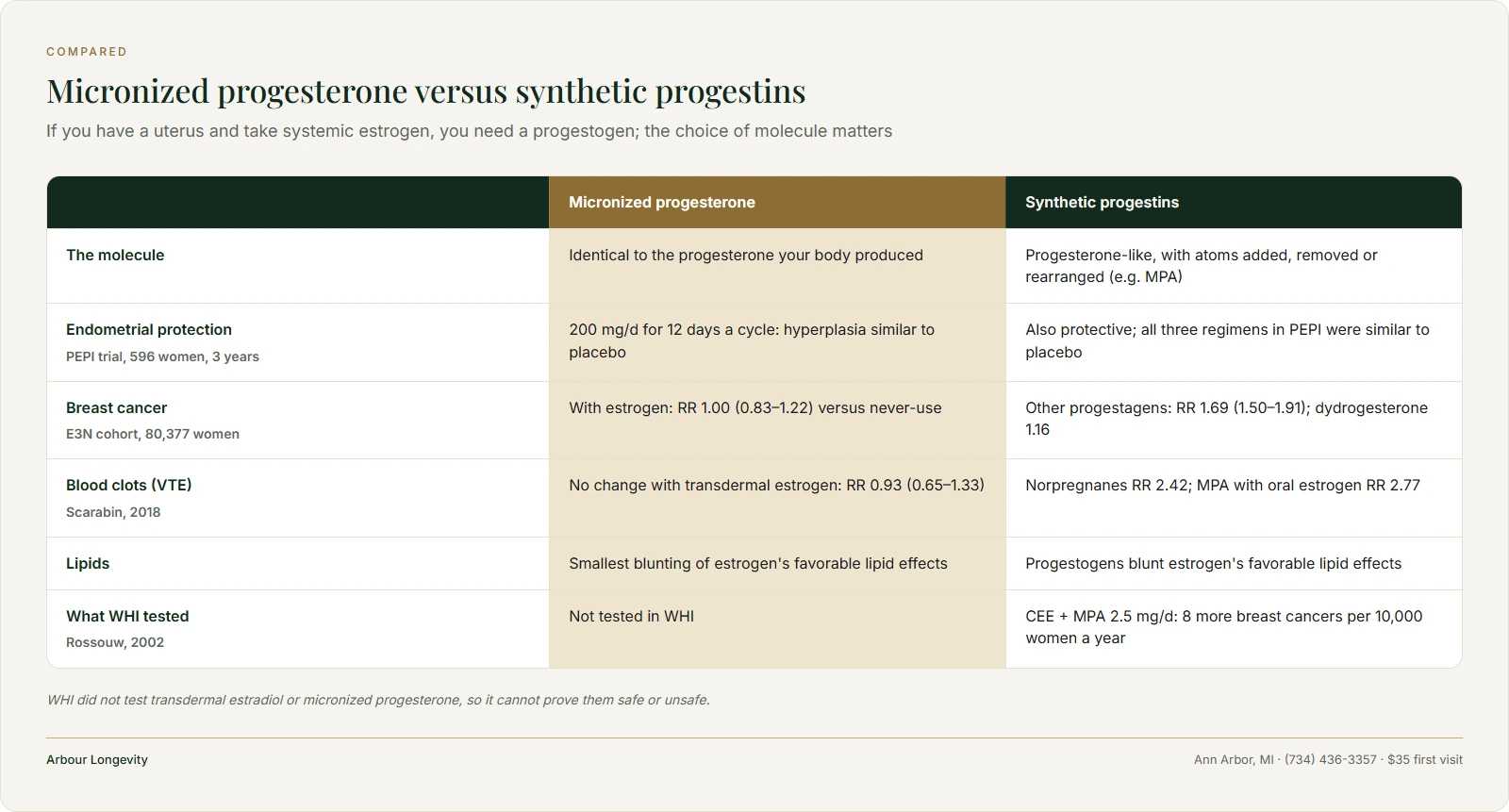
The breast signal is where progestogens part ways. The French E3N cohort followed 80,377 women for a mean of 8.1 years after menopause. In that time 2,354 invasive breast cancers occurred. Compared with never-use, estrogen with progesterone carried an RR of 1.00 (95% CI 0.83-1.22). Estrogen with dydrogesterone carried 1.16 (0.94-1.43), and estrogen with other progestins 1.69 (1.50-1.91) (Fournier et al., Breast Cancer Res Treat, 2008, DOI). That study found no difference by estrogen route for breast cancer risk. That result cuts against part of the standard BHRT pitch.
For clotting, progestogen choice mattered again. Among skin-estrogen users, micronized progesterone showed no change in VTE risk (RR 0.93, 95% CI 0.65-1.33). Norpregnane derivatives, another progestin class, carried RR 2.42 (1.84-3.18). With oral estrogen, MPA carried RR 2.77 (2.33-3.30) (Scarabin, 2018, DOI). Progestogens also blunt estrogen's helpful effects on blood fats, and progesterone blunts them least (Shufelt & Manson, 2021, DOI).
The honest caveat: these are observational data (from watching real patients, not from a trial). No large randomized trial has compared skin estradiol plus progesterone against CEE plus MPA for clinical events. The pattern holds across studies and makes sense. But it is not the grade of evidence WHI provides.
Bioidentical vs Conventional at a Glance
Patients often ask for the practical differences in one place. Here they are, with the caveats the evidence requires:
- Molecular structure. Bioidentical hormones match human hormones exactly. Conventional hormones such as CEE and synthetic progestins are similar but not identical. That can change how your body handles them, as the receptor and clotting data above show.
- Custom dosing. Approved products come in a range of fixed, labeled doses. Compounded hormones can be mixed to a precise dose or ratio based on your labs. That flexibility comes at the cost of the testing and oversight that approved products get.
- Delivery options. Both offer several routes. Compounding allows mixes and doses that off-the-shelf products do not.
- Side-effect profile. Many patients report fewer side effects with BHRT, though responses vary from person to person. The matching structure may help receptor binding, but no head-to-head randomized trial has settled this.
- Monitoring. Both need regular lab checks. BHRT plans usually involve more frequent testing to fine-tune doses, above all in the first 90 days.
Who Is a Candidate for Hormone Therapy?
Hormone therapy suits men and women with symptoms of hormone decline or imbalance. Common candidates include:
- Women in perimenopause (the years of shifting hormones before periods stop) or menopause with hot flashes, night sweats, vaginal dryness, mood changes, or bone loss.
- Men with low testosterone confirmed by lab work, with fatigue, less muscle, more body fat, low libido (sex drive), or slipping memory and focus.
- Adults of any age with thyroid problems or other hormone imbalances confirmed through full testing.
Every hormone plan at Arbour starts with a full panel, not a symptom checklist. For sex hormones, that means more than total testosterone or estradiol. We also check free and bioavailable levels, SHBG and DHEA-S (an adrenal hormone your body turns into testosterone and estrogen). The panel adds a thyroid panel and metabolic markers such as lipids, fasting glucose and A1c. We also take a real baseline: your symptom list, blood pressure, personal and family history, and current mammogram.
Which option suits you is decided in a room with your history in front of us. Nothing here is advice for any one person. The decision turns on:
- How far you are from your final period (NAMS, 2022, DOI).
- Your clotting and blood-vessel history. Prior VTE, thrombophilia (a tendency to form clots), migraine with aura and blood pressure all move the route decision.
- Whether you still have a uterus.
- Your breast history.
- Which symptoms are bothering you.
NAMS says treatment should be tailored to the woman, with regular review of whether to continue (NAMS, 2022, DOI). That means planned follow-up rather than a yearly refill.
One point deserves plain speaking, because it is where marketing lives. Systemic estrogen is dosed to your symptoms and tolerance, not to a number on a lab slip. Levels confirm absorption and check for too-high exposure. They are not a scoreboard. Any unexpected bleeding, or any bleeding after menopause, is checked no matter what the labs show.
Why Arbour Longevity Chooses Bioidentical
Gandhi Bhattarai, FNP-BC, PMHNP-BC, our founder and triple board-certified clinician, chose BHRT as Arbour's standard. The reason is the clinic's guiding idea: work with the body, not against it. "When you give someone a molecule their body already recognizes, you're restoring what was there, not introducing something foreign," says Bhattarai. "The goal isn't just symptom relief."
That choice does not mean picking a side in a marketing fight. Most women who ask us for BHRT want two things. They want hormones matching what their body used to make. And they want a clinician who will tell them the truth about risk in numbers they can hold. We start with a history and an exam, not a product, and we set the follow-up interval before you leave.
Delivery methods at Arbour include creams, injections, pellets, and troches (lozenges that dissolve in the mouth). The choice depends on your lifestyle and how your body handles hormones. Our BHRT plans are paired with ongoing lab checks, health coaching and lifestyle support. Hormone therapy is one piece of a larger longevity plan. That plan includes metabolic health, peptide therapy (many peptides are investigational and have not been reviewed or approved by FDA for these uses), IV nutrient support, and functional medicine. Read more about our approach to hormone replacement therapy in Ann Arbor, our work as a menopause specialist in Ann Arbor, and longer-term hormone optimization.
What to Expect at Your First Visit in Ann Arbor
Your first visit at Arbour Longevity is $35 and lasts 30 to 45 minutes. It includes a full health history review, a symptom review and a lab order. Once your results are in, we design a tailored hormone plan and schedule a follow-up to review it in detail. Follow-ups can be in person or by telehealth. The $35 is applied toward your treatment plan.
Most patients feel better within 2 to 6 weeks of starting, with full effect often by 90 days. We recheck labs at about 6 weeks, at 90 days, and then about every 6 months to keep your plan on track. Results vary from person to person.
Common Questions
Is BHRT safer than HRT?
Not as asked, because BHRT is a subset of HRT, not a rival to it. The question you can answer is whether estradiol and micronized progesterone are safer than CEE and MPA. Real-world evidence points that way on clotting and breast cancer (Scarabin, 2018, DOI; Fournier et al., 2008, DOI). But no randomized trial has compared them head to head.
Do I have to use a compounding pharmacy to get bioidentical hormones?
No. FDA-approved bioidentical estrogens are available, often as patches or gels, and are recommended for hot flashes and night sweats (Crandall et al., 2023, DOI). Oral micronized progesterone is also approved. Compounding has a real role when an approved product truly will not work for you (Pinkerton, 2022, DOI).
Does the WHI mean hormone therapy causes breast cancer?
It means one specific pairing was linked to 8 extra invasive breast cancers per 10,000 women per year (Rossouw et al., 2002, DOI). In the same program, estrogen alone after hysterectomy was linked to significantly fewer breast cancer cases and deaths over 20-plus years (Chlebowski et al., 2020, DOI). Deaths from any cause at 18 years were not increased (Manson et al., 2017, DOI).
Why might a patch be preferred over a pill?
A swallowed estrogen passes through the liver first and shifts its output of clotting proteins. A patch or gel largely does not (Shufelt & Manson, 2021, DOI). In pooled data, oral estrogen alone raised VTE risk (RR 1.48) while the skin route did not (RR 0.97) (Scarabin, 2018, DOI). One veterans cohort did not reproduce that finding (Blondon et al., 2021, DOI).
I am 58 and eight years past my last period. Is it too late?
Not on its own. NAMS describes a favorable benefit-risk ratio for women under 60 or within 10 years of menopause onset with no reason to avoid it (NAMS, 2022, DOI). You are inside it on both counts. That is the start of a talk about your risk, not a decision.
Which labs will I need, and how often?
A baseline panel, a recheck at about 6 weeks and again at 90 days, then about every 6 months. What goes on the panel and what each marker means is set out in our guide to hormone testing and monitoring.
Hormone Consultations in Ann Arbor
Gandhi Bhattarai, FNP-BC, PMHNP-BC, Anti-Aging/Functional Medicine BC, is a triple board certified nurse practitioner and the founder of Arbour Longevity. We are at 2217 Packard St #15, in the Eastover Professional Center, Ann Arbor, MI 48104. We are open Thursday through Monday, 10am to 7pm, and closed Tuesday and Wednesday. Parking is free and right outside, with no meters and no structure. Suite 15 is down a flight of stairs. If stairs are difficult for you, please call (734) 436-3357 before your visit.
The first visit is $35, lasts 30 to 45 minutes, and is applied toward your treatment plan. Cash pay, HSA and FSA are accepted. For more on the cost of bioidentical hormone therapy in Michigan, see our guide to BHRT cost in Michigan. You can book your $35 first visit online or call (734) 436-3357.
Clinical information here is drawn from articles retrieved from PubMed and provided for education. It is not medical advice, a diagnosis, or a promise of any result.

Gandhi Bhattarai, FNP-BC, PMHNP-BC, Anti-Aging/Functional Medicine BC
Triple board-certified nurse practitioner and founder of Arbour Longevity in Ann Arbor. Every article is written from clinic practice and reviewed against current guidelines.
✓ Medically reviewed · Last updated August 17, 2026
How we reviewed this article
Arbour Longevity articles are written by the treating clinician, checked against primary sources (peer-reviewed journals, FDA labeling, Endocrine Society and other specialty guidelines) and re-reviewed when guidance changes. See our editorial policy. Spotted an error? Email info@arbourlongevity.com.
This article is educational and is not a substitute for individualized medical advice. Whether a treatment is appropriate for you is determined during consultation.
Your symptoms have a cause. Let’s find it.
Book a $35 first visit in Ann Arbor. It’s a 30–45 minute consultation with Gandhi Bhattarai, applied toward your plan. Serving Ann Arbor, Ypsilanti, Saline, Dexter, Chelsea, and Michigan by telehealth.






.webp)

