

Compounded vs Brand Semaglutide | Comparison for Patients, Ann Arbor
Key takeaways
- Brand semaglutide is FDA-approved and reviewed before it reaches you; compounded semaglutide has never been reviewed by FDA.
- Compounding was legal only while semaglutide sat on the FDA shortage list, and that permission ended in 2025.
- The molecule acts the same in your body; the real differences are oversight, ingredients, dosing units and supply.
- Compounded doses are often measured in units rather than milligrams, which is where tenfold dosing errors happen.
- Michigan patients on a compounded version should plan the switch with a clinician, starting with labs, rather than stop alone.
The short version. Brand semaglutide is an FDA-approved drug, checked before it is sold. Compounded semaglutide has not been reviewed or approved by FDA. It was broadly allowed only while semaglutide sat on the FDA shortage list. That permission ended in 2025.
Both products are GLP-1 medications (drugs that mimic a gut hormone to curb appetite and steady blood sugar). This article is the head-to-head comparison. It also has a short section for Michigan patients who are on a compounded version today. For the practical steps in order, read our step-by-step transition plan.
What a Compounded Preparation Actually Is
Compounding (a pharmacy mixing or altering drug ingredients to make a drug for one patient) has a long history. A pharmacist might remove a dye someone reacts to, turn a tablet into a liquid, or make a strength no factory makes.
Here is the fact most marketing hides. Compounded drugs have not been reviewed or approved by FDA. They skip FDA's premarket review for safety and effectiveness. They are not generics either. FDA says plainly that they "are not the same as generic drugs, which are FDA-approved" (FDA, March 3, 2026).
That does not make compounding wrong. It does mean the comparison is not "same drug, cheaper." It is a different legal category with a different oversight structure behind it.
503A Pharmacies vs 503B Outsourcing Facilities
Federal law creates two compounding pathways. They are named for the sections of the Federal Food, Drug, and Cosmetic Act that create them. Patients are rarely told which one made their product, and it matters.
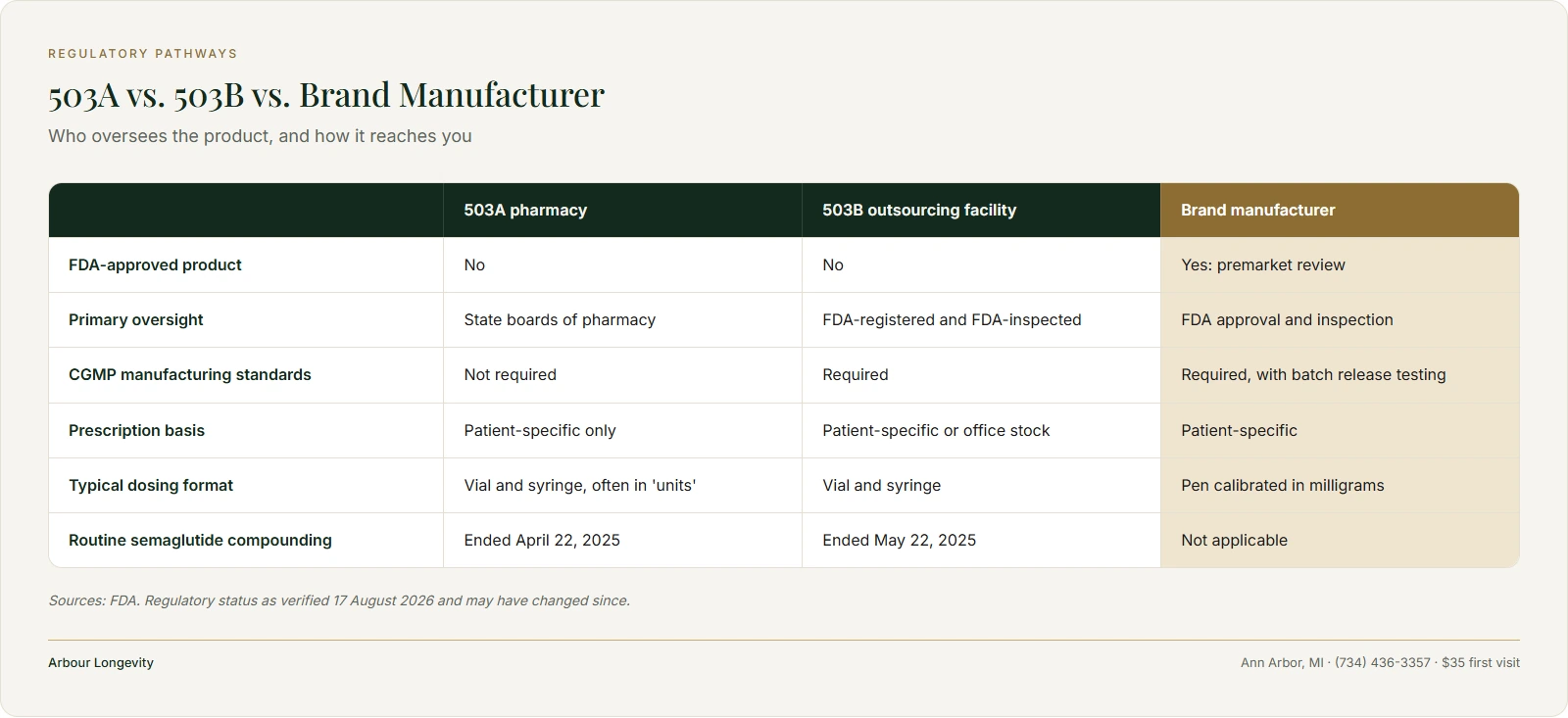
503A: traditional compounding pharmacies. These are state-licensed pharmacies. Under section 503A, drugs "must be compounded based on the receipt of valid patient-specific prescriptions" (FDA, Compounding Laws and Policies). They are not held to CGMP (current good manufacturing practice, the factory-grade quality rules brand makers follow). State boards of pharmacy handle day-to-day oversight (FDA Q&A).
503B: outsourcing facilities. Congress created these in 2013 through the Drug Quality and Security Act. The trigger was a fungal meningitis outbreak traced to contaminated compounded injections. A 503B facility registers with FDA, follows CGMP, and is inspected by FDA on a risk-based schedule. It may ship against a patient-specific prescription or a provider order "that is not for an identified individual patient (e.g., for office stock)" (FDA).
So 503B is held to manufacturing-style standards and federal inspection; 503A is not. Neither produces an FDA-approved product.
The Shortage List Is the Switch That Turns Compounding On and Off
This is the mechanism almost no one explains, and it is the whole story. Both sections ban compounding a drug that is "essentially a copy of a commercially available drug product" (sections 503A(b)(1)(D) and 503B(d)(2)). FDA has issued formal guidance on what counts (FDA Guidance for Industry).
A drug on FDA's shortage list is not treated as commercially available. That one definition opened the door. While semaglutide sat on the shortage list, compounders could make copies at scale without breaking the essentially-a-copy rule.
For 503B facilities there is a second door: the 503B Bulks List. This is a list of bulk substances FDA has decided there is a clinical need to compound from. Semaglutide has never been on it.
When the shortage ends, the door closes. Not because of a safety recall, but because the legal basis was gone.
What Changed, and Exactly When
FDA published the timeline itself (FDA clarifies policies for compounders as national GLP-1 supply begins to stabilize). The end dates below mark the close of FDA's enforcement discretion (the grace period during which FDA chose not to act against compounders).
- December 19, 2024: FDA found the tirzepatide injection shortage was resolved.
- February 18, 2025: grace period ended for 503A tirzepatide.
- February 21, 2025: FDA found the semaglutide injection shortage was resolved.
- March 19, 2025: grace period ended for 503B tirzepatide.
- April 22, 2025: grace period ended for 503A semaglutide.
- May 22, 2025: grace period ended for 503B semaglutide.
FDA then moved to make the 503B rule permanent. On April 30, 2026 it proposed excluding semaglutide, tirzepatide and liraglutide from the 503B Bulks List. Its reason: there is no clinical need for outsourcing facilities to compound them from bulk substance. FDA's announcement explains why (FDA, April 30, 2026). Commissioner Marty Makary said outsourcing facilities "cannot lawfully compound using bulk drug substances unless there is a clear clinical need" when FDA-approved drugs are available. The proposal appeared in the Federal Register on May 1, 2026 (doc. 2026-08552). The comment period was extended to July 30, 2026 (Federal Register, June 26, 2026).
Where that leaves things as of 17 August 2026. Semaglutide is off the shortage list and not on the 503B Bulks List. So neither pathway supports routine, large-scale compounding. The April 2026 proposal would make that permanent for 503B facilities. At the time of writing we could not confirm a final FDA ruling, and the comment period closed only weeks ago. Rules and lawsuits move. Check the FDA pages linked above, or ask us, rather than relying on this paragraph six months from now.
Separately, on March 3, 2026 FDA sent warning letters to 30 telehealth firms for false or misleading claims (FDA). Two claims stood out. Some firms implied their compounded products were equal to FDA-approved drugs. Others sold under their own brand without saying who really compounded the product.
For Michigan Patients: What This Means in Plain Terms
If you have been using a lower-cost compounded semaglutide or tirzepatide, here is the plain-English version. During the 2022 to 2024 shortages, pharmacies were allowed to make their own copies, and those copies were much cheaper. Once FDA declared the shortages over in 2025, that permission ended. Federal law only allows copies of these patent-protected drugs during a true shortage. So the compounded versions are no longer broadly available. Most patients have moved to the brand products (Wegovy, Ozempic, Mounjaro, Zepbound) or adjusted their plans. Your old supply chain may be ending, but your treatment does not have to.
Why "just switch to the brand" is not the whole story. The active drug is the same molecule, so on paper the switch is simple. Two real-world wrinkles get in the way.
- Inactive ingredients differ. Compounded and brand versions can use slightly different inactive ingredients. A minority of people get a brief return of nausea after switching. Slowing the dose increase often fixes it.
- Cost. A compounded version might have run a few hundred dollars a month. Brand list price can exceed $1,000 a month without insurance. Manufacturer self-pay programs have narrowed that gap; see the cost section below.
So treat the switch as a chance to re-check your labs and your plan, not just a pen swap. The bigger picture on these drugs is in semaglutide vs tirzepatide and medical weight loss vs diet culture. If you are on Medicare, see our guide to GLP-1 Medicare coverage in Michigan. For the steps in order, from confirming your true dose to lining up the prescription, use the step-by-step transition plan.
On a compounded GLP-1 and not sure what comes next?
Your $35 first visit at Arbour Longevity in Ann Arbor covers your current dose, your labs and your coverage options, and is applied toward your plan.
Book your $35 first visit Call (734) 436-3357
What Is the Same, and What Genuinely Differs
What is the same. If a compounded product truly contains semaglutide base at the stated strength, the drug acts the same way. It is a GLP-1 receptor agonist with a roughly week-long half-life. The molecule does not care which building it was prepared in.
1. The evidence attaches to the approved product. The outcome data patients hear about come from trials of the approved product. In STEP 1, 1,961 adults on once-weekly semaglutide 2.4 mg lost a mean 14.9% of body weight over 68 weeks. The placebo (inactive look-alike) group lost 2.4% (Wilding et al., NEJM 2021, PMID 33567185, DOI). SELECT followed 17,604 patients with heart disease and no diabetes (Lincoff et al., NEJM 2023, PMID 37952131, DOI). The primary cardiovascular (heart and blood vessel) composite outcome occurred in 6.5% on semaglutide versus 8.0% on placebo (HR 0.80). No compounded product carries its own outcome trial.
2. Manufacturing oversight. Brand product is made under CGMP with batch release testing and stability data. A 503B facility is also under CGMP and FDA inspection. A 503A pharmacy is not.
3. Supply reliability. This supply rested on a legal permission that has already been withdrawn once. That is not something to plan a two-year treatment course around.
4. What the safety-signal data show. A review of the FDA Adverse Event Reporting System (FAERS) covered 2018 to 2024. It found 707 compounded-product reports among 81,078 GLP-1 reports. Compounded products had higher reporting odds ratios (how much more often a problem was reported, not how often it happened) for three outcomes. They had a lower one for a fourth (McCall et al., Expert Opin Drug Saf 2025, PMID 40285721, DOI).
- Preparation errors: 48.92 (95% CI 12.63–189.6).
- Contamination: 19.00 (4.24–85.03).
- Hospitalisation: 2.35 (1.94–2.83).
- Dosing errors: lower odds, 0.24 (0.17–0.32).
We report the finding that cuts against the narrative as well as the one that supports it. This kind of review of a voluntary database shows reporting patterns, not how often events happen.
5. The active ingredient may not be the one in the approved drug. Some products were made with salt forms, such as semaglutide sodium and semaglutide acetate. FDA is direct: these salt forms "are different active ingredients than are used in the approved drugs" (FDA's Concerns with Unapproved GLP-1 Drugs).
The Dosing-Unit Problem: The Part That Hurts People
Brand semaglutide comes in a pen marked in milligrams: you dial a dose. Compounded semaglutide has mostly come as a multi-dose vial at a pharmacy-chosen strength. You draw it with a separate syringe, often a U-100 insulin syringe marked in units, not milligrams. Three measurement systems end up in one conversation.
FDA's alert of July 26, 2024 describes what follows (FDA). Patients told to draw a 5-unit (0.05 mL) dose drew 50 units, a tenfold error. Some prescriptions were written for 25 units instead of 5, and 20 instead of 2. Patients gave themselves five to 20 times the intended dose. Some needed medical attention or hospital care.
A poison control centre case series makes the same point. It covered three patients: two had tenfold errors, and one was given a vial and syringes with no pharmacist counselling. The authors concluded that these vials lack the safety features of prefilled pens and allow large overdoses (Lambson et al., J Am Pharm Assoc 2023, PMID 37392810, DOI).
If you are on any vial-and-syringe product, know three numbers: your strength in mg/mL, your dose in milligrams, and the matching volume in millilitres. Write all three down. Do not accept a dose expressed only in "units" without the conversion. That habit prevents the most common serious error in this category.
Cost, Stated Carefully
Cost was the honest reason many patients chose compounded product, and it deserves a straight answer. The gap has narrowed. On November 17, 2025 Novo Nordisk announced a lower self-pay price for Wegovy and Ozempic (Novo Nordisk news release). Through its direct pharmacy channel, the price is $349 per month. It also offered a $199 starting price for the first two doses of the 0.25 mg and 0.5 mg strengths, running through March 31, 2026. That window has closed, and pricing programs change often. Check current pricing with the maker before budgeting. Treat any figure on any clinic website, including this one, as likely stale. Insurance coverage varies widely by plan and by the condition being treated.
Telling a Legitimate Pharmacy From an Unsafe Source
Framed as things to check, not things to fear.
- It is a state-licensed pharmacy. Check it through FDA's BeSafeRx or the National Association of Boards of Pharmacy list at safe.pharmacy.
- A prescription is required and a real clinician is involved. No prescription, no clinician, no questions about your health: that is the clearest signal to walk away.
- Nothing is marked "for research use only". FDA has warned that firms illegally sold unapproved semaglutide or tirzepatide marked "for research purposes". They shipped to consumers with dosing instructions (FDA). This includes anything you mix yourself from powder.
- The active ingredient is semaglutide, not a salt form.
- The ingredient source is traceable. On September 5, 2025 FDA launched a "green list" import alert. It covers GLP-1 active ingredients from facilities FDA has inspected or evaluated. Ingredients from other sources can be detained at the border without physical examination (FDA).
- Marketing does not claim brand equivalence, and you are told who compounded it. Both were cited in FDA's March 2026 warning letters.
For scale: as of November 30, 2024 FDA had received over 392 adverse event reports for compounded semaglutide and 215 for compounded tirzepatide (FDA). Voluntary reporting undercounts, and counts are not rates.
How We Handle the Switch at Arbour Longevity
Our role is clinician-supervised prescribing and monitoring. We assess whether GLP-1 therapy is right for you at all, prescribe within the current rules, and monitor you on it. We do not solve legal problems with workarounds. We will say plainly when a route is not available.
When someone comes in on a compounded GLP-1, we start by checking what you are really taking: the strength in mg/mL and the true milligram dose. That number is often not what the patient believes. Then we review labs, so the plan rests on what treatment has achieved, not the scale alone. The labs include:
- HbA1c (your average blood sugar over the past three months).
- Fasting insulin (the hormone that moves sugar from your blood into your cells).
- Cholesterol.
- Thyroid (the gland that sets your metabolic speed).
From there we map your options.
- Switch to the brand at an equivalent dose, and pursue insurance prior authorization (your insurer's approval before it will pay) when that is possible.
- Adjust the dose, with careful titration (changing the dose step by step) rather than assuming the numbers map one to one.
- If the drug has become unaffordable, build a structured plan to protect your results with nutrition, strength training and monitoring before stopping, not after regain starts.
What we see in clinic: the patients who switch smoothly plan ahead. They line up the brand prescription or the prior authorization, and lock in protein and training habits early, rather than scrambling when the last refill runs out.
More on our approach: semaglutide, GLP-1 therapy, weight loss shots and medical weight loss in Ann Arbor.
Frequently Asked Questions
Is compounded semaglutide the same drug as Ozempic or Wegovy?
Not in the legal sense, and sometimes not chemically either. Compounded products have not been reviewed or approved by FDA, and they are not generics (FDA, March 3, 2026). Some used salt forms that FDA counts as different active ingredients (FDA).
Is compounded semaglutide illegal now? Can I still get it?
The broad, shortage-based permission ended in 2025: April 22, 2025 for 503A pharmacies and May 22, 2025 for 503B facilities (FDA). Compounding for a documented individual clinical need that the approved product cannot meet is a narrow, separate question. An allergy to an inactive ingredient is one example. It is a clinical decision, not a preference, and cost alone does not qualify. This area is moving, so confirm the current rules rather than relying on any article's snapshot.
I have been on compounded semaglutide and it worked. Do I have to start over?
No. A change in product does not erase your treatment history. The work is checking what you are really taking in milligrams, reviewing your labs, and titrating with care. That is a planning conversation, not a restart.
Why do I dose in "units" on the compounded version and milligrams on the pen?
Vials are filled at a pharmacy-chosen strength and drawn with insulin syringes marked in units. That mismatch is the documented source of tenfold errors, such as patients drawing 50 units where 5 units (0.05 mL) was intended (FDA, July 26, 2024). Always know your mg/mL, your milligram dose, and the millilitre volume that matches it.
Will switching to the brand bring back side effects?
For most people, no. A minority get mild, temporary nausea for a week or two after switching. Easing the dose up more slowly often solves it.
Will insurance cover the brand version?
It varies a lot. Many Michigan plans cover Ozempic for diabetes but not for weight loss. Wegovy, which is approved for weight loss, often needs prior authorization showing a qualifying BMI and a prior attempt at lifestyle change. We help with that paperwork when coverage is possible.
What happens if I just stop?
There is no withdrawal. Appetite returns over about 4 to 6 weeks as the drug clears. Without a structured plan, most people regain a large share of the weight within a year. The key is putting nutrition, strength training and monitoring in place before stopping. Our step-by-step transition plan sets out how to do that in order.
Is compounded semaglutide dangerous?
That is the wrong frame. The risks are specific and mostly avoidable:
- Measurement errors from vial-and-syringe dosing.
- Ingredient sourcing you cannot verify.
- Salt forms that are not the approved active ingredient.
- Sources with no clinician involved.
The FAERS review above found higher reporting odds for preparation errors, contamination and hospitalisation, and lower odds for dosing errors (PMID 40285721, DOI). Those are reporting patterns, not rates.
How do I check whether a pharmacy is legitimate?
Confirm it is state-licensed, requires a prescription, and involves a real clinician. Verify through FDA's BeSafeRx or the NABP list at safe.pharmacy. Anything sold without a prescription, marked "for research use only", or mixed from powder by you sits outside the legitimate supply chain.
Could compounding become permitted again?
It could, if a genuine shortage were declared again. That is exactly how the mechanism works. The April 30, 2026 proposal would close the separate 503B bulks pathway for good (FDA). We could not confirm a final ruling as of 17 August 2026.
Talking It Through in Ann Arbor
Gandhi Bhattarai, FNP-BC, PMHNP-BC, Anti-Aging/Functional Medicine BC, is a triple board certified nurse practitioner. We are at 2217 Packard St #15, in the Eastover Professional Center, Ann Arbor, MI 48104. We are open Thursday through Monday, 10am to 7pm, and closed Tuesday and Wednesday. Parking is free and directly outside, with no meters and no structure. Suite 15 is down a flight of stairs. If stairs are difficult for you, please call (734) 436-3357 before visiting.
If you are on a compounded GLP-1 and want a clinician-guided switch rather than a scramble, we can help. Call (734) 436-3357 or book your $35 first visit. It covers your current regimen, your insurance and your labs, and the $35 is applied toward your treatment plan. Cash pay, HSA and FSA accepted.
References
- U.S. Food and Drug Administration. FDA clarifies policies for compounders as national GLP-1 supply begins to stabilize (2025). fda.gov
- U.S. Food and Drug Administration. Updates on compounded GLP-1 medications and resolved drug shortages (2025).
- FDA Drug Shortages database. Semaglutide and tirzepatide shortage status.
- U.S. Food and Drug Administration. FDA warns 30 telehealth companies against illegal marketing of compounded GLP-1s. Press announcement, March 3, 2026. fda.gov
- U.S. Food and Drug Administration. FDA proposes to exclude semaglutide, tirzepatide and liraglutide from the 503B Bulks List. Press announcement, April 30, 2026. fda.gov
- Federal Register. List of Bulk Drug Substances for Which There Is a Clinical Need Under Section 503B. Doc. 2026-08552, May 1, 2026; comment period extension, June 26, 2026.
- U.S. Food and Drug Administration. Compounding Laws and Policies; Compounding and the FDA: Questions and Answers; Compounded Drug Products That Are Essentially Copies of a Commercially Available Drug Product (Guidance for Industry). fda.gov
- U.S. Food and Drug Administration. FDA's Concerns with Unapproved GLP-1 Drugs Used for Weight Loss. fda.gov
- U.S. Food and Drug Administration. FDA alerts health care providers, compounders and patients of dosing errors associated with compounded injectable semaglutide products. July 26, 2024. fda.gov
- U.S. Food and Drug Administration. FDA launches "green list" to protect Americans from illegal imported GLP-1 drug ingredients. September 5, 2025. fda.gov
- Wilding JPH, et al. Once-Weekly Semaglutide in Adults with Overweight or Obesity (STEP 1). NEJM 2021;384:989-1002. PMID 33567185. DOI
- Lincoff AM, et al. SELECT trial. NEJM 2023. PMID 37952131. DOI
- McCall et al. FAERS analysis of compounded GLP-1 products, 2018–2024. Expert Opin Drug Saf 2025. PMID 40285721. DOI
- Lambson et al. Poison control case series on compounded semaglutide dosing errors. J Am Pharm Assoc 2023. PMID 37392810. DOI
- Novo Nordisk. Self-pay offer for Wegovy and Ozempic. News release, November 17, 2025. prnewswire.com
Clinical information on this page is drawn from articles retrieved from PubMed and from primary FDA sources, and is provided for education. It is not medical advice, not legal advice, not a diagnosis, and not a promise of any individual result. Regulatory status reflects sources verified on 17 August 2026 and may have changed since.

Gandhi Bhattarai, FNP-BC, PMHNP-BC, Anti-Aging/Functional Medicine BC
Triple board-certified nurse practitioner and founder of Arbour Longevity in Ann Arbor. Every article is written from clinic practice and reviewed against current guidelines.
✓ Medically reviewed · Last updated August 17, 2026
How we reviewed this article
Arbour Longevity articles are written by the treating clinician, checked against primary sources (peer-reviewed journals, FDA labeling, Endocrine Society and other specialty guidelines) and re-reviewed when guidance changes. See our editorial policy. Spotted an error? Email info@arbourlongevity.com.
This article is educational and is not a substitute for individualized medical advice. Whether a treatment is appropriate for you is determined during consultation.
Your symptoms have a cause. Let’s find it.
Book a $35 first visit in Ann Arbor. It’s a 30–45 minute consultation with Gandhi Bhattarai, applied toward your plan. Serving Ann Arbor, Ypsilanti, Saline, Dexter, Chelsea, and Michigan by telehealth.






.webp)

