
Erectile Dysfunction Treatment Ann Arbor | Arbour Longevity
Key takeaways
- Erectile dysfunction is usually a blood-vessel and hormone problem, not just a part of getting older.
- A pill treats the symptom. It does not tell you why the problem started.
- A proper workup checks hormones, blood sugar, cholesterol and inflammation before any prescription.
- Treatment may include hormone therapy, the P-Shot (PRP) and metabolic care, chosen from your results.
The 52-year-old executive sitting across from me had normal testosterone on paper. His cardiologist had cleared him. His primary care provider suggested Viagra and sent him on his way. Six months later, he was still struggling. His erections had been getting weaker for two years. Now he was asking a fair question. Was this just aging, or were his doctors missing something?
He was right to ask. Most men with erectile dysfunction (ED, or trouble getting or keeping an erection) never get a true root cause workup. They get a prescription.
What Standard Care Misses About Erectile Dysfunction
Standard care treats ED like a plumbing problem: not enough blood flow. The fix is a PDE5 inhibitor (the drug class that includes Viagra and Cialis) to boost flow for a short time. Take the pill, problem solved. But for a growing number of men, the pills stop working. Some never worked well. Others only hide a deeper decline.
Here is what gets missed. An erection is a blood-vessel event, a hormone event, a nerve event and a metabolic event, all at once. When any of those systems weakens, function suffers. The 2024 StatPearls clinical review on ED makes this clear. ED rises with age not because aging itself causes it. It rises because years of metabolic, vascular (blood-vessel) and hormonal damage finally show up.
Most men over 45 who visit a standard urology office leave with a Cialis prescription. No one checks:
- fasting insulin.
- the ratio of free testosterone (the usable share of the hormone) to estradiol (the main form of estrogen).
- inflammation markers.
- how well the blood-vessel lining works.
The symptom gets treated. The system stays broken.
Why Erectile Function Reflects Whole-Body Health
Erections depend on a healthy endothelium (the single layer of cells lining your blood vessels). This lining makes nitric oxide, the molecule that relaxes and widens blood vessels. Three things damage those cells:
- insulin resistance (cells stop responding to insulin, so blood sugar and belly fat rise).
- chronic inflammation.
- oxidative stress.
When the lining is damaged, nitric oxide drops. The penis has some of the smallest arteries in the body, so it shows the damage first.
This is why several long-term studies show that ED often comes three to five years before coronary artery disease (clogged heart arteries). It is the same disease, showing up earlier in smaller vessels. Men with ED but no heart symptoms have significantly higher rates of silent atherosclerosis (plaque in the artery walls) on imaging than men of the same age without ED. That finding held up in a 2023 meta-analysis (a study that pools the results of many trials) in the Journal of Sexual Medicine.
Testosterone is the main male sex hormone. It drives desire, muscle, energy and mood. But it matters for more than sex drive. It also does three things that matter here:
- It boosts the enzyme that makes nitric oxide (nitric oxide synthase).
- It keeps the smooth muscle of the corpora cavernosa (the two spongy chambers inside the penis) working well.
- It makes tissue more responsive to PDE5 inhibitors.
Men with low-normal free testosterone often say Viagra works poorly. The hormone signal underneath is too weak to support the drug.
Then there is the metabolic piece. Insulin resistance damages the same cells that make nitric oxide. It also fuels inflammation. And it often comes with visceral fat (deep belly fat around the organs), which converts testosterone into estradiol. Most men do not link their ED to a growing waistline or rising fasting blood sugar. But the two are tightly connected.
A Composite Patient Case
A 48-year-old attorney came in with ED that had worsened over 18 months. He could get partial erections but could not keep them. His primary care provider had checked total testosterone. It was 520 ng/dL, technically normal. He was given a trial of tadalafil (Cialis). It helped a little, but not reliably.
Full labs told a different story:
- Free testosterone sat at the 22nd percentile for his age.
- Estradiol was high at 42 pg/mL.
- Fasting insulin was 14 mU/L, a sign of early insulin resistance.
- HbA1c (your average blood sugar over three months) was 5.6%, in the pre-diabetic range.
- Lipid particle testing showed elevated small, dense LDL cholesterol particles.
He had metabolic syndrome (the cluster of belly fat, high blood pressure, high blood sugar and abnormal cholesterol) in its earliest, silent form. His ED was the first symptom.
Most men in this situation respond well to a three-part plan: fix the metabolism and correct the hormones. His plan included:
- testosterone therapy to bring free testosterone to a healthy level.
- metformin (a diabetes drug, used here for a purpose the FDA has not reviewed or approved) to improve insulin sensitivity.
Within eight weeks, his function had improved a great deal. Four months later, he no longer needed PDE5 inhibitors.
Want to know what this would mean for you?
Your $35 first visit at Arbour Longevity in Ann Arbor is a private, unhurried 30–45 minute consultation, and the $35 is applied toward your treatment plan.
Book your $35 first visit Call (734) 436-3357
The Arbour Longevity Approach to Erectile Dysfunction
We do not start with a prescription. We start with a full diagnostic workup. The hormone panel covers:
- total and free testosterone.
- estradiol.
- SHBG (sex hormone-binding globulin, a protein that ties up testosterone so your tissues cannot use it).
- DHEA-S (an adrenal hormone your body turns into testosterone and estrogen).
- prolactin (a brain hormone that can lower testosterone when it runs high).
We pair that with metabolic markers:
- fasting insulin.
- HbA1c.
- lipid particle analysis (a detailed cholesterol test).
- high-sensitivity CRP (a blood marker of inflammation).
For men in Ann Arbor who want more than symptom control, this workup shows what is driving the problem. Is it hormonal, metabolic, vascular, or a mix? That answer changes the whole treatment plan.
Treatment may include:
- Bioidentical hormone therapy (hormones with the same structure as the ones your body makes), dosed to reach a healthy free testosterone level.
- The P-Shot: injections of platelet-rich plasma (PRP, a concentrate of your own blood platelets, rich in growth factors) into penile tissue. The goal is to repair the vessel lining and grow new blood vessels.
We also fix the metabolic base. Weight-loss programs using GLP-1 medications (drugs that mimic a gut hormone to curb appetite and steady blood sugar) can quickly improve insulin sensitivity and lower inflammation. NAD+ IV therapy (NAD+ is a molecule every cell needs to make energy) supports the mitochondria (the tiny power plants inside your cells) and may help the vessel lining. These are not "alternative" treatments. They target the biology behind the dysfunction.
What to Expect During Your Consultation
Your first visit starts with a detailed medical and sexual health history and a physical exam. If you do not have recent full labs, we order them. We take time to understand:
- when your symptoms started and how they changed.
- what was happening with stress, weight or health at the time.
- which treatments you have already tried.
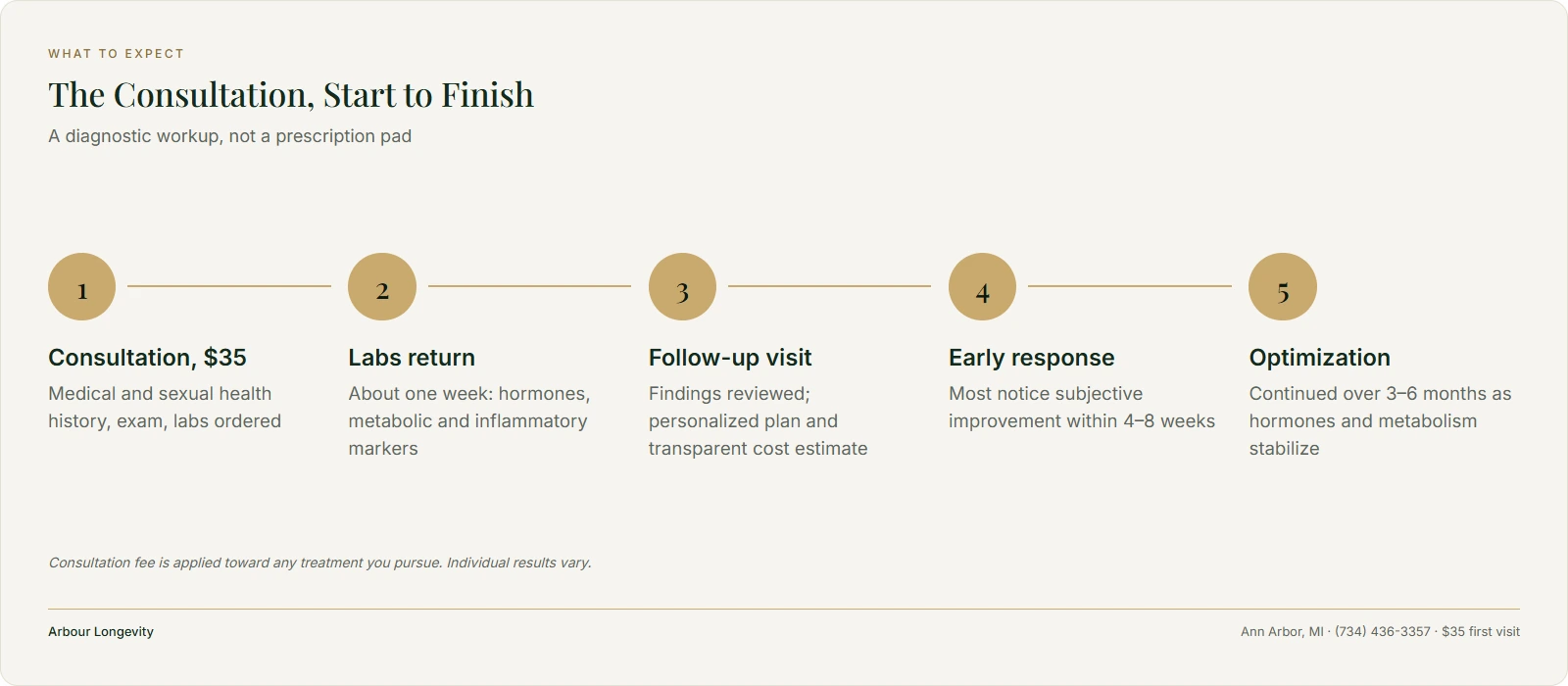
Lab results usually come back within one week. At the follow-up visit we go through the findings in detail. Then we lay out a plan built for your physiology, not pulled from a flowchart. Most men start to notice a change within four to eight weeks. Improvement continues over three to six months as hormones and metabolism settle.
The goal is to restore function without relying on symptom-only drugs forever. Some men still do best when better physiology is paired with targeted medication, and we support that too.
Frequently Asked Questions About ED Treatment
What is the main cause of erectile dysfunction in men over 40?
There is rarely one cause. Most cases in men over 40 involve a mix of three things:
- a damaged blood-vessel lining (endothelial dysfunction).
- testosterone that is lower than it should be.
- metabolic problems such as insulin resistance or visceral fat.
The penile arteries are among the smallest in the body, so vessel disease shows up there first. Psychological factors can play a part, but they are rarely the main driver at this age.
How does testosterone affect erectile dysfunction?
Testosterone works through several pathways:
- It raises nitric oxide synthase in the vessel lining.
- It supports the smooth muscle of the corpora cavernosa.
- It drives desire and arousal in the brain.
Men with low or low-normal free testosterone often get less from PDE5 inhibitors because the signaling underneath is weak. Bringing testosterone to a healthy level often makes the medication work again, or reduces the need for it.
What is the P-Shot and does it work for ED?
The P-Shot injects platelet-rich plasma, concentrated growth factors from your own blood, directly into penile tissue. The theory is that these growth factors spur new blood-vessel growth, collagen remodeling and tissue repair. Clinical data is still limited but growing. Several studies show modest gains in erectile function scores and patient satisfaction. Results are best when the P-Shot is combined with treating hormones and metabolism, rather than used alone.
How long does it take to see results from ED treatment?
It depends on the cause and the treatment:
- Hormone therapy: most men notice a change within four to eight weeks as levels stabilize.
- P-Shot: often six to twelve weeks, as tissue remodels.
- Metabolic treatment (weight loss, insulin sensitivity): steady gains over three to six months.
Most men notice a meaningful change within the first two months.
Is erectile dysfunction a sign of heart disease?
Often, yes. ED and coronary artery disease share the same root process: a damaged vessel lining and atherosclerosis. Because the penile arteries are smaller, they show trouble first. Several studies show that men with ED and no heart symptoms have higher rates of silent coronary disease on imaging. Think of ED as a window into your vascular health, not just a sexual health issue. That is why a full evaluation matters.
How much does erectile dysfunction treatment cost in Michigan?
Cost varies widely with the treatment plan. A consultation at Arbour Longevity is $35, applied toward any treatment you choose. Hormone therapy and procedures like the P-Shot are priced by plan. We give you clear cost estimates at your follow-up visit, once we have reviewed your labs and talked through options. Most men find the investment worthwhile because the benefits reach well beyond sexual function.
If This Sounds Familiar
Maybe you have been told your levels are normal. Or that this is just aging. Or that a pill is your only option. If you suspect there is more to the story, we would welcome the chance to take a deeper look. Arbour Longevity is in Ann Arbor, Michigan. Our approach is built around finding and fixing root causes, not just managing symptoms.
Ready to start? You can book your $35 first visit online or call our team at (734) 436-3357. The $35 is applied toward treatment if you decide to move forward.
This article is for educational purposes only and is not medical advice. Individual results vary. Talk with a qualified clinician about your own health.

Gandhi Bhattarai, FNP-BC, PMHNP-BC, Anti-Aging/Functional Medicine BC
Triple board-certified nurse practitioner and founder of Arbour Longevity in Ann Arbor. Every article is written from clinic practice and reviewed against current guidelines.
✓ Medically reviewed · Last updated June 8, 2026
How we reviewed this article
Arbour Longevity articles are written by the treating clinician, checked against primary sources (peer-reviewed journals, FDA labeling, Endocrine Society and other specialty guidelines) and re-reviewed when guidance changes. See our editorial policy. Spotted an error? Email info@arbourlongevity.com.
This article is educational and is not a substitute for individualized medical advice. Whether a treatment is appropriate for you is determined during consultation.
Your symptoms have a cause. Let’s find it.
Book a $35 first visit in Ann Arbor. It’s a 30–45 minute consultation with Gandhi Bhattarai, applied toward your plan. Serving Ann Arbor, Ypsilanti, Saline, Dexter, Chelsea, and Michigan by telehealth.