Exosome Therapy Skin Benefits: Repair & Renew Skin
You've tried the serums. You've layered the retinol, booked the facials, maybe even sat through a few microneedling sessions. And yet your skin still looks tired fine lines that won't budge, texture that won't smooth out, a dullness no amount of moisturizer seems to fix.
Here's the part most skincare marketing won't tell you: topical products mostly work on the surface. They can hydrate and protect, but they struggle to signal your skin to repair itself at the cellular level. That's the gap exosome therapy is built to fill.
Exosomes are one of the most talked-about areas in regenerative skin research today, and the idea is simple. Instead of just feeding your skin ingredients, exosome preparations carry biological messengers that are being studied for their role in prompting skin cells to build collagen and calm inflammation. As the team at Arbour Longevity in Ann Arbor puts it, exosomes are "the language your cells already speak."
Before we go further, the most important thing to know: at Arbour Longevity, exosome preparations are applied topically to the skin surface only. They are never injected and are never delivered into the dermis or into any other tissue. They are investigational, only Phase 2 research preparations are used, they are not a cure for anything, and they are not proven to do anything. Everything below should be read in that light.
Below, we'll walk through how exosome therapy works, the real skin benefits you can expect, how it's applied to the skin surface, and how to decide whether it's right for you.
What Is Exosome Therapy and How Does It Work on Your Skin?
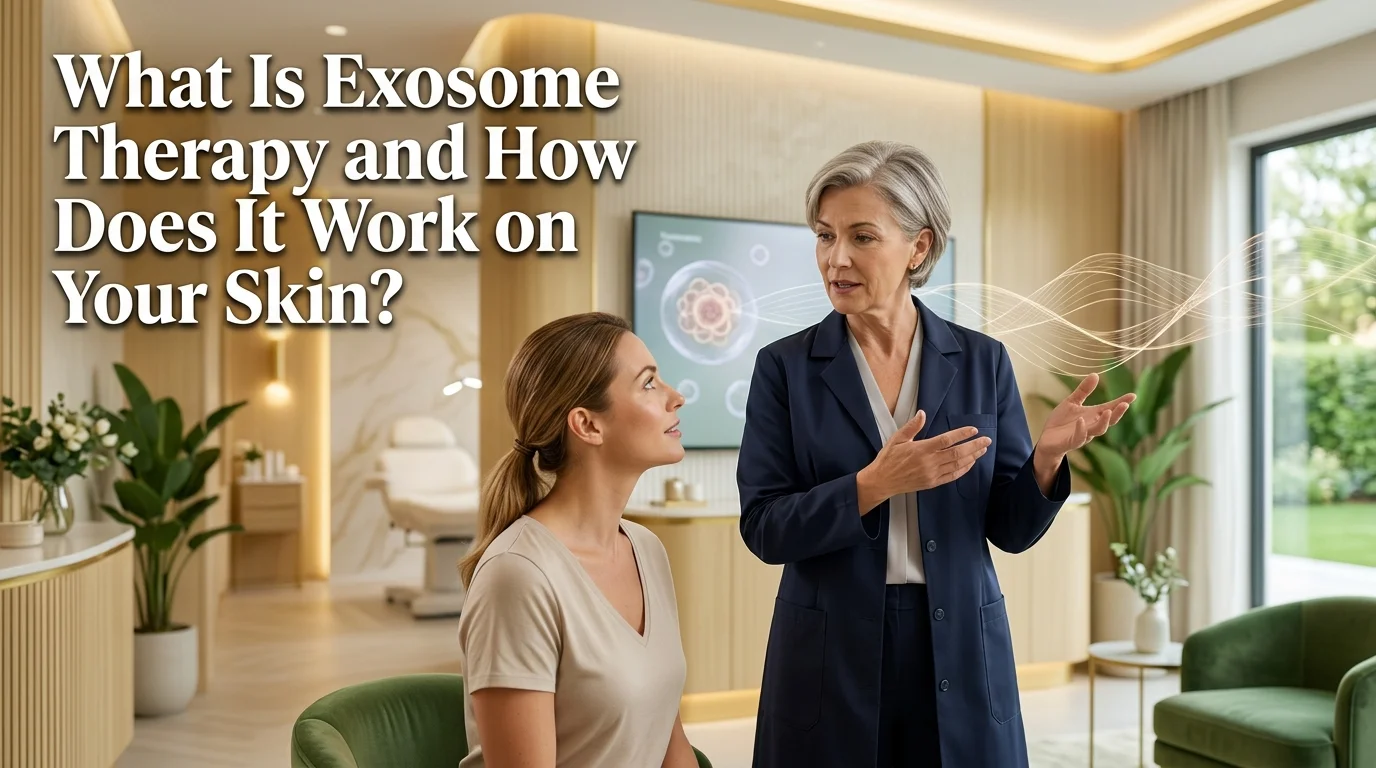
Before you spend money on any regenerative treatment, it helps to understand what you're actually paying for. Exosome therapy isn't a single "product" so much as a system for restoring cellular communication and that distinction is what sets it apart from almost everything else on a skincare menu.
What Are Exosomes? (Extracellular Vesicles Explained Simply)
Exosomes are tiny extracellular vesicles think of them as microscopic shipping containers your cells use to talk to one another. Measuring just 30 to 150 nanometers across, they carry growth factors, proteins, lipids, and microRNA sequences that influence how surrounding cells behave.
In plain terms: exosomes are biological messengers. When a healthy, active cell wants to tell a neighboring cell to "repair," "calm down," or "produce more collagen," it packages those instructions into an exosome and ships them over.
As we age, that cellular communication naturally diminishes and so does the skin's ability to repair itself. Exosome therapy is an investigational attempt to reintroduce that signaling language at the skin surface.
How Do Exosomes Work to Repair and Regenerate Skin?
Your skin is constantly trying to repair itself. The problem is that years of UV exposure, oxidative stress, and inflammation slow that machinery down and make the signaling noisy. Cells stop communicating efficiently.
Exosome preparations are being investigated as a way to reintroduce that signal. Unlike a peptide that triggers one pathway or PRP that delivers your own platelet growth factors, exosomes carry a complex biological payload over 1,000 growth factors including FGF, VEGF, PDGF, TGF-β, EGF, and IGF, plus microRNA that modulates gene expression in recipient cells.
That breadth is why the category is interesting. The open research question is whether reintroducing that signalling language at the skin surface changes anything measurable, and that work is still ongoing which is why exosomes in skincare are best described as investigational rather than established.
The Role of Cell Signaling, Fibroblasts, and Collagen Production
Among the most important cells exosomes communicate with are fibroblasts, the workhorse cells in your dermis responsible for producing collagen and elastin, the two proteins that keep skin firm, springy, and smooth.
As fibroblast activity declines with age, collagen breaks down faster than it's replaced. Skin thins, loses bounce, and wrinkles set in. In laboratory research, exosome signals have been observed to interact with fibroblasts and to encourage collagen and elastin synthesis, and to help calm inflammation and counter oxidative stress two of the biggest drivers of premature skin aging. At Arbour Longevity the preparations are applied to the skin surface only and are never delivered into the dermis, so what that surface application does below the surface remains an investigational question rather than a claim we make.
So you get a two-front benefit: more rebuilding, less breaking down.
Where Arbour Longevity's Exosomes Come From (and Why Source Matters)
Not all exosome products are created equal, and this is a question worth asking any provider directly.
The exosome biologics used at Arbour Longevity are mesenchymal stem cell (MSC) derived and 3D bioreactor-cultured a sourcing standard that matters for both potency and safety. Each lot is:
- NTA-verified for particle count, so the concentration is known and consistent
- cGMP-aligned, meeting good-manufacturing-practice standards
- Accompanied by a Certificate of Analysis per lot, so there's documentation behind every vial
That level of transparency is itself a trust signal. A clinic that can tell you exactly where its exosomes come from and prove what's in each lot is a very different proposition from one that can't.
The Top Skin Benefits of Exosome Therapy (What Results Can You Expect?)

This is the section everyone really wants, so let's be specific and honest, because exaggerated promises help no one.
Exosome therapy won't turn back the clock overnight, and it isn't a substitute for sun protection or a sensible routine. But for the right person, patients often describe a meaningful difference, particularly when a topical exosome preparation is applied to the skin surface alongside a procedure that is itself doing the regenerative work. Exosome preparations remain investigational, and nothing here is a promised or proven outcome.
Does Exosome Therapy Boost Collagen and Improve Skin Texture?
This is the outcome patients most often describe. Alongside microneedling or resurfacing, which are the treatments doing the structural work, patients whose session is finished with a topical exosome preparation most commonly report smoother, firmer, more refined skin texture. That is a reported outcome from an investigational preparation, not a proven effect.
In practice, that shows up as:
- Softer fine lines and a plumper, more hydrated look
- More even skin tone and visible radiance
- Skin that simply feels healthier and more resilient
These changes build gradually over weeks as new collagen matures exactly what you'd expect from true skin regeneration rather than a temporary surface effect. At Arbour Longevity, this is the foundation of their Exosome Facial Rejuvenation protocol, which patients describe as their skin "coming alive."
Can Exosomes Help With Acne Scars, Pigmentation, and Melasma?
This is where exosome treatment for the face gets genuinely exciting. Their anti-inflammatory and tissue-repair properties make them well-suited to several stubborn concerns:
- Texture and acne scarring: By encouraging healthy collagen remodeling, exosome therapy can help soften the appearance of pitted scars over a series of sessions.
- Pigmentation and melasma: Clinical studies exploring exosome applications have reported pigmentation improvement in a majority of participants around 68% in some trials, supporting a more even complexion over time.
- Post-procedure redness: Their calming effect makes them a powerful add-on after resurfacing.
A realistic note: deep, old scars and stubborn melasma rarely vanish completely with any single modality. Exosomes work best as part of a layered plan, and pigment conditions in particular need ongoing sun protection to hold results. Arbour Longevity is transparent that individual outcomes vary and are discussed at consultation.
Exosome Therapy for Skin Tightening, Enlarged Pores, and Anti-Aging
Because the treatments exosomes are paired with work on the skin's structural support, the reported exosome therapy skin benefits most often centre on firmness and laxity. Stronger collagen and elastin networks mean:
- Improved firmness and a tighter look, especially through the cheeks and jawline
- Smaller-looking pores, since firmer skin around each pore reduces its visible diameter
- A general anti-aging effect as elasticity and bounce improve
This benefit isn't limited to the face. Arbour Longevity's Exosome Body Skin Renewal protocol applies the same topical, investigational preparations to the skin surface of areas like the arms, décolleté, abdomen, and thighs, where skin often loses collagen first.
For significant sagging, exosomes alone won't replace energy-based or plasma treatments but as part of a regenerative plan, they're a meaningful contributor to overall skin restoration.
Who Is a Good Candidate for Exosome Skin Treatment?
One of the best things about exosomes is how broadly suitable they are. At Arbour Longevity, exosome protocols are most appropriate for people who want to:
- Maximize the results of a microneedling or resurfacing procedure
- Improve skin texture, tone, fine lines, or scarring
- Recover faster after an aggressive treatment
- Optimize follicular regeneration (for hair concerns)
- Pursue broader cellular support as part of a longevity program
Candidacy and protocol design are always determined at a clinical consultation rather than assumed.
Exosome Therapy for All Fitzpatrick Skin Types - Year-Round
Here's a real differentiator. Because exosomes are anti-inflammatory rather than irritating, they tend to be well-tolerated by people who can't handle harsher actives and they're suitable across all six Fitzpatrick skin types, which Arbour Longevity offers year-round.
That matters most for deeper skin tones (types IV–VI), which carry a higher risk of post-inflammatory hyperpigmentation with more aggressive, heat-based treatments. A gentle, signaling-based approach is a thoughtful option for sensitive skin and for patients of color who've been told to avoid certain lasers. As always, your clinician assesses your specific skin before recommending a protocol.
What to Expect From an Exosome Treatment: Application, Recovery, and Cost

Understanding the logistics removes the anxiety and helps you tell a quality clinic from a cut-rate one. Here's how exosome therapy is actually applied and what's involved afterward.
How Are Exosomes Applied? (The Microneedling Connection)
This is the part many people get wrong. At Arbour Longevity, exosome preparations are applied topically to the skin surface only. They are never injected, and they are never delivered into the dermis or into any other tissue. Any provider describing exosomes as something that is placed into your skin is not describing what happens here.
They are applied to the surface of freshly treated skin, immediately after the procedure that has done the regenerative work. At Arbour Longevity, topical exosome preparations are applied during or immediately after:
- Microneedling (the most common route for an exosome facial)
- Plexr Plus Shower, CAT Resurfacing, GlassLIFT, and Plexrplasty (their plasma soft-surgery treatments)
- RF microneedling and deep peels
The sequence is simple: the procedure is performed first and is what drives the regenerative response, and the topical exosome preparation is then applied to the skin surface. Whether that surface application adds anything beyond the procedure itself is precisely what is still being investigated, which is why we describe exosomes as investigational and make no claims for them.
This is also the foundation of Arbour Longevity's Rockstar Treatment, which pairs plasma with a topically applied, investigational exosome preparation in a single zero-downtime session.
Exosome Therapy vs. PRP: Which Is Right for You? (Or Both?)
If you've researched regenerative facials, you've run into PRP platelet-rich plasma, the basis of the Vampire Facial®. Both stimulate skin repair, but they work differently. Here's a straightforward comparison:
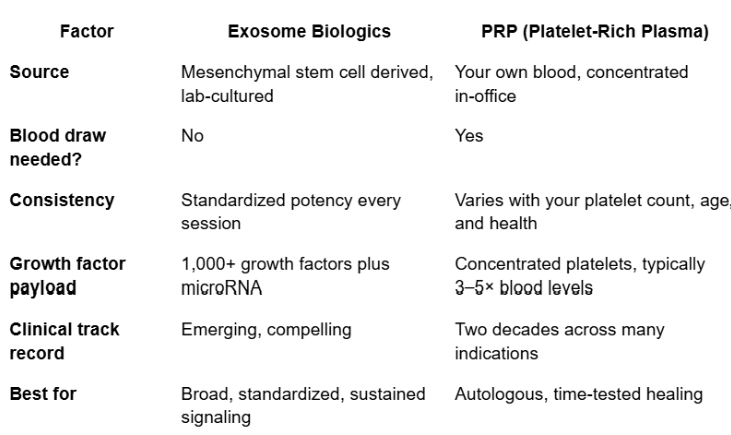
But here's the key point Arbour Longevity emphasizes, and it's different from how many clinics frame it: it's often not either/or. Many patients receive both in the same session - PRP, which is autologous and is injected, and a topical exosome preparation applied to the skin surface afterwards. Their Exosome + PRP Protocol combines the two, though the exosome component is investigational and no published trial establishes that adding topical exosomes outperforms PRP alone.
So the better question often isn't "which one?" it's "would the combination get me a better result?"
Recovery, Treatment Frequency, and Side Effects
One of the biggest draws is the minimal downtime. Patients frequently report that recovery feels gentler when a topical exosome preparation is used to finish the session, though that is a reported impression from an investigational preparation rather than a proven effect. In fact, Arbour Longevity offers a dedicated Post-Procedure Exosome Recovery protocol specifically to shorten redness and improve the quality of newly healed skin after treatments like CAT Resurfacing, laser, or deep peels.
What patients generally report:
- Mild redness similar to a light sunburn on the day of treatment
- A noticeable "glow" within the first several days
- The deeper collagen-driven results building over the following weeks
Treatment frequency and the number of sessions depend on your skin, your goals, and which procedure the exosomes are paired with, which is why these specifics are mapped out at your consultation rather than prescribed from a generic template.
On safety and side effects: reactions are generally mild and short-lived, temporary redness, swelling, or tenderness at the treatment site. It's also important to know the regulatory context, and Arbour Longevity is refreshingly direct about it: exosome preparations are investigational, and no exosome product currently holds FDA approval. Only Phase 2 research preparations are used. They are professionally sourced, cGMP-aligned, and applied topically to the skin surface only alongside established procedures, never injected and never delivered into tissue, and the clinic makes no therapeutic claims and does not present exosomes as a cure for anything. That kind of honesty explaining the science and its limits so you can make an informed decision is exactly what you want from a regenerative-medicine provider.
What Does Exosome Therapy Cost, and How Long Do Results Last?
Cost depends on which procedure the exosomes are paired with. As a reference point, Arbour Longevity's Rockstar Treatment, plasma plus topically applied exosomes in one session is $750, and exosomes can also be added to other protocols (Gold and VIP members receive a discounted exosome add-on rate). Because pricing varies by protocol, the exact investment for your plan is confirmed at consultation.
On longevity: results build over weeks and are sustained as new collagen matures. How long they last depends on your age, skin condition, lifestyle, and aftercare, consistent sun protection and a solid home routine meaningfully extend results. Many patients maintain their outcomes with periodic sessions, often through a membership.
Experience Exosome Skin Rejuvenation at Arbour Longevity in Ann Arbor, Michigan
You've done the research, now it comes down to who performs the treatment. With regenerative therapy, the quality of the exosomes and the skill of the clinician matter more than almost anything else. The same procedure can deliver very different results depending on the hands you're in.
Why Choose Arbour Longevity for Regenerative Skin Therapy?
Arbour Longevity is led by Gandhi Bhattarai, FNP-BC, PMHNP-BC, Anti-Aging/Functional Medicine BC triple board certified in Family Medicine, Psychiatric Mental Health, and Anti-Aging and Functional Medicine, with advanced training in regenerative medicine. Rather than treating exosomes as a tacked-on menu item, the clinic offers distinct topical exosome protocols for the areas where a preparation can be applied to the skin surface: facial rejuvenation, hair restoration, post-procedure recovery, topical exosomes alongside PRP, and body skin renewal. Every one of them is a surface application, and every one of them is investigational.
What that means for you:
- Documented, MSC-derived exosomes with a Certificate of Analysis per lot - full transparency about what's used on your skin
- Protocols matched to your goals and your Fitzpatrick skin type, not a one-size-fits-all approach
- A clinician who assesses your skin within a complete clinical framework hormonal, vascular, and whole-person, not just the symptom
- Honest expectations, including straight talk about the science and the current regulatory status
If you'd like to understand how exosomes fit alongside your other goals, it's worth exploring Arbour Longevity's broader regenerative medicine and skin longevity offerings, and reading more about microneedling - the procedure most often paired with a topical exosome facial.
Book Your Exosome Therapy Consultation Today
The best way to know whether exosome therapy is right for your skin is a proper, in-person assessment. A private, 45-minute consultation with Gandhi covers what matters to you, what's biologically going on, and the shortest path to the outcome you want, with complete transparency about the science and realistic expectations. Your consultation fee is applied toward your treatment.
Ready to see what regenerative skincare can do for you? Visit Arbour Longevity at 2217 Packard St #15, Ann Arbor, MI 48104, or call (734) 436-3357 to book your exosome consultation and take the first real step toward skin that looks restored, refreshed, and genuinely healthier.
Frequently Asked Questions About Exosome Therapy Skin Benefits
What are exosomes and how do they work?
Exosomes are nano-sized extracellular vesicles (30–150 nanometers) that cells release to communicate with one another. They carry over 1,000 growth factors, proteins, lipids, and microRNA that influence how recipient cells repair and regenerate. At Arbour Longevity, MSC-derived exosome preparations are applied topically to the skin surface only, after procedures like microneedling. They are never injected and are never delivered into tissue, they are investigational, and only Phase 2 research preparations are used.
What's the difference between exosomes and PRP?
PRP uses growth factors concentrated from your own blood, autologous and well-established, but variable with your platelet count. Topical exosome preparations carry a standardized, broader payload of 1,000+ growth factors and microRNA, and are applied to the skin surface only. The two are often combined at Arbour Longevity, though the exosome component is investigational and no trial establishes that the combination outperforms PRP alone.
Are exosomes FDA-approved?
No exosome product currently holds FDA approval, and Arbour Longevity is transparent about this at every consultation. Exosomes are described to every patient as investigational, only Phase 2 research preparations are used, and they are applied topically to the skin surface only, never injected and never delivered into tissue. The clinic makes no therapeutic claims, just honest context so you can make an informed decision.
What results can I expect?
Clinical studies exploring exosome applications report improvements in skin texture and tone, reductions in fine lines, and pigmentation improvement in a majority of participants in some trials. Patients often report that sessions finished with a topical exosome preparation feel like they recover faster. Exosome preparations are investigational and are not proven to produce any particular result; individual outcomes vary and are discussed at consultation.
Does exosome therapy work for all skin types?
Yes. Because exosomes are anti-inflammatory rather than irritating, they're suitable across all six Fitzpatrick skin types and are offered year-round, including for deeper skin tones that carry higher pigmentation risk with heat-based treatments.
Can exosomes be combined with other treatments?
Yes. Topical exosome preparations are commonly applied to the skin surface after microneedling, after plasma treatments like GlassLIFT, CAT Resurfacing, and the Rockstar Treatment, and after laser resurfacing. They are applied to the surface only and are never injected, they remain investigational, and your clinician will advise on the best combination for your goals.
Exosome therapy represents a real shift in how we approach aging and damaged skin from masking problems on the surface to prompting the skin to rebuild itself using the same cellular language it already speaks. For the right candidate, a topical, investigational exosome preparation can be a reasonable addition to a plan especially when it is offered by a clinician who is honest about both its promise and its limits. If that's the kind of skin restoration you're after, a consultation with Arbour Longevity is the natural next step.

Gandhi Bhattarai, FNP-BC, PMHNP-BC, Anti-Aging/Functional Medicine BC
Triple board-certified nurse practitioner and founder of Arbour Longevity in Ann Arbor. Every article is written from clinic practice and reviewed against current guidelines.
✓ Medically reviewed · Last updated August 21, 2026
How we reviewed this article
Arbour Longevity articles are written by the treating clinician, checked against primary sources (peer-reviewed journals, FDA labeling, Endocrine Society and other specialty guidelines) and re-reviewed when guidance changes. See our editorial policy. Spotted an error? Email info@arbourlongevity.com.
This article is educational and is not a substitute for individualized medical advice. Whether a treatment is appropriate for you is determined during consultation.
Your symptoms have a cause. Let’s find it.
Book a $35 first visit in Ann Arbor. It’s a 30–45 minute consultation with Gandhi Bhattarai, applied toward your plan. Serving Ann Arbor, Ypsilanti, Saline, Dexter, Chelsea, and Michigan by telehealth.





.webp)

