

Functional Medicine Optimal Labs: What Normal Misses
Key takeaways
- Functional medicine optimal labs compare your results to healthy targets, not just to the population average.
- "Normal" ranges catch disease, while optimal ranges catch dysfunction years before a diagnosis lands.
- Thyroid, inflammation, blood sugar, gut and nutrient markers explain fatigue, weight gain and brain fog best when read together.
- Good results lead to a tailored plan you can follow, not a thicker report.
- Arbour Longevity in Ann Arbor offers optimal lab testing, and your first visit is $35.
You've done everything right. You went to the doctor, got the bloodwork, and waited for answers. Then the call came: "Everything looks normal."
Except it doesn't feel normal. You're still exhausted by 3 p.m. The weight won't budge. Your brain runs through fog, and somewhere between "your labs are fine" and "you'll feel like this forever," you stopped getting real answers.
If that's you, you're not imagining it. The gap between "technically normal" and "actually well" is where functional medicine optimal labs do their work. Standard medicine names what you have. Functional medicine finds why you have it.
This guide covers four things:
- What optimal lab testing measures.
- Why standard ranges miss so much.
- How to read your own results.
- What to do once you have answers worth acting on.
What Are Functional Medicine Optimal Labs (and How Do They Differ From Standard Bloodwork)?

Functional medicine optimal labs look at the biology beneath your symptoms. Instead of simply asking whether you're sick enough to diagnose, they check:
- Gut integrity.
- Hormone metabolism.
- Mitochondrial function (mitochondria are the tiny power plants inside your cells that make energy).
- Nutrient status.
- Toxin burden.
That single shift changes everything about what your results mean.
What is the difference between "normal" and "optimal" lab ranges?
A normal range tells you whether your result falls within the typical spread of the general population. An optimal range tells you where your result should sit for your body to work at its best.
Those are not the same thing. The difference matters more than most people realize.
Think of it like a grading curve. A "normal" range is a pass/fail line drawn around average. But average isn't the goal when so many people deal with fatigue, inflammation, blood-sugar issues, and poor sleep.
As Arbour Longevity puts it plainly: "Normal for your age" isn't the goal. Optimal is.
Why Can Your Standard Labs Come Back "Normal" While You Still Feel Unwell?
Because "normal" is a wide net. You can fall inside it while drifting far from your own best.
Here's a pattern functional medicine clinicians see all the time. A patient arrives with crushing fatigue and a "normal" thyroid result. Their TSH (thyroid-stimulating hormone, the brain's signal to the thyroid gland) sits at the high end of a range that often stretches to around 4.5. On paper, nothing's wrong.
But the whole point is to look beyond what a TSH and basic panel will ever show. That patient isn't "fine." They're parked at the sluggish edge of normal. Their symptoms are telling the truth their lab report glossed over.
This is the core frustration optimal labs solve: normal ranges catch disease, but optimal ranges catch dysfunction. That slow slide happens for years before a diagnosis ever lands.
How conventional reference ranges are actually calculated
Most standard reference ranges describe the crowd, not a goal. Labs gather results from a large population. Then they define "normal" as roughly the middle 95% of those values.
The problem? That population isn't always healthy. It includes people who are stressed, sleep-deprived, pre-diabetic, and inflamed.
So when you're compared to that group, you're measured against a baseline that's already off. Falling "within range" simply means you look like the crowd, not that you're well.
What an optimal range looks like for the same marker
Optimal ranges are built differently. They come from research on where markers sit in people who are truly healthy and low-risk. They tend to be narrower and stricter.
A quick comparison makes the gap obvious:
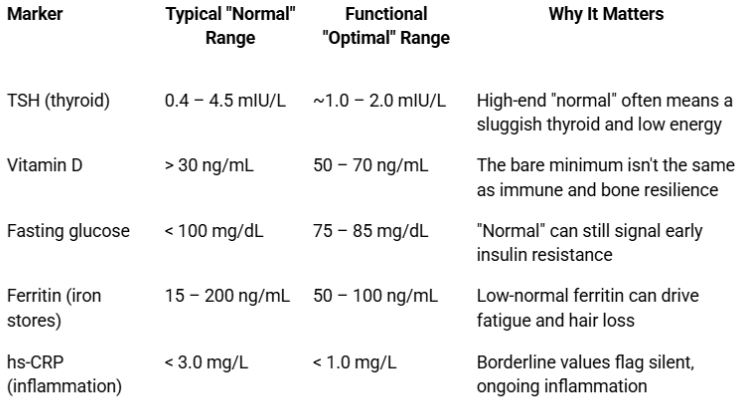
Borderline values flag silent, ongoing inflammation
(Ranges vary by lab, age, and individual context. These show the concept, not a personal target. Your clinician interprets every marker against your full history.)
Look at glucose. A fasting reading of 98 mg/dL clears the "normal" bar with room to spare. Through a functional lens, though, it's a yellow light. It can be a quiet sign that insulin resistance (when cells stop responding to insulin, so blood sugar and belly fat rise) is building years before pre-diabetes would show up.
Want your own numbers, not averages?
Your $35 first visit at Arbour Longevity starts the work of reading your labs against optimal ranges, and the $35 is applied toward your plan.
Book your $35 first visit Call (734) 436-3357
Which Optimal Lab Markers Matter Most and What They Tell You About Your Health

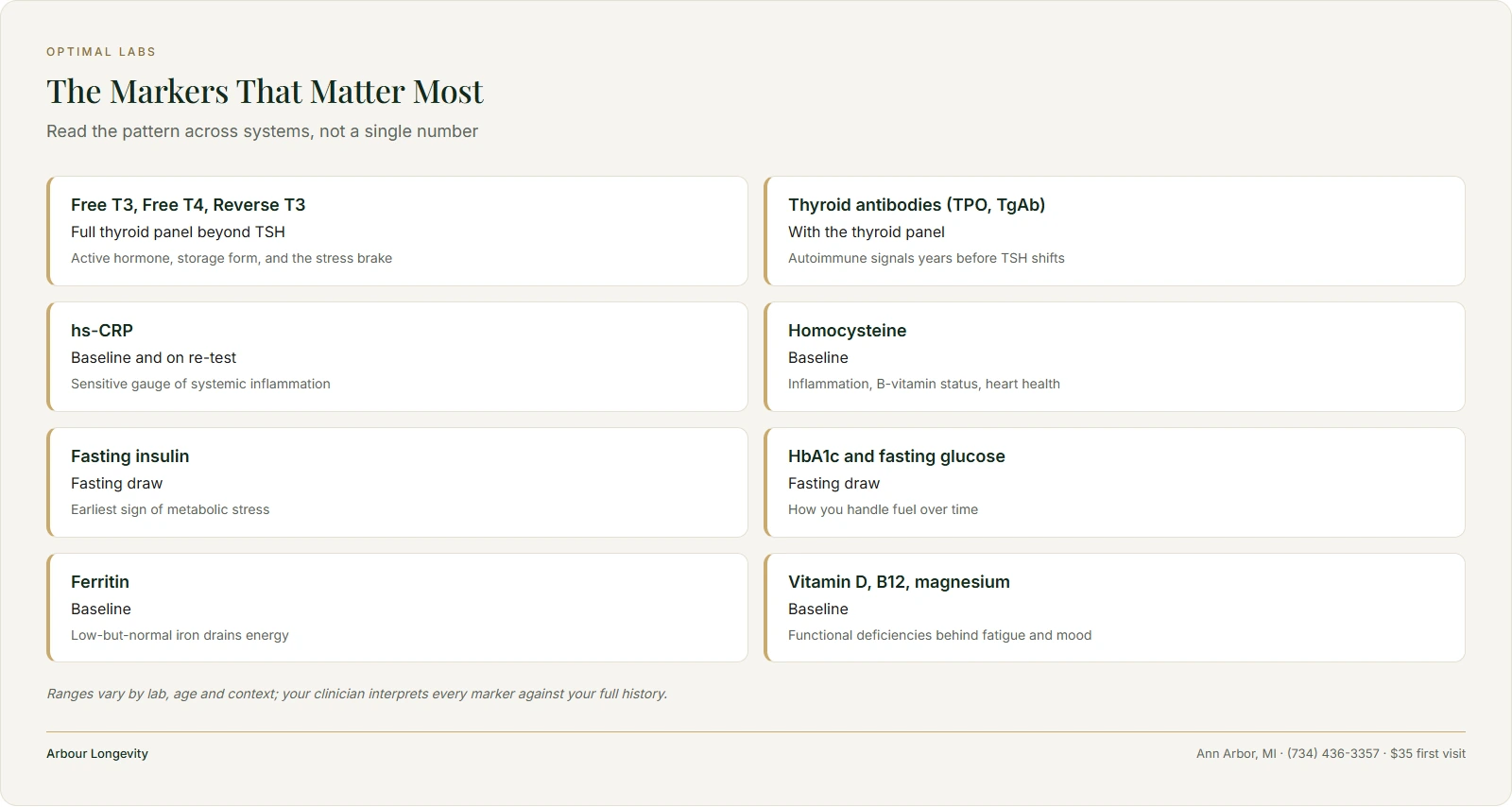
Not every marker carries the same weight. The real power of optimal labs is reading the right markers together. That maps the links a single number can't reveal:
- The gut-brain link.
- The hormone-metabolism link.
- The toxin-immune link.
What thyroid markers do functional medicine optimal labs check beyond TSH?
Standard thyroid testing usually stops at TSH. That's like judging an engine by the warning light alone.
A complete functional thyroid panel typically looks at:
- Free T3 (the active thyroid hormone your cells use for energy). You can have a fine TSH and still convert hormone poorly here.
- Free T4 (the storage form your body converts into T3).
- Reverse T3 (a kind of "brake" that rises under stress and can blunt thyroid function).
- Thyroid antibodies (TPO and TgAb), meaning thyroid peroxidase and thyroglobulin antibodies. These are early warning signs of autoimmune thyroid conditions like Hashimoto's, often years before TSH ever shifts.
Seeing these side by side explains why someone feels hypothyroid (underactive thyroid) even when their TSH looks fine. To go deeper on hormone metabolism, Arbour Longevity uses the DUTCH test (Dried Urine Test for Comprehensive Hormones) with full thyroid panels to see what standard testing misses. Learn more about Hormones & Adrenal Health.
Which biomarkers reveal hidden inflammation before symptoms appear?
Chronic, low-grade inflammation (the body's alarm response, stuck in the "on" position) is one of the quietest drivers of long-term disease. It rarely announces itself. Optimal labs look for it directly instead of waiting for the damage.
Key inflammatory markers include:
- hs-CRP (high-sensitivity C-reactive protein), a sensitive gauge of body-wide inflammation. It is linked to cardiovascular (heart and blood vessel) and metabolic risk.
- Homocysteine. Raised levels can signal inflammation, B-vitamin deficiency, and heart-health concerns.
- Fasting insulin. Often overlooked, but high insulin is one of the earliest signs of metabolic stress and inflammation.
When these run high together, they tell a clear story long before you'd feel a symptom.
What do optimal labs show about gut health, blood sugar, and nutrient status?
This is where the whole-body picture comes together. Functional testing links systems that standard panels keep in separate boxes. At Arbour, the search often starts in the gut, because it's the origin of so much chronic disease.
- Gut and microbiome: Intestinal permeability, dysbiosis, SIBO, and food reactivity show up far beyond the gut. In plain terms, that means a leaky gut lining, an imbalance of gut bacteria, small intestinal bacterial overgrowth (SIBO), and foods your body reacts to. They appear as brain fog, hormone imbalance, skin conditions, and mood changes. Organic acids testing (OAT) and food sensitivity panels help pinpoint the specific problems.
- Blood sugar & metabolism: Beyond fasting glucose, markers like HbA1c (your average blood sugar over the past three months) and fasting insulin show how your body handles fuel over time. They catch trouble far earlier than a single reading.
- Nutrient status: Optimal labs flag low levels of vitamin D, B12, magnesium, and ferritin (your stored iron). These are the low-but-"normal" levels that quietly drain energy, mood, and immunity.
How these markers connect to fatigue, weight, and brain fog
Here's the part that finally makes sense of how you feel. Suppose your results show a high-normal TSH, low-normal ferritin, vitamin D at 32, and slightly raised fasting insulin. On its own, every value is "normal."
Together, they paint a clear picture: a sluggish thyroid, depleted iron, low vitamin D, and early metabolic resistance. That's a near-perfect recipe for exhaustion, stubborn weight, and brain fog.
That mirrors what real patients describe. One Arbour patient spent two years with brain fog. It turned out to be mitochondrial dysfunction and B12 depletion, visible on the organic acids test. No one had thought to look for it.
That's the difference. One report. Several "normal" numbers. One clear explanation standard testing missed entirely.
How to Read and Act on Your Optimal Lab Results

Data without direction is just anxiety. The goal of functional medicine labs isn't a thicker report. It's a clear, tailored plan you can follow, with someone walking it beside you.
How do you interpret functional medicine optimal labs correctly?
Three principles separate a useful reading from a confusing one:
- Read the pattern, not the point. A single out-of-optimal marker is a clue. Several pointing the same direction is a diagnosis-in-waiting.
- Anchor to optimal, not normal. Always ask where a value should be for thriving, not just whether it cleared the low bar.
- Layer in your story. Your symptoms, history, diet, sleep, and stress turn raw numbers into a real, human picture.
This is also why reading results takes real clinical training. Here, your clinician reviews your results in full with you. The links between findings (gut-brain, hormone-metabolism, toxin-immune) are mapped and explained, not handed to you as a spreadsheet of green checkmarks. Learn more about Functional Medicine at Arbour Longevity.
What should you do after reviewing your results?
It depends on what the pattern shows. The path forward almost always falls into one of two directions: refine, or dig deeper.
When optimal labs call for a follow-up or deeper testing
Sometimes the first round raises smart new questions. Raised inflammation with gut symptoms might call for a deeper microbiome check. Stubborn fatigue with borderline thyroid antibodies might call for the DUTCH test or a genomic panel. That panel checks MTHFR (a gene that affects how you process folate) and key SNPs (single nucleotide polymorphisms, or small common gene variants).
Good testing narrows the search. It doesn't pretend to have every answer on day one.
Lifestyle, nutrition, and treatment adjustments your results may point to
More often, your results point straight to practical, high-impact changes:
- Targeted nutrition to rebuild specific shortfalls: iron-rich foods for low ferritin, or strategic carb timing for early insulin resistance.
- Precise supplements based on what you lack, instead of a guessing-game cabinet of pills.
- Lifestyle levers: sleep, stress, and movement changes aimed at the exact systems your labs flagged.
- Integrated clinical support when warranted. Care here isn't a standalone consult, so your findings can flow straight into the right program. Hormone imbalances go to hormone optimization, mitochondrial dysfunction to NAD+ IV protocols (NAD+ is a molecule every cell needs to make energy), and metabolic disease to medical weight loss.
The win here is precision. You stop throwing random fixes at vague symptoms. You start treating the specific imbalances your data revealed.
Get Functional Medicine Optimal Labs at Arbour Longevity in Ann Arbor, Michigan

Knowing about optimal labs is one thing. Having a skilled clinician turn your results into a plan that changes how you feel is another. That's what happens at Arbour.
Functional medicine here is led by Gandhi Bhattarai, FNP-BC, PMHNP-BC. Gandhi is board-certified in Family Medicine, Psychiatric Mental Health, and Functional Medicine (Anti-Aging). Most providers in this field hold one certification. Holding three means you get conventional clinical rigor and integrative depth, and the psychiatric side of chronic illness is never ignored.
What does the optimal labs process look like at Arbour Longevity?
The process is thorough, evidence-based, and never a template:
- A thorough intake first. A 75–90 minute new-patient visit covers your full health history, symptom timeline, and prior labs.
- Diagnostic testing that goes deep. Standard labs plus advanced testing when your case calls for it: DUTCH, OAT, genomic panels, and specialty labs matched to your history.
- Root cause analysis. Your results are reviewed in full. The links between findings are mapped and explained in plain language.
- A tailored protocol. Targeted treatments for every root cause: nutrition, supplements, lifestyle, and links to hormone, peptide, IV, and weight-loss programs where needed.
- Ongoing follow-up. Regular check-ins to review progress, re-test, and adjust. Root cause medicine requires root cause follow-through: an ongoing relationship, not a one-time report. Telehealth follow-up is offered to Michigan residents.
Who is functional lab testing right for?
Optimal lab testing tends to be a fit if you see yourself in any of these:
- You feel "off" but keep getting told your labs are normal.
- You're tired of managing symptoms instead of finding root causes.
- You want to improve your health, longevity, and biological age now, not wait for a diagnosis.
- You're dealing with fatigue, weight changes, brain fog, hormonal shifts, gut issues, or stubborn inflammation.
If you nodded along to even one of those, this kind of testing was built for you.
Book your functional medicine optimal labs consultation
You've spent long enough being told nothing's wrong while knowing something is. Your symptoms have a cause. Let's find it, and build a plan that moves the needle. Your first visit is $35, and it is applied toward your plan.
Frequently Asked Questions
Does Arbour Longevity accept insurance for functional medicine optimal labs?
Arbour Longevity is a cash-pay clinic. That keeps visits longer and treatment choices driven by clinical judgment rather than insurance rules. That said, many services are HSA and FSA eligible (health savings account and flexible spending account), including:
- Hormone optimization labs.
- Functional medicine.
- IV therapy.
- Peptide therapy.
The clinic provides detailed receipts you can submit to be paid back where it applies.
Can I use my existing bloodwork for an optimal labs review?
Often, yes. Prior labs are reviewed as part of your full intake. If your recent results include the right markers, they can be re-read against optimal ranges. Extra advanced testing (like DUTCH or OAT) may still be suggested to complete the picture.
What advanced tests does Arbour Longevity use beyond standard labs?
Alongside standard bloodwork, the clinic uses:
- The DUTCH test for hormone metabolites.
- Organic acids testing (OAT) for mitochondrial and metabolic function.
- Full thyroid panels.
- Genomic panels for MTHFR and key SNPs.
Tests are selected based on your history and symptoms.
How often should I get optimal labs done?
For most people, a full panel works well as a baseline. Re-testing happens during active protocol adjustments so progress can be tracked and treatments fine-tuned. Your clinician sets the timing based on what your results show.
Where is Arbour Longevity located, and is telehealth available?
Arbour Longevity is at 2217 Packard St #15, Ann Arbor, MI 48104. The clinic serves Ann Arbor, Dexter, Ypsilanti, Saline, Plymouth, Canton, Northville, and Southeast Michigan. Telehealth is offered to Michigan residents for follow-up care. To get started, book your $35 first visit online or call (734) 436-3357.

Gandhi Bhattarai, FNP-BC, PMHNP-BC, Anti-Aging/Functional Medicine BC
Triple board-certified nurse practitioner and founder of Arbour Longevity in Ann Arbor. Every article is written from clinic practice and reviewed against current guidelines.
✓ Medically reviewed · Last updated August 21, 2026
How we reviewed this article
Arbour Longevity articles are written by the treating clinician, checked against primary sources (peer-reviewed journals, FDA labeling, Endocrine Society and other specialty guidelines) and re-reviewed when guidance changes. See our editorial policy. Spotted an error? Email info@arbourlongevity.com.
This article is educational and is not a substitute for individualized medical advice. Whether a treatment is appropriate for you is determined during consultation.
Your symptoms have a cause. Let’s find it.
Book a $35 first visit in Ann Arbor. It’s a 30–45 minute consultation with Gandhi Bhattarai, applied toward your plan. Serving Ann Arbor, Ypsilanti, Saline, Dexter, Chelsea, and Michigan by telehealth.






.webp)

