
HydraFacial vs Microneedling | Skin Treatment Comparison, Ann Arbor
Key takeaways
- HydraFacial exfoliates the dead surface layer and infuses serum without wounding; microneedling creates controlled micro-injuries so the dermis rebuilds collagen.
- That one difference explains the downtime: microneedling has some, HydraFacial has none.
- Microneedling has far more research, especially for atrophic acne scars; HydraFacial-specific studies are few and small.
- They treat different skin layers, so they are often sequenced together rather than chosen between.
- At Arbour, the glow facial is $175, $299 with dermabrasion, and the first visit is $35.
These two treatments get compared all the time, and the comparison is usually framed the wrong way. HydraFacial® and microneedling are not two versions of one idea. One works on the surface and leaves the deeper layers alone on purpose. The other injures the deeper layers on purpose, because that injury is the treatment.
The short version. HydraFacial is a hydradermabrasion treatment (vacuum-based exfoliation, extraction and serum infusion at the outermost layer of the skin). It does not create a wound. Microneedling is percutaneous collagen induction: fine needles make tiny controlled micro-injuries into the dermis so the repair response lays down new collagen.
That one mechanical difference explains everything else: the downtime, what each is studied for, and why they are often used alongside each other rather than instead of each other.
HydraFacial vs Microneedling: The One Difference That Explains Everything
The epidermis is the outer layer of skin. Its outermost few micrometers are the stratum corneum (the dead, compacted barrier layer). Beneath it sits the dermis, where collagen (the protein that keeps skin firm), elastin and fibroblasts (the cells that make collagen) live. Every meaningful difference between these two treatments comes down to which layer the device acts on.
HydraFacial acts on the stratum corneum. An imaging study looked at exactly this. Eight volunteers with Fitzpatrick skin types II to V (a scale of skin tone) were imaged with line-field confocal optical coherence tomography (a high-resolution skin scan). They were scanned before hydradermabrasion, immediately after, and at two weeks.
Average stratum corneum thickness fell from 9.42 to 6.67 micrometers immediately after treatment. The stratum corneum was more uniform (improved homogenization), with fewer undulations in the epidermis. At two weeks it measured 9.75 micrometers, slightly above baseline.
The superficial dermis appeared stretched immediately after treatment and had returned to baseline by two weeks. At that point there were no visible differences in the quality or quantity of collagen fibers in the dermis (Razi et al., Skin Res Technol, 2024, DOI). A device that removes a few micrometers of dead surface layer and leaves dermal collagen unchanged is doing what a non-wounding treatment is supposed to do.
Microneedling acts on the dermis, on purpose. Its formal name is percutaneous collagen induction. Fine needles create thousands of microscopic channels through the epidermis into the dermis. Nothing is removed; the channels themselves trigger the wound-healing cascade, and the remodeling that follows is the treatment.
The approach preserves the epidermis while promoting regeneration rather than cicatrization, meaning repair without scar formation. That is how a review in Aesthetic Plastic Surgery describes it (Atiyeh et al., Aesthet Plast Surg, 2021, DOI).
So: one treatment resurfaces what is already dead and pushes serum into the space it clears. The other creates controlled damage in living tissue and lets your biology respond. Those are different jobs. Our post on collagen and skin aging covers why the dermal side of that distinction matters as skin gets older.
What Does a HydraFacial Do?
Mechanically it is a vacuum device. A handpiece delivers fluid to the skin surface while applying suction. That creates a vortex that loosens and lifts debris as serum is deposited. The published protocol for the branded acne treatment describes three steps:
- Cleansing and peeling
- Suction to extract dead skin cells, sebum and debris
- A finishing step (Storgard et al., J Clin Aesthet Dermatol, 2022, PubMed)
Does the suction contribute anything, or is it an acid peel with theater attached? A randomized split-face study of 23 women (each side of the face treated differently) tested this. A 4 percent alpha hydroxy acid solution went on both sides of the face, and negative pressure was added to one side only.
Whiteheads and blackheads decreased significantly at one, two and four weeks in the negative-pressure group. They were also significantly better than the peel-only side at one week. Pore area and number decreased significantly at one week, and sebum output at four weeks, both only in that group (Kim et al., Int J Cosmet Sci, 2015, DOI). That study used a generic device and solution, not a HydraFacial, so it is adjacent evidence for how the method works, not evidence about a branded treatment.
HydraFacial vs Facial: What Is Actually Different
A conventional facial is manual: cleansing, steam, manual extraction, massage, a mask. Hydradermabrasion uses an instrument, and the instrument does two things hands cannot. It abrades the stratum corneum measurably, and it uses pressure to move serum into skin whose barrier has just been thinned. The imaging study above quantifies the first part (Razi et al., 2024, DOI).
The second part matters more than it sounds. Removing stratum corneum is a recognized way to reduce the skin's barrier resistance. That idea is the basis of an entire field of transdermal (through-the-skin) delivery research (Parhi et al., Curr Drug Deliv, 2015, DOI). Applying actives to a thinned barrier is not the same event as applying them to an intact one.
HydraFacial vs Dermaplaning
Dermaplaning belongs on the same side of the line. Researchers treated skin with four strokes of a dermaplaning device and examined it under the microscope. It removed the stratum corneum and some parts of the viable epidermis. It also produced a significant drop in electrical resistance across all treatment groups, confirming depletion of the barrier.
The same work found significant variation between different operators using the same device (Tijani et al., AAPS PharmSciTech, 2023, DOI). Dermaplaning and hydradermabrasion are both epidermal procedures using different tools: a blade versus fluid and vacuum. Neither is a collagen induction procedure.
HydraFacial Benefits: Being Honest About How Much Evidence Exists
This is the part most articles skip, so we will be direct. When we searched PubMed for this article, the term "HydraFacial" returned three records, only two of them about the treatment. "Hydradermabrasion" returned five. Searches for microneedling in acne scarring alone return dozens of randomized controlled trials (studies where people are assigned by chance to treatment or comparison).
They also return several meta-analyses (studies that pool the results of many trials). That asymmetry is real and worth saying out loud. It does not mean HydraFacial does not work. It means the published clinical literature supporting it is thin, industry-adjacent and mostly unblinded, and claims about it should be weighed accordingly.
The Two HydraFacial-Specific Studies
The imaging study above is one. It enrolled eight volunteers and reported imaging rather than clinical outcomes (Razi et al., Skin Res Technol, 2024, DOI).
The other is a 12-week, multicenter, open-label study (everyone knew who was being treated) of the branded Clarifying Treatment. It enrolled twenty adults with mild-to-moderate acne. The proportion rated as having no acne or almost clear skin on the Global Acne Severity Score rose from 20 to 65 percent by investigator assessment (p = 0.0027). By patient self-report it rose from 5 to 55 percent (p = 0.0016).
More than 80 to 100 percent of investigators and patients agreed or strongly agreed skin appearance had improved across multiple parameters. Treatments were generally well tolerated (Storgard et al., J Clin Aesthet Dermatol, 2022, PubMed).
Two things belong in the same breath as those results. The authors state that, due to the nature of the treatment, blinding of neither investigators nor patients was feasible. So there was no control arm and no blinding. And one listed author is affiliated with the company that makes the device.
Neither fact invalidates the findings. Both change how much weight a reasonable person puts on them.
Adjacent Hydradermabrasion Evidence, Labeled as Adjacent
Older work exists on hydradermabrasion as a general technique rather than on the HydraFacial brand. Twenty women aged 34 to 56 were randomized to one of two groups. One group had a series of six facial hydradermabrasion treatments with a polyphenolic antioxidant serum. The other had manual application of the identical serum without the device.
In the device group, treated skin showed increased epidermal thickness, papillary dermal thickness and polyphenolic antioxidant levels (P < 0.01). Biopsies showed replacement of elastotic dermal tissue, collagen hyalinization and increased fibroblast density. Fine lines, pore size and hyperpigmentation decreased, and no complications were reported. In the manual group there was no change in skin structure, antioxidant levels or clinical skin attributes (Freedman, J Cosmet Dermatol, 2008, DOI).
Note the tension between that 2008 biopsy study and the 2024 imaging study. One reported dermal changes after a series of treatments; the other found no visible difference in dermal collagen at two weeks. They are not directly comparable: different devices, different serums, biopsy versus optical imaging, one treatment followed for two weeks versus a series of six. We flag the discrepancy rather than pick the flattering result.
A more recent prospective study evaluated biweekly diamond-tip hydradermabrasion combined with a growth factor serum in 29 women with facial photodamage (sun damage). It reported significant improvements across investigator-assessed parameters and good tolerability (Huang et al., J Cosmet Dermatol, 2024, DOI). It used a different device, was industry-sponsored, had no control arm, and paired the device with a proprietary serum. So it cannot separate device from serum.
Not sure which layer your concern lives in?
A 30–45 minute in-person skin assessment to see whether your concern sits at the surface or in the dermis, with the $35 applied toward your plan.
Book your $35 first visit Call (734) 436-3357
How Microneedling Works
The needles pass through the epidermis into the dermis and withdraw, leaving microscopic channels. What follows is ordinary wound healing at very small scale. First comes an inflammatory phase. Then a proliferative phase, in which fibroblasts migrate in and lay down new matrix.
Finally there is a remodeling phase over the following weeks and months, in which that matrix is reorganized. That remodeling is what alters the texture of a scar. A surface treatment cannot reach it, because the tissue being remodeled is below the surface.
This is also why microneedling has downtime and HydraFacial does not. Erythema (redness), pinpoint bleeding and short-lived swelling are the visible face of an inflammatory phase, not a sign of it going wrong.
Microneedling Benefits: What the Trials and Meta-Analyses Report
A systematic review in the Journal of Plastic, Reconstructive and Aesthetic Surgery examined microneedling across a wide range of uses:
- Atrophic (pitted) acne scars
- Skin rejuvenation
- Hypertrophic scars and keloids (raised scars)
- Striae distensae (stretch marks)
- Androgenetic alopecia (pattern hair loss)
- Melasma and acne vulgaris
It reported that microneedling showed noteworthy results on its own and combined with topical products or radiofrequency. Compared with other treatments it showed similar results but was preferred due to minimal side effects and shorter downtime. The same review states the literature does show methodological shortcomings and that further research is required (Ramaut et al., J Plast Reconstr Aesthet Surg, 2017, DOI).
Microneedling for Atrophic Acne Scars
Atrophic acne scarring is where the evidence concentrates. A meta-analysis in Aesthetic Plastic Surgery pooled twelve randomized controlled trials totaling 414 participants comparing microneedling with other treatments. For objective scar improvement, microneedling without radiofrequency yielded a pooled mean difference of 0.42 (95% CI −0.12 to 0.73), significant at the 5 percent level. The fractional radiofrequency subgroup did not reach significance at that level.
On subjective satisfaction, most results showed no significant difference between microneedling and comparison treatments. No case of secondary scarring or infection was reported. The pooled result for post-inflammatory hyperpigmentation (dark marks left behind after skin inflammation) favored microneedling (Shen et al., Aesthetic Plast Surg, 2022, DOI).
A larger network meta-analysis (one that compares many treatments at once) in Archives of Dermatological Research pooled 24 randomized trials with 1,546 participants. Microneedling combined with chemical peels ranked highest for degree of improvement, patient satisfaction and treatment efficacy (how well it worked) among the options compared. Those options included:
- Microneedling alone
- Microneedling with hyaluronic acid, botulinum toxin-A or platelet-rich plasma
- PRP alone
- Chemical peels alone
- Laser therapy
Combinations outperformed microneedling alone. Side effects including erythema, pain and post-inflammatory hyperpigmentation showed no significant differences across the treatments assessed (Li et al., Arch Dermatol Res, 2024, DOI).
Individual trials fill in the texture. A double-blind randomized controlled trial enrolled 120 patients with atrophic post-acne scars. They were assigned to microneedling alone, chemical peeling alone, or the combination, with two expert raters blinded to treatment scoring the Goodman-Baron scale. Only the combination group showed a statistically significant improvement on that scale (2.87 ± 0.83 before versus 2.03 ± 1.16 after, p = 0.0005).
Patients in all three groups experienced statistically significant improvement in dermatology-specific quality of life (Pakla-Misiur et al., Postepy Dermatol Alergol, 2021, DOI). We include that trial specifically because microneedling alone did not reach statistical significance in it.
Two observations. Scar subtype matters: rolling, boxcar, icepick and hypertrophic scars do not behave the same way, and the trials did not all study the same mix. And microneedling in these trials is very often combined with something else, with the combinations frequently outperforming it alone.
A Note on the Quality of the Microneedling Literature
Having more studies is not the same as having better ones. A review in Aesthetic Plastic Surgery identified 25 published studies on percutaneous collagen induction. Of those:
- Four were experimental animal studies.
- Most clinical reports were case series or small non-randomized cohorts. They lacked methodological unity and mixed scars, wrinkles and skin laxity.
- Only four specifically investigated the effect on wrinkles and aging skin.
- Five included histologic evaluation of biopsies.
The authors concluded the literature revealed a limited number of high-quality studies. Data and conclusions, they wrote, must be carefully interpreted before translating them into clinical recommendations (Atiyeh et al., Aesthet Plast Surg, 2021, DOI).
Microneedling has a substantially larger randomized-trial base than hydradermabrasion. It is not a settled science.
Microneedling vs Laser
That is a genuinely different comparison: two wounding treatments delivering injury by different means, mechanical versus thermal. There are head-to-head split-face trials on it. We cover it in full in a separate article on microneedling vs laser skin resurfacing rather than repeat it here.
Downtime Is the Practical Consequence of the Mechanism
If you take nothing else from this page, take this: you cannot have the remodeling without the injury, and you cannot have the injury without the recovery. A treatment that produces no downtime is telling you something true about what it did to your skin.
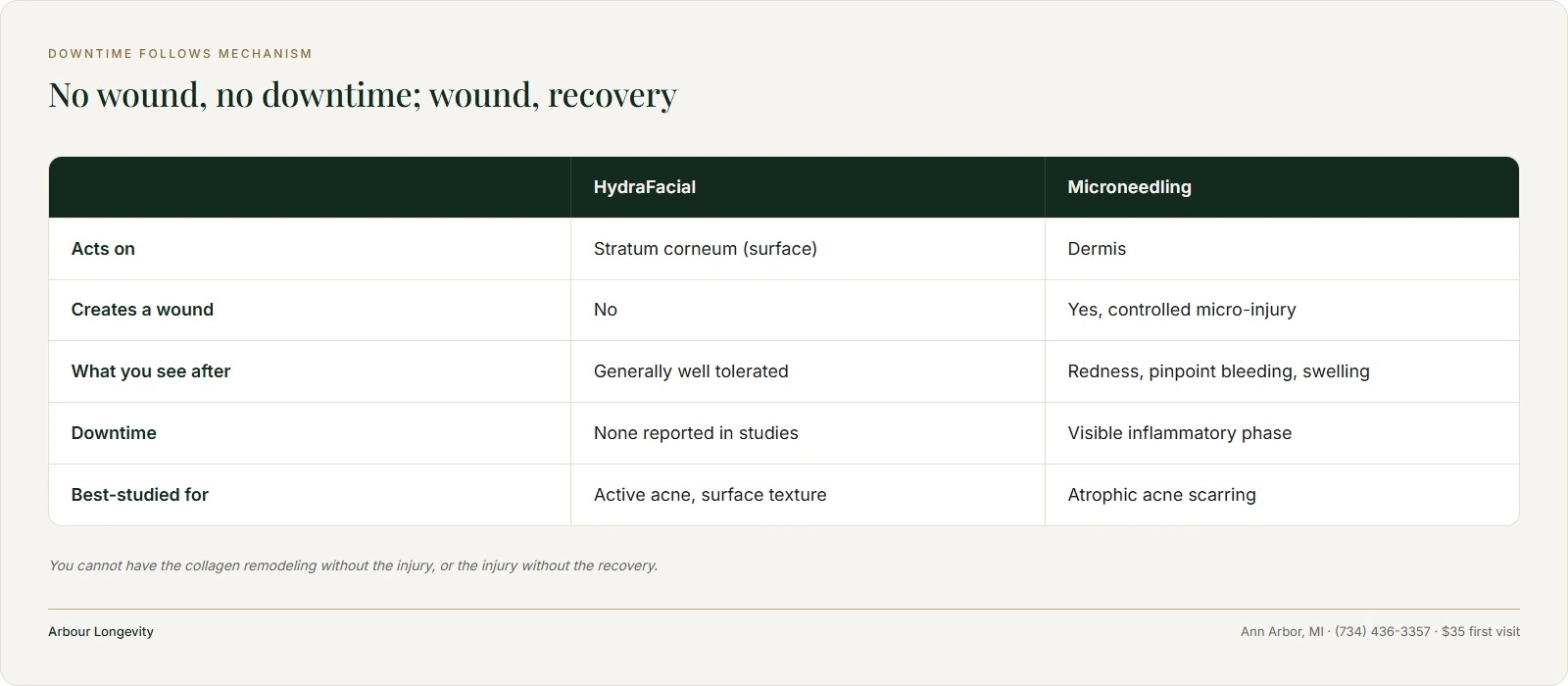
The hydradermabrasion studies above reported treatments that were generally well tolerated with no reported complications. That fits a procedure that removes surface layer and does not wound the dermis (Storgard et al., 2022, PubMed; Freedman, 2008, DOI).
The microneedling systematic review describes it as preferred over comparators due to minimal side effects and shorter downtime. But the comparators there are other resurfacing treatments, not surface exfoliation (Ramaut et al., 2017, DOI). Erythema and pain were among the side effects tracked across the acne scar meta-analyses (Li et al., 2024, DOI).
What the Choice Actually Depends On
We are not going to tell you which one you need from a web page. That is a clinical assessment, and it depends on things a page cannot see. Here is what it turns on.
What is being treated, and how deep it sits. Dullness, congestion, blackheads and surface texture are stratum corneum and follicular (pore-level) concerns. Atrophic scarring is a dermal architecture concern. Microneedling is the treatment with the randomized-trial literature in atrophic acne scarring (Shen et al., 2022, DOI; Li et al., 2024, DOI). Hydradermabrasion is studied at the level of the stratum corneum and in active acne (Razi et al., 2024, DOI; Storgard et al., 2022, PubMed).
Whether recovery time is available to you. One of these creates a visible inflammatory phase and one does not. That is a scheduling question as much as a clinical one, and a legitimate input. Active inflammatory skin conditions also change what is appropriate, which is an in-person judgment.
Your skin type and pigmentation history. Post-inflammatory hyperpigmentation risk is one of the outcomes tracked in the microneedling meta-analyses. It is one of the reasons skin type is assessed before any wounding treatment is discussed (Shen et al., 2022, DOI).
What else is in the plan. The scar literature repeatedly found microneedling combined with another treatment outperformed microneedling alone (Li et al., 2024, DOI). The real question is often not which single treatment, but what the sequence looks like alongside other options:
- Aesthetic PRP (PRP is platelet-rich plasma, a concentrate of your own blood platelets, rich in growth factors)
- CAT resurfacing
- Plasma soft surgery
Which of these is appropriate for you is determined at consultation, after your skin is examined and your history is taken. Nothing on this page is a diagnosis or a recommendation for any individual.
Can You Have Both?
They are not really competitors, and in practice they are often sequenced rather than chosen between. A surface exfoliation and infusion treatment and a dermal collagen induction treatment address different layers. That is exactly why combining them is coherent.
We are not publishing intervals or an order of operations, for the same reason we do not publish session counts. Appropriate spacing depends on the device, the depth treated, your skin type and how your skin responded last time. We also did not find a published trial establishing a general schedule for combining these two treatments that we would be comfortable citing. What the literature does support is the broader pattern that combination approaches were studied more favorably than a single treatment in acne scarring (Li et al., 2024, DOI).
HydraFacial Pricing in Ann Arbor
Our glow facial service is $175. The version combined with dermabrasion is $299. The first visit is $35, applied toward your treatment plan.
We do not publish a microneedling price here, because the appropriate treatment and therefore the cost is confirmed at consultation. We would rather quote you accurately in person than roughly online. Cash pay, HSA and FSA are accepted.
Frequently Asked Questions
Is microneedling or HydraFacial better?
Neither framing holds up, because they are not doing the same job. One removes stratum corneum and infuses serum without wounding the skin (Razi et al., 2024, DOI). The other creates controlled dermal micro-injury to induce collagen (Atiyeh et al., 2021, DOI). Which is appropriate depends on what is being treated and is determined in person.
Does a HydraFacial build collagen?
The one HydraFacial-specific imaging study found no visible differences in the quality or quantity of dermal collagen fibers at two weeks after treatment (Razi et al., 2024, DOI). An older randomized study of generic hydradermabrasion with an antioxidant serum did report increased papillary dermal thickness and fibroblast density on biopsy. That was after a series of treatments (Freedman, 2008, DOI). Those studies used different devices and different methods, and we would not present either as settled.
Why does microneedling have downtime when a HydraFacial does not?
Microneedling deliberately creates micro-wounds in the dermis, and the visible recovery is the inflammatory phase of healing. Hydradermabrasion acts on the stratum corneum and does not create that wound (Razi et al., 2024, DOI).
Which one has more research behind it?
Microneedling, by a wide margin. Its acne scar literature alone supports meta-analyses pooling 12 randomized trials in 414 participants (Shen et al., 2022, DOI) and 24 randomized trials in 1,546 participants (Li et al., 2024, DOI). HydraFacial-specific clinical literature amounts to a handful of small, unblinded studies. Even the microneedling literature has been criticized by reviewers for methodological shortcomings (Ramaut et al., 2017, DOI; Atiyeh et al., 2021, DOI).
HydraFacial and Microneedling Consultations in Ann Arbor
At Arbour Longevity we assess skin in person before recommending anything. Whether your concern lives at the surface or in the dermis is not a question a web page can answer. Our skin longevity approach treats any single treatment as one part of a longer plan. We offer:
Gandhi Bhattarai, FNP-BC, PMHNP-BC, Anti-Aging/Functional Medicine BC is a triple board certified nurse practitioner. We are at 2217 Packard St #15, in the Eastover Professional Center, Ann Arbor, MI 48104, open Thursday through Monday, 10am to 7pm. The first visit is $35, applied toward your treatment plan, and cash pay, HSA and FSA are accepted. Call (734) 436-3357 or book your $35 first visit online.
Clinical information on this page is drawn from articles retrieved from PubMed and is provided for education. It is not medical advice, not a diagnosis, and not a promise of any individual result.

Gandhi Bhattarai, FNP-BC, PMHNP-BC, Anti-Aging/Functional Medicine BC
Triple board-certified nurse practitioner and founder of Arbour Longevity in Ann Arbor. Every article is written from clinic practice and reviewed against current guidelines.
✓ Medically reviewed · Last updated August 17, 2026
How we reviewed this article
Arbour Longevity articles are written by the treating clinician, checked against primary sources (peer-reviewed journals, FDA labeling, Endocrine Society and other specialty guidelines) and re-reviewed when guidance changes. See our editorial policy. Spotted an error? Email info@arbourlongevity.com.
This article is educational and is not a substitute for individualized medical advice. Whether a treatment is appropriate for you is determined during consultation.
Your symptoms have a cause. Let’s find it.
Book a $35 first visit in Ann Arbor. It’s a 30–45 minute consultation with Gandhi Bhattarai, applied toward your plan. Serving Ann Arbor, Ypsilanti, Saline, Dexter, Chelsea, and Michigan by telehealth.






.webp)

