

Key takeaways
- IV nutrient therapy helps a few groups most: poor gut absorption, absorption-blocking medicines, high demand, and a few specific conditions.
- It is a delivery route, not a treatment in itself. The mix is chosen from your labs and symptoms.
- If you are healthy, eating well and sleeping, a drip is unlikely to change how you feel.
- Arbour treats IV therapy as a clinical service. It starts with a consultation and labs, not a walk-in menu.

You take the supplements. You eat well. And you still feel run-down, slow to recover, and worn out through every cold season. IV nutrient therapy gets talked about as the fix. The honest answer is that some people have a real medical reason to need it. Many do not. This guide draws that line clearly.
Here is the short answer. IV nutrient therapy (intravenous: vitamins, minerals, and fluid dripped straight into a vein) skips the gut. That means your body gets the full dose. It helps most for people with poor gut absorption, high demand, or specific conditions. It does little for a healthy person who already eats well. We will tell you honestly which group you are in.
What IV nutrient therapy actually does
IV nutrient therapy is simply a delivery route. A sterile mix of vitamins, minerals, and fluid drips into a vein over about 30 to 90 minutes.
The advantage over pills comes from three things.
- Full absorption. Pills lose a lot of their dose in the gut. An IV puts all of it into your blood.
- A fast, high peak. Pills cannot match it. That matters when a migraine is starting or when you are recovering after hard effort.
- A bypass for a damaged gut. People who cannot absorb nutrients well still get the full dose.
The trade-off is that it is a needle, it takes time, and it costs more than a supplement. For a healthy person with a good diet, pills usually do the job just fine.
What is in an IV nutrient drip?
The exact mix depends on the formula, but the building blocks are familiar. Each one has a clear job.
- Sterile fluid for hydration. Most drips start here.
- Magnesium (a mineral your body uses for hundreds of reactions, including sleep, muscle relaxation, and blood pressure). It is one of the most useful single ingredients.
- B vitamins and B12 support energy and red blood cells.
- Vitamin C supports the immune system and helps build collagen (the protein that keeps skin firm).
- Glutathione (your body's main antioxidant), zinc, or biotin, added in some formulas.
The right mix is chosen at your visit based on your labs and symptoms.
Who actually benefits from IV nutrient therapy?
A handful of groups get real value from IV nutrient therapy. If you do not see yourself here, you probably do not need a regular drip.
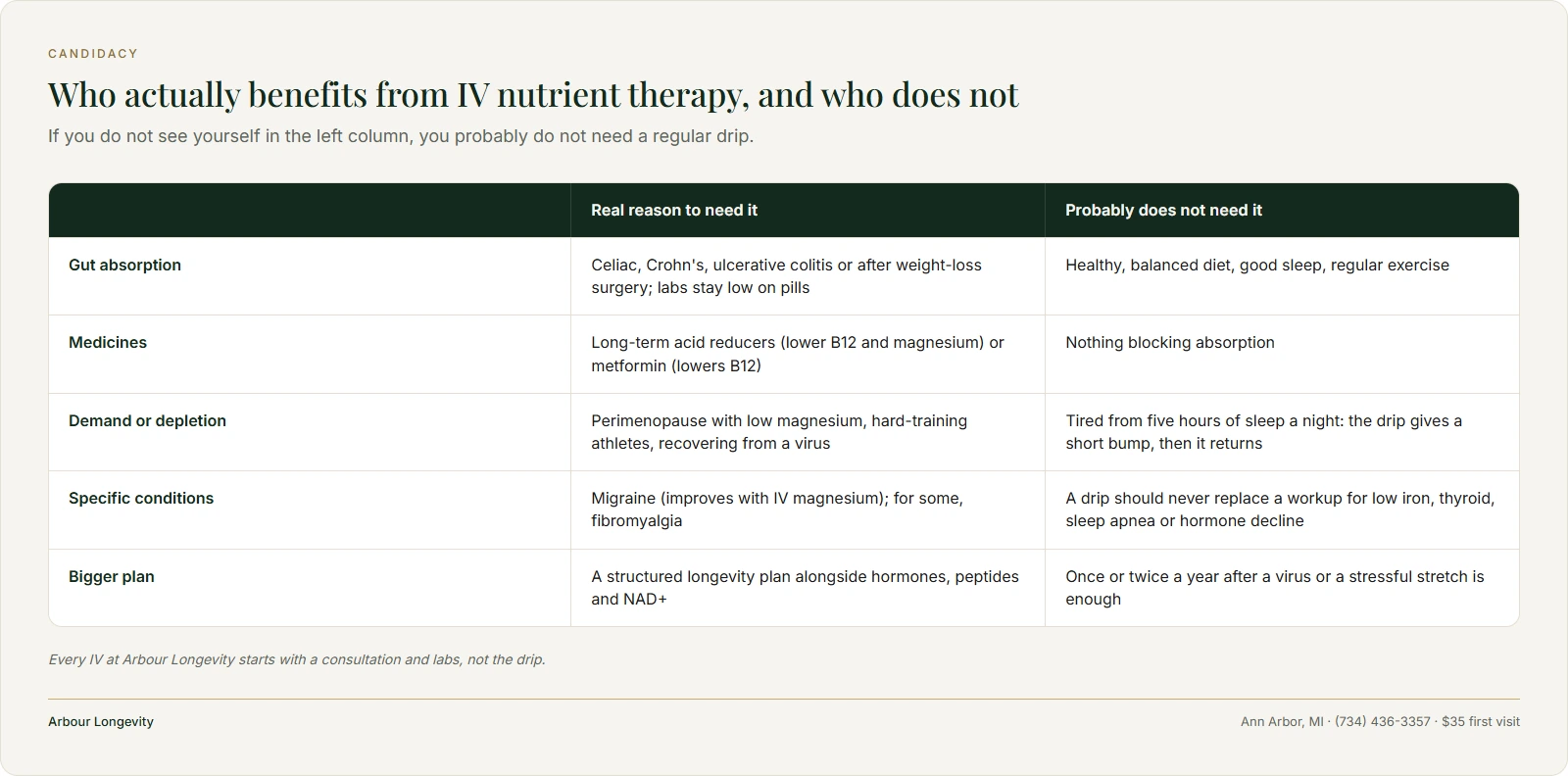
- People with poor gut absorption. This is the clearest group. It includes celiac disease (a gut reaction to gluten), Crohn's disease and ulcerative colitis (two forms of inflammatory bowel disease), and people who have had weight-loss surgery. Their labs often stay low even with pills.
- People on medicines that block absorption. Long-term acid reducers lower B12 and magnesium. Metformin (a common diabetes medicine) lowers B12.
- People with high demand or depletion. This includes women in perimenopause (the years of shifting hormones before periods stop) with low magnesium, hard-training athletes, and people recovering from a virus.
- Some specific conditions. Migraine improves with IV magnesium. For some people, fibromyalgia (widespread pain and fatigue) responds too.
- People on a structured longevity plan. IV therapy can be one supportive tool alongside hormones and peptides (short chains of amino acids that act as signals to cells). It also pairs with NAD+ IV therapy (a molecule every cell needs to make energy and repair DNA).
Recognize yourself in this?
Your $35 first visit is a 30–45 minute consultation that maps the labs you need, with the $35 applied toward your plan.
Book your $35 first visit Call (734) 436-3357
Who does not need IV therapy
This is the part most drip bars skip. We will not.
If you are healthy, eat a balanced diet, sleep well, and exercise, you probably do not need a monthly IV. You might enjoy one once or twice a year after a virus or a stressful stretch. That is different from needing one every month.
A drip is also not a substitute for fixing the real problem. If you are exhausted because you sleep five hours a night, the drip gives a short bump. Then the tiredness returns.
And a drip should never replace a proper workup for problems like these:
- Low iron.
- Thyroid problems. The thyroid is the gland that sets your metabolic speed.
- Sleep apnea (pauses in breathing during sleep).
- Hormone decline.
That is why every IV here starts with a consultation and labs.
What I see in clinic
A common visitor has been buying drips off a menu somewhere, hoping to feel better. No one has checked why they are tired. When we run labs, we sometimes find a clear cause we can treat directly, like low iron or a thyroid issue. Sometimes we find a real deficiency that an IV is perfect for. The point is to match the tool to the person instead of selling the same drip to everyone.
What a session looks like at Arbour Longevity
We treat IV therapy as a clinical service, not a walk-in. The first step is the consultation and labs, not the drip.
At the visit, you settle into a comfortable chair. We take your vitals (blood pressure, pulse, and temperature), and a nurse places the IV. The drip runs about 30 to 90 minutes depending on the formula. You can read, work, or rest. Most people leave feeling more hydrated and clearer. A few feel briefly tired or notice a warm flush during the infusion (the drip itself). We ease that by slowing it down.
For acute needs, a single session or short series is typical. For ongoing needs, a monthly rhythm is common.
Safety and screening
IV nutrient therapy is a medical procedure, and we treat it that way. We run labs first, check for reasons you should not get it, and review your medicines and allergies.
We do not give drips to people in certain situations, such as:
- Active cancer treatment.
- Pregnancy without obstetric clearance (an OK from your pregnancy provider).
- Severe kidney or liver disease.
And we do not give a drip just because someone requests it if it is not the right call. The value is in a clinician paying attention, not in saying yes to everything.
Frequently Asked Questions
Will I feel something during the drip?
Most people feel the cool sensation of the fluid. Some notice a brief warm flush if B vitamins or magnesium run quickly, which we pace to limit. A vitamin taste in the mouth is also normal. Most describe the experience as relaxing.
How long does it take?
A simple hydration drip runs about 30 to 45 minutes. Standard nutrient formulas run about 45 to 75 minutes. High-dose vitamin C and NAD+ take longer. Plan for some extra time for check-in and IV placement.
Will I feel different afterward?
Many people notice better hydration, energy, and clarity within a few hours, sometimes lasting several days. People on a series often report steady gains in sleep and recovery over time. Results depend a lot on whether you were actually depleted to begin with.
Do I need labs every time?
Labs are required before your first session. We then recheck them at sensible intervals, usually every 6 to 12 months. We recheck sooner if your symptoms change or you start a new plan.
Can I do IV therapy with hormone therapy or peptides?
Yes. IV nutrient therapy works well alongside other treatments:
- Hormone therapy.
- Peptide therapy.
- Medical weight loss.
- NAD+.
Many people use IV as the supportive base layer under a larger plan.
Does insurance cover IV nutrient therapy?
Most IV nutrient therapy is self-pay. We accept HSA and FSA cards (health savings and flexible spending accounts). Financing options are available for larger plans. We keep pricing clear and discuss it during your consultation.
Is the IV given by a nurse or a clinician?
Trained clinical nurses place and monitor every IV. The clinic provider, Gandhi Bhattarai, FNP-BC, PMHNP-BC, reviews and approves every protocol before the infusion.
The next step
If your energy, recovery, immune health, or sleep are not where you want them, start with a real assessment, not a drip off a menu. We will review your labs, symptoms, and goals. Then we will tell you honestly whether IV nutrient therapy belongs in your plan. You can also compare specific options like the Myers Cocktail and high-dose vitamin C IV therapy. Or read what happens at the $35 consultation, then book your $35 first visit or call (734) 436-3357.
Arbour Longevity - 2217 Packard St #15, Ann Arbor, MI 48104 - (734) 436-3357 - Hours: Thursday through Monday, 10am to 7pm.
References
- Ali A, Njike VY, Northrup V, et al. (2009). Intravenous micronutrient therapy (Myers' Cocktail) for fibromyalgia: a placebo-controlled pilot study. Journal of Alternative and Complementary Medicine.
- Gaby AR. (2002). Intravenous nutrient therapy: the “Myers' cocktail.” Alternative Medicine Review.
- Padayatty SJ, Levine M. (2016). Vitamin C: the known and the unknown and Goldilocks. Oral Diseases.
- DiNicolantonio JJ, O'Keefe JH, Wilson W. (2018). Subclinical magnesium deficiency. Open Heart.
This article is educational and does not replace individualized medical advice.

Gandhi Bhattarai, FNP-BC, PMHNP-BC, Anti-Aging/Functional Medicine BC
Triple board-certified nurse practitioner and founder of Arbour Longevity in Ann Arbor. Every article is written from clinic practice and reviewed against current guidelines.
✓ Medically reviewed · Last updated August 21, 2026
How we reviewed this article
Arbour Longevity articles are written by the treating clinician, checked against primary sources (peer-reviewed journals, FDA labeling, Endocrine Society and other specialty guidelines) and re-reviewed when guidance changes. See our editorial policy. Spotted an error? Email info@arbourlongevity.com.
This article is educational and is not a substitute for individualized medical advice. Whether a treatment is appropriate for you is determined during consultation.
Your symptoms have a cause. Let’s find it.
Book a $35 first visit in Ann Arbor. It’s a 30–45 minute consultation with Gandhi Bhattarai, applied toward your plan. Serving Ann Arbor, Ypsilanti, Saline, Dexter, Chelsea, and Michigan by telehealth.





.webp)

