

Mounjaro vs Ozempic | Tirzepatide vs Semaglutide Comparison, Ann Arbor
Key takeaways
- Four brands, two molecules: Ozempic and Wegovy are semaglutide, while Mounjaro and Zepbound are tirzepatide.
- In each pair, one brand carries the diabetes label and the other the weight label. The molecule is the same.
- In the SURMOUNT-5 head-to-head trial, tirzepatide averaged −20.2% weight loss and semaglutide −13.7% at 72 weeks.
- Semaglutide has the deeper heart-outcome record. Tirzepatide has the only sleep apnea trials.
- Both step up slowly over 16 to 20 weeks, and weight tends to return if you stop.
Ozempic and Mounjaro are brand names for two different molecules. Ozempic is semaglutide (a drug that copies one gut hormone, GLP-1). Mounjaro is tirzepatide (a drug that copies two gut hormones, GLP-1 and GIP). The pens look alike. The molecules do not, and that is why the trial results differ.
The short version. Both are once-weekly injections. Both help you eat less by acting on the gut-brain signals that govern appetite and fullness. In the one large head-to-head trial in adults with obesity, tirzepatide produced more average weight loss. Semaglutide still delivered a result that would have been remarkable before 2020, and it holds the longer heart-outcome record. Both are excellent tools. The right one is the one you can tolerate, get each week, and stay on.
Four brand names, two molecules: which is which?
Semaglutide is sold as Ozempic and as Wegovy. Same molecule, two brands. Ozempic carries the type 2 diabetes label. Wegovy carries the chronic weight management label and goes to a higher top dose (2.4 mg weekly).
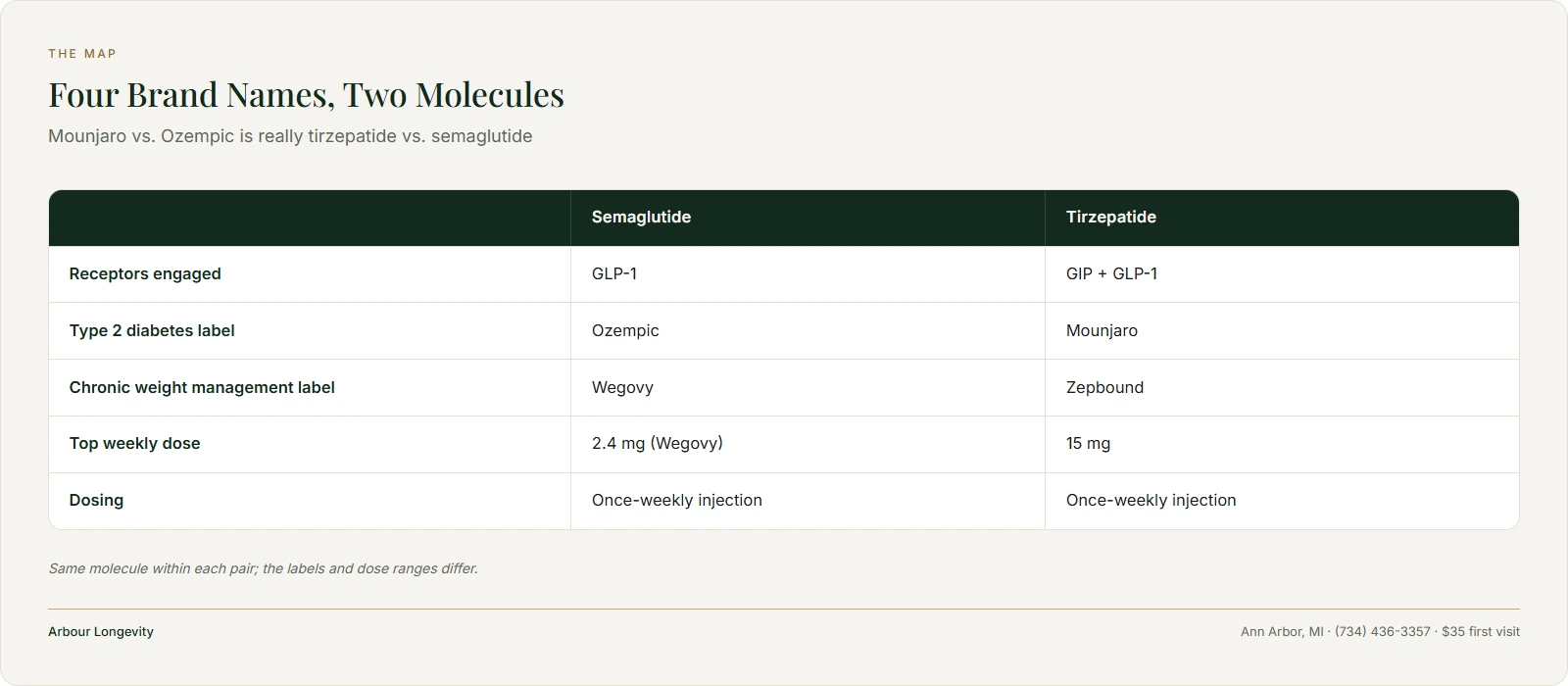
Tirzepatide is sold as Mounjaro and as Zepbound. Same molecule, two brands. Mounjaro carries the type 2 diabetes label. Zepbound carries the chronic weight management label. The dose ladder runs to 15 mg weekly on both.
So "Mounjaro vs Ozempic" really means tirzepatide vs semaglutide. It is the same comparison as "Zepbound vs Wegovy" too. Wegovy and Zepbound are the weight-labelled brands, studied at weight-specific doses. If one friend lost weight on Wegovy and another on Ozempic, they took the same drug at different doses under different labels. Our overview of GLP-1 therapy in Ann Arbor covers the class as a whole. We also have separate pages on semaglutide and tirzepatide.
Both drugs were studied alongside a reduced-calorie diet and more physical activity. That is how they are meant to be used.
How does each one work?
Semaglutide: one receptor, deeply studied.
GLP-1 (glucagon-like peptide-1) is a hormone your small intestine releases when you eat. It prompts insulin release when blood sugar is high. It slows stomach emptying, so food stays with you longer. And it signals fullness in the brain. Semaglutide is a long-acting copy of it. One weekly shot keeps a steady level in the blood. Patients often say the constant background chatter about food goes quiet. Portions shrink without willpower doing the work.
Tirzepatide: two receptors, a different lever.
Tirzepatide activates the GLP-1 receptor too. It also activates the receptor for GIP (glucose-dependent insulinotropic polypeptide), a second gut hormone. GIP has its own effects on insulin release and on how fat tissue handles nutrients. Adding that second signal seems to change how much the drug can do, not just repeat the first. That is why a head-to-head trial was worth running.
Why two receptors beat one is not fully settled. In a randomized trial (people assigned to each drug by chance) in type 2 diabetes, tirzepatide cut body weight and fat mass more than semaglutide. Yet appetite scores and measured energy intake did not differ (Heise et al., Diabetes Care, 2023, DOI).
What did the head-to-head trial, SURMOUNT-5, find?
Most comparisons set results from separate trials side by side. That is not a real comparison. SURMOUNT-5 is, and it is the trial people are actually asking about.
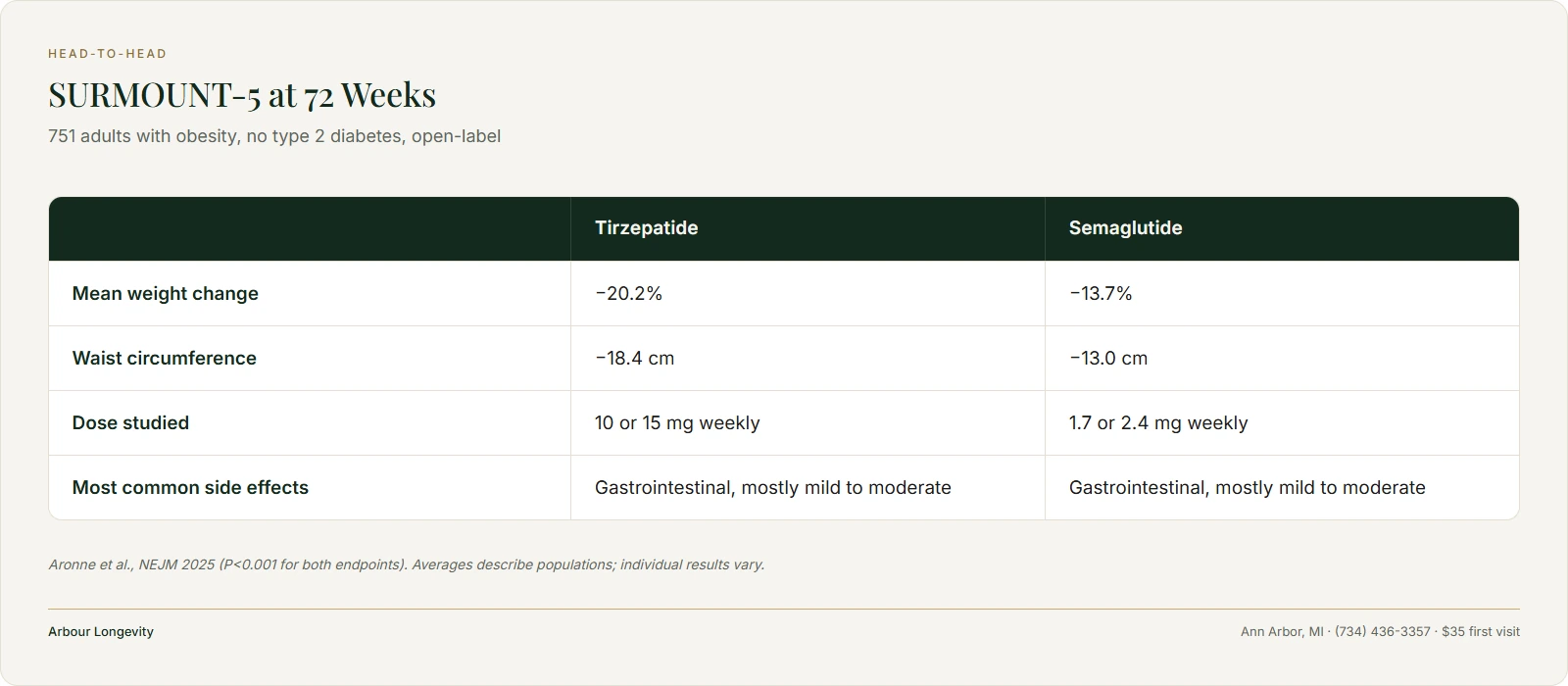
SURMOUNT-5 was a phase 3b, open-label, controlled trial. It enrolled 751 adults with obesity but without type 2 diabetes. Each was assigned by chance to the highest dose they could tolerate of tirzepatide (10 or 15 mg) or of semaglutide (1.7 or 2.4 mg). Both were given once weekly for 72 weeks.
At week 72, the average (least-squares mean) weight change was −20.2% with tirzepatide and −13.7% with semaglutide. The 95% CIs were −21.4 to −19.1 and −14.9 to −12.6 (P<0.001). Waist size fell 18.4 cm with tirzepatide and 13.0 cm with semaglutide (P<0.001). People on tirzepatide were more likely to lose at least 10%, 15%, 20% and 25%. The most common side effects in both groups were gastrointestinal (gut-related). Most were mild to moderate and came mainly during dose increases (Aronne et al., N Engl J Med, 2025, DOI).
Read that in both directions. Tirzepatide won the primary endpoint, clearly. And semaglutide delivered a 13.7% average loss and a 13 cm waist change. No lifestyle programme reliably produces that. This is not a good drug versus a bad drug. It is two very good drugs with different average results.
Two caveats belong in the same breath. The trial was open-label, so people knew which drug they were on. And "maximum tolerated dose" means some semaglutide patients finished on 1.7 mg rather than 2.4 mg. Neither point erases a 6.5-percentage-point gap. Both belong on the table.
Quality of life improved with both. In a prespecified SURMOUNT-5 analysis, SF-36v2 physical component scores rose from baseline in both arms (p < 0.001). The General Health domain improved more on tirzepatide (5.45 vs 4.20; p = 0.003). Those who lost the most weight gained the most in physical function and bodily pain. That held whichever drug they took (Shukla et al., Diabetes Obes Metab, 2025, DOI).
How do they compare on blood sugar?
Before the obesity head-to-head there was SURPASS-2. This was an open-label, 40-week phase 3 trial in 1,879 adults with type 2 diabetes. People were assigned to tirzepatide 5, 10 or 15 mg, or to semaglutide 1 mg. HbA1c (your average blood sugar over the past three months) fell 2.01, 2.24 and 2.30 percentage points on the three tirzepatide doses. It fell 1.86 points on semaglutide. Tirzepatide was non-inferior and superior at every dose. Weight loss was also greater with tirzepatide, by 1.9, 3.6 and 5.5 kg. Gut side effects were the most common on both:
- Nausea: 17–22% on tirzepatide versus 18% on semaglutide.
- Diarrhoea: 13–16% versus 12%.
- Vomiting: 6–10% versus 8% (Frías et al., N Engl J Med, 2021, DOI).
Two things stand out. The blood-sugar gap is real but narrow. And the side-effect profiles in that trial nearly overlapped.
What did each achieve against placebo?
A placebo is an inactive look-alike treatment. Placebo trials show what each drug does on its own.
Semaglutide, STEP 1. 1,961 adults with overweight or obesity and without diabetes took part. Entry required a BMI of 30 or more, or 27 or more with a weight-related condition. They were assigned 2:1 to semaglutide 2.4 mg or placebo for 68 weeks. Average weight change was −14.9% versus −2.4%, or −15.3 kg versus −2.6 kg. At least 5% loss was reached by 86.4%, 10% by 69.1% and 15% by 50.5%. Cardiometabolic risk factors (heart and metabolic health markers) and self-reported physical function improved (Wilding et al., N Engl J Med, 2021, DOI).
Tirzepatide, SURMOUNT-1. 2,539 adults without diabetes, with the same broad entry criteria, took part. They were assigned to tirzepatide 5, 10 or 15 mg, or placebo, for 72 weeks. Average weight change was −15.0%, −19.5% and −20.9% versus −3.1%. At least 5% loss was reached by 85% to 91%. Half of the 10 mg group lost at least 20%, and so did 57% of the 15 mg group. Only 3% on placebo did (Jastreboff et al., N Engl J Med, 2022, DOI).
Three years out. Longer follow-up exists for tirzepatide. The three-year SURMOUNT-1 analysis followed people with obesity and prediabetes. Average weight change at week 176 was −12.3%, −18.7% and −19.7% versus −1.3% with placebo. Only 1.3% were diagnosed with type 2 diabetes, versus 13.3% on placebo (hazard ratio 0.07). No new safety signals were found (Jastreboff et al., N Engl J Med, 2024, DOI).
With diabetes in the picture. SURMOUNT-2 tested tirzepatide 10 and 15 mg against placebo in 938 adults over 72 weeks. Weight change was −12.8% and −14.7% versus −3.2% (Garvey et al., Lancet, 2023, DOI). Weight loss runs lower alongside diabetes on either molecule. That is normal and worth expecting.
How fast does it work, and how is the dose raised?
Both drugs start low and climb. The dose is raised in monthly steps over roughly 16 to 20 weeks. This is called titration (adjusting the dose step by step). It is not a delay to be endured. It is how the drug becomes tolerable, and it is the main tool for limiting side effects.
The trials show the schedule. In STEP 1, semaglutide was stepped up over 16 weeks to the 2.4 mg weekly maintenance dose. In STEP 4, 89.0% of people reached that dose (Rubino et al., JAMA, 2021, DOI). In SURMOUNT-1, tirzepatide was stepped up over 20 weeks, to a maintenance dose of 5, 10 or 15 mg (Jastreboff et al., 2022, DOI). Judging either drug at week eight is judging the titration, not the treatment. The pace should follow your tolerance, not a calendar.
Appetite change is often noticed within the first few weeks. But the headline percentages above are 15- to 18-month figures, not 12-week figures.
Speed varies a lot. A post hoc SURMOUNT-5 analysis labelled people who lost at least 15% by week 24 as rapid responders. That was 32.3% overall: 44% on tirzepatide and 21% on semaglutide. Rapid responders reached higher week-72 thresholds. They reported somewhat more gut and hepatobiliary (liver and gallbladder) side effects. But they completed treatment at similar rates to everyone else (Aronne et al., Am J Med, 2026, DOI). Being a slower responder is common. It is not a sign of failure.
Not sure which one fits you?
Your first visit at Arbour Longevity in Ann Arbor is $35 and includes a metabolic workup and a plan that fits your life. It is applied toward your treatment plan.
Book your $35 first visit Call (734) 436-3357
What are the side effects, and how are they managed?
The two molecules have broadly similar side-effect profiles, and the gut dominates. Across SURMOUNT-5, SURPASS-2, STEP 1 and SURMOUNT-1, the most common side effects on both were gut-related:
- Nausea and vomiting.
- Diarrhoea.
- Constipation.
- Acid reflux.
Most were mild to moderate. They clustered during dose increases and eased with time on a stable dose (Aronne et al., 2025, DOI; Frías et al., 2021, DOI).
Drop-out rates give a sense of scale. In STEP 1, 4.5% of the semaglutide group stopped because of gut side effects, versus 0.8% on placebo (Wilding et al., 2021, DOI). In SURMOUNT-1, side effects led 4.3%, 7.1% and 6.2% to stop across the three tirzepatide doses. The placebo figure was 2.6% (Jastreboff et al., 2022, DOI). The great majority finished treatment.
A 2026 review in Nutrients is blunt about why this matters. Gut effects are a major driver of people quitting. Targeted nutrition strategies may play a pivotal role in easing them. Yet most trials relied on general lifestyle advice, so practical guidance is fragmented (Pardali et al., Nutrients, 2026, DOI).
Closing that gap is clinic work. Tolerability is largely a dosing question, not a fixed property of the molecule. The levers we use:
- Hold a dose rather than step up when symptoms are meaningful.
- Adjust portion size, meal timing and eating pace.
- Manage fat and fibre, and protect protein intake.
- Keep up fluids and treat constipation early.
Nobody should white-knuckle through nausea in silence. Anything severe or persistent should be reported the same day. That includes severe belly pain, ongoing vomiting or signs of dehydration. That is a call to the clinic.
Beyond weight: what do the outcome trials show?
Weight and HbA1c are surrogates. What patients want is a longer, healthier life. Here the two molecules have different depths of evidence, and the gap is useful when choosing.
Heart outcomes: semaglutide has the longer record.
Cardiovascular means the heart and blood vessels. In SELECT, 17,604 adults aged 45 or over took semaglutide 2.4 mg or placebo. All had existing heart disease and a BMI of 27 or more, and none had diabetes. Over a mean 39.8 months, a first major heart event occurred in 6.5% versus 8.0% (hazard ratio 0.80; 95% CI 0.72 to 0.90; P<0.001). That composite was cardiovascular death, non-fatal myocardial infarction (heart attack) or non-fatal stroke. Side effects led 16.6% to stop, versus 8.2% on placebo (Lincoff et al., N Engl J Med, 2023, DOI). This is the strongest heart-outcome evidence either drug has in obesity without diabetes.
Earlier, SUSTAIN-6 assigned 3,297 people with type 2 diabetes and high heart risk to semaglutide or placebo over 104 weeks. The same composite occurred in 6.6% versus 8.9% (hazard ratio 0.74). It also found lower rates of new or worsening nephropathy (kidney damage). But it found a higher rate of retinopathy (eye damage) complications on semaglutide. That is one reason eye history is part of our intake (Marso et al., N Engl J Med, 2016, DOI).
Heart outcomes: tirzepatide's trial is newer.
SURPASS-CVOT assigned 13,299 patients with type 2 diabetes and atherosclerotic heart disease to tirzepatide up to 15 mg or to dulaglutide 1.5 mg. Dulaglutide is an active comparator already shown to cut heart events, so this was a demanding benchmark. The primary composite occurred in 12.2% versus 13.1% (hazard ratio 0.92; 95.3% CI 0.83 to 1.01). That met non-inferiority (P = 0.003) but not superiority (P = 0.09) (Nicholls et al., N Engl J Med, 2025, DOI).
Where the evidence is thinner: there is no completed heart-outcome trial of tirzepatide in people with obesity but without diabetes, comparable to SELECT. And no trial has compared heart outcomes between the two molecules directly. We will not guess how such a trial would read.
Sleep apnea: tirzepatide has the only trials.
SURMOUNT-OSA ran two 52-week randomized trials in adults with moderate-to-severe obstructive sleep apnea and obesity. One enrolled people not using positive airway pressure (a breathing machine worn at night), and one enrolled people using it. Average baseline AHI (apnea-hypopnea index, the number of breathing pauses per hour of sleep) was 51.5 and 49.5 events per hour. At week 52, AHI fell 25.3 versus 5.3 events per hour in the first trial, and 29.3 versus 5.5 in the second (both P<0.001). Hypoxic burden, high-sensitivity CRP and systolic blood pressure also improved (Malhotra et al., N Engl J Med, 2024, DOI). We found no equivalent published trial for semaglutide at the weight-management dose, so we are not claiming one.
A network meta-analysis (a study that pools the results of many trials) of 56 obesity drug trials in 60,307 patients maps the same split. Semaglutide and tirzepatide were the two agents that exceeded 10% total body weight loss. Semaglutide reduced major heart events and knee osteoarthritis pain. Tirzepatide achieved remission of obstructive sleep apnea and of metabolic dysfunction-associated steatohepatitis (fatty liver disease with inflammation). Both achieved type 2 diabetes remission and cut heart failure hospital stays. Its closing advice is the one we take most seriously: tailor the choice to the person (McGowan et al., Nat Med, 2025, DOI).
What happens if you stop?
This is the part that matters most and gets discussed least. Both molecules answer it the same way.
Semaglutide. In STEP 4, adults lost a mean 10.6% during a 20-week run-in. They were then assigned to continue or to switch to placebo. Over the next 48 weeks, the continued group lost a further 7.9%. The placebo group regained 6.9% (Rubino et al., JAMA, 2021, DOI). The STEP 1 extension followed 327 people for a year after treatment was withdrawn. Mean loss at week 68 had been 17.3%. By week 120 they had regained 11.6 percentage points of it, leaving a net 5.6% below baseline. That is roughly two-thirds of the loss regained, and heart and metabolic gains drifted back toward baseline. The authors concluded that obesity is chronic. Ongoing treatment is required to keep the gains (Wilding et al., Diabetes Obes Metab, 2022, DOI).
Tirzepatide. In SURMOUNT-4, adults lost a mean 20.9% during a 36-week lead-in. They were then assigned to continue or to switch to placebo. From week 36 to 88, the continued group lost a further 5.5%. The placebo group regained 14.0%. And 89.5% of those continuing kept at least 80% of their lead-in loss, versus 16.6% on placebo (Aronne et al., JAMA, 2024, DOI).
Obesity behaves like a chronic condition. These drugs behave like treatments for one. Neither is a course you finish. Planning for the long arc is not an optional add-on to the injection. It is what makes the injection worth taking. That plan includes:
- Nutrition built around protein.
- Resistance training to protect lean mass.
- Sleep and stress.
We would rather have that conversation at the start than at month 18.
What about cost, supply and access?
Coverage differs by plan, by which brand is on your formulary, and by whether you are treated for diabetes or for weight. So two people on the same molecule can pay very different amounts. Coverage in the United States is inconsistent and changes, so we verify benefits rather than guess. Manufacturer savings programmes exist for both and change from time to time. Supply across this class has swung since demand outran manufacturing. Whether a given dose is in stock in a given week is a real constraint we plan around.
The published health economics is worth knowing, but it is not your pharmacy counter. A US patient-level simulation built on the SURMOUNT-5 population found tirzepatide at maximum tolerated dose both less costly and more effective than semaglutide. It estimated per-patient savings of $41,688 and 0.506 quality-adjusted life years gained (Johansson et al., J Med Econ, 2026, DOI). Several authors work for the maker of tirzepatide, which we flag rather than bury.
A shorter Greek payer analysis found the 72-week drug cost higher for tirzepatide (EUR 5,645.70 versus EUR 3,201.68). Semaglutide was numerically cheaper per responder at lower weight-loss targets, and tirzepatide was favoured at higher ones. But confidence intervals overlapped at every threshold. So there was no statistically significant difference in cost of control (Papantoniou and Maniadakis, Healthcare, 2025, DOI).
The useful framing: the best drug for you is the one you can get reliably every week for a year. A slightly lower average loss you stay on beats a higher one you abandon at month four.
How is the choice actually made at Arbour?
We will not pick one from a web page. Here is what the decision genuinely turns on.
What we are treating. Weight alone, weight with type 2 diabetes, or weight with heart disease are different starting points. The evidence maps onto them differently. Established heart disease without diabetes puts SELECT squarely in the frame (Lincoff et al., 2023, DOI). Moderate-to-severe sleep apnea puts SURMOUNT-OSA in the frame. These are the substance of the decision, not tiebreakers.
Your target and timeline. If the goal needs a large change, SURMOUNT-5 is directly relevant (Aronne et al., 2025, DOI). The head-to-head gap widens at higher weight-loss thresholds. That is one of the few places the choice is truly evidence-driven. If a moderate, steady loss is the goal, either molecule reaches it.
Your gut, your history and your other medicines. All of these shape what is appropriate and how we titrate:
- Reflux, gastroparesis (slow stomach emptying), chronic constipation or poor tolerance of other drugs.
- Gallbladder and pancreatitis history.
- Thyroid and family history, and retinopathy.
- Current diabetes medicines and pregnancy plans.
That is an in-person assessment. It is the part a comparison article cannot do for you.
What you can access and sustain. Coverage, supply, and how a titration schedule fits your life all matter. So does what surrounds the injection: protein, resistance training, sleep and follow-up cadence. Given the withdrawal data, staying on is not a minor point. Our medical weight loss programme is built around that. Our weight loss shots page explains how the injections fit inside it.
Nothing on this page is a diagnosis or a recommendation for any individual.
Frequently asked questions
Is Mounjaro better than Ozempic for weight loss?
In the one large head-to-head trial in adults with obesity and no diabetes, tirzepatide produced more average weight loss than semaglutide at 72 weeks. The figures were −20.2% versus −13.7%, with waist reductions of 18.4 cm versus 13.0 cm (Aronne et al., 2025, DOI). "Better for you" is a different question. It depends on tolerance, your medical history, coverage and supply.
Are Ozempic and Wegovy the same thing? What about Mounjaro and Zepbound?
Ozempic and Wegovy are both semaglutide. Mounjaro and Zepbound are both tirzepatide. Within each pair, one brand carries the type 2 diabetes label and the other the chronic weight management label, and the dose ranges differ. Four brands, two molecules.
Is Zepbound just a stronger version of Wegovy?
No. They are different molecules. Semaglutide acts on the GLP-1 receptor; tirzepatide acts on GLP-1 and GIP. Tirzepatide produced more average weight loss head-to-head, −20.2% versus −13.7% at 72 weeks. But that is a difference between two drugs, not two strengths of one (Aronne et al., 2025, DOI).
Can I switch from Ozempic to Mounjaro, or the other way?
Switching is common, for tolerance, coverage or a plateau. It is decided in person, because the dose ladders are not interchangeable. Switching means a fresh titration, not a straight dose swap. The restart point depends on where you are, how you tolerated the first drug, and why you are switching. Please do not improvise a conversion at home. Call (734) 436-3357 and we will plan it properly.
Which one has fewer side effects?
Neither has a clearly gentler profile. In SURPASS-2 the rates were close: nausea 17–22% on tirzepatide versus 18% on semaglutide, and diarrhoea 13–16% versus 12% (Frías et al., 2021, DOI). How you tolerate a given titration matters more than the molecule. That is why the pace is tailored to you.
How long until I see results?
Appetite change is often noticed within the first few weeks. But the published weight figures are measured at 68 to 72 weeks, and weight was still falling at that point. About a third of SURMOUNT-5 participants reached at least 15% loss by week 24. That means about two-thirds did not, and they still did well by week 72 (Aronne et al., 2026, DOI).
I have sleep apnea. Does that change the answer?
It is one of the clearest places the evidence differs. Two 52-week trials enrolled adults with moderate-to-severe obstructive sleep apnea and obesity. Tirzepatide cut the AHI by 25.3 and 29.3 events per hour, versus 5.3 and 5.5 with placebo (Malhotra et al., 2024, DOI). We found no equivalent published trial for semaglutide at the weight-management dose. Bring your sleep study.
I have heart disease. Does that change the answer?
It can, in the other direction. SELECT enrolled 17,604 patients with existing heart disease and overweight or obesity, but no diabetes. Semaglutide 2.4 mg cut the composite of heart death, non-fatal heart attack and non-fatal stroke from 8.0% to 6.5% (Lincoff et al., 2023, DOI). Tirzepatide's heart trial ran in a different population against a different comparator, and met non-inferiority (Nicholls et al., 2025, DOI).
What happens if I stop?
Weight tends to return. In the withdrawal trials, people switched to placebo regained 6.9% over 48 weeks after semaglutide (Rubino et al., 2021, DOI). After tirzepatide, they regained 14.0% over 52 weeks (Aronne et al., 2024, DOI). Those who continued kept losing. A year after semaglutide was withdrawn, people had regained about two-thirds of their prior loss (Wilding et al., 2022, DOI). We plan for this from the first visit.
Mounjaro, Ozempic, Wegovy and Zepbound consultations in Ann Arbor
We assess in person before recommending a molecule. The trial averages above describe populations, and you are an individual. We offer semaglutide and tirzepatide within a structured medical weight loss programme, alongside our broader GLP-1 care.
Gandhi Bhattarai, FNP-BC, PMHNP-BC, Anti-Aging/Functional Medicine BC, is a triple board certified nurse practitioner. We are at 2217 Packard St #15, in the Eastover Professional Center, Ann Arbor, MI 48104. We are open Thursday through Monday, 10am to 7pm, and closed Tuesday and Wednesday. Parking is free and directly outside: no meters and no parking structure. Suite 15 is down a flight of stairs. If stairs are difficult for you, please call (734) 436-3357 before your visit so we can make arrangements.
Call (734) 436-3357 or book your $35 first visit. The $35 is applied toward your treatment plan. Cash pay, HSA and FSA accepted.
Clinical information on this page is drawn from articles retrieved from PubMed and is provided for education. It is not medical advice, not a diagnosis, and not a promise of any individual result.

Gandhi Bhattarai, FNP-BC, PMHNP-BC, Anti-Aging/Functional Medicine BC
Triple board-certified nurse practitioner and founder of Arbour Longevity in Ann Arbor. Every article is written from clinic practice and reviewed against current guidelines.
✓ Medically reviewed · Last updated August 17, 2026
How we reviewed this article
Arbour Longevity articles are written by the treating clinician, checked against primary sources (peer-reviewed journals, FDA labeling, Endocrine Society and other specialty guidelines) and re-reviewed when guidance changes. See our editorial policy. Spotted an error? Email info@arbourlongevity.com.
This article is educational and is not a substitute for individualized medical advice. Whether a treatment is appropriate for you is determined during consultation.
Your symptoms have a cause. Let’s find it.
Book a $35 first visit in Ann Arbor. It’s a 30–45 minute consultation with Gandhi Bhattarai, applied toward your plan. Serving Ann Arbor, Ypsilanti, Saline, Dexter, Chelsea, and Michigan by telehealth.






.webp)

