
Non-Surgical Blepharoplasty Recovery: Day-by-Day Timeline
Key takeaways
- Expect carbon dots for 5 to 10 days, peak swelling in the first 48 hours, and a result that builds for weeks.
- Numbing cream goes on well before treatment, so most people find the procedure itself tolerable.
- Tightness, warmth, itching as the crusts dry, and uneven swelling between the two sides are all normal.
- Do not pick or scratch the crusts; nearly every eye-area complication we see traces back to that.
- Surgical eyelid recovery runs on a longer clock, with roughly 10 to 14 days of bruising and swelling.

Almost everyone books a non-surgical eye lift on the strength of the before-and-after photos. Then they get to the car and think: wait, what do I actually look like tomorrow? This guide answers that question honestly, day by day. It runs from the hour after treatment to the point where your result settles.
Still deciding between treatments? Read Non-Surgical Blepharoplasty vs Surgery: Which Eye Lift Is Right for You? first for the full head-to-head on results, candidacy, and cost. This article assumes you have already chosen the non-surgical route. It shows you what the healing weeks look like.
Here is the short version of non-surgical blepharoplasty (eyelid lift) recovery:
- Tiny brown carbon dots across the treated skin for roughly 5 to 10 days.
- The most swelling in the first 48 hours.
- No makeup until the crusts have fallen off on their own.
- Daily SPF (sunscreen) for weeks afterward.
The visible part of recovery is short. The part that decides your final result runs longer: not picking, and not baking your face in the sun.
Why recovery looks the way it does
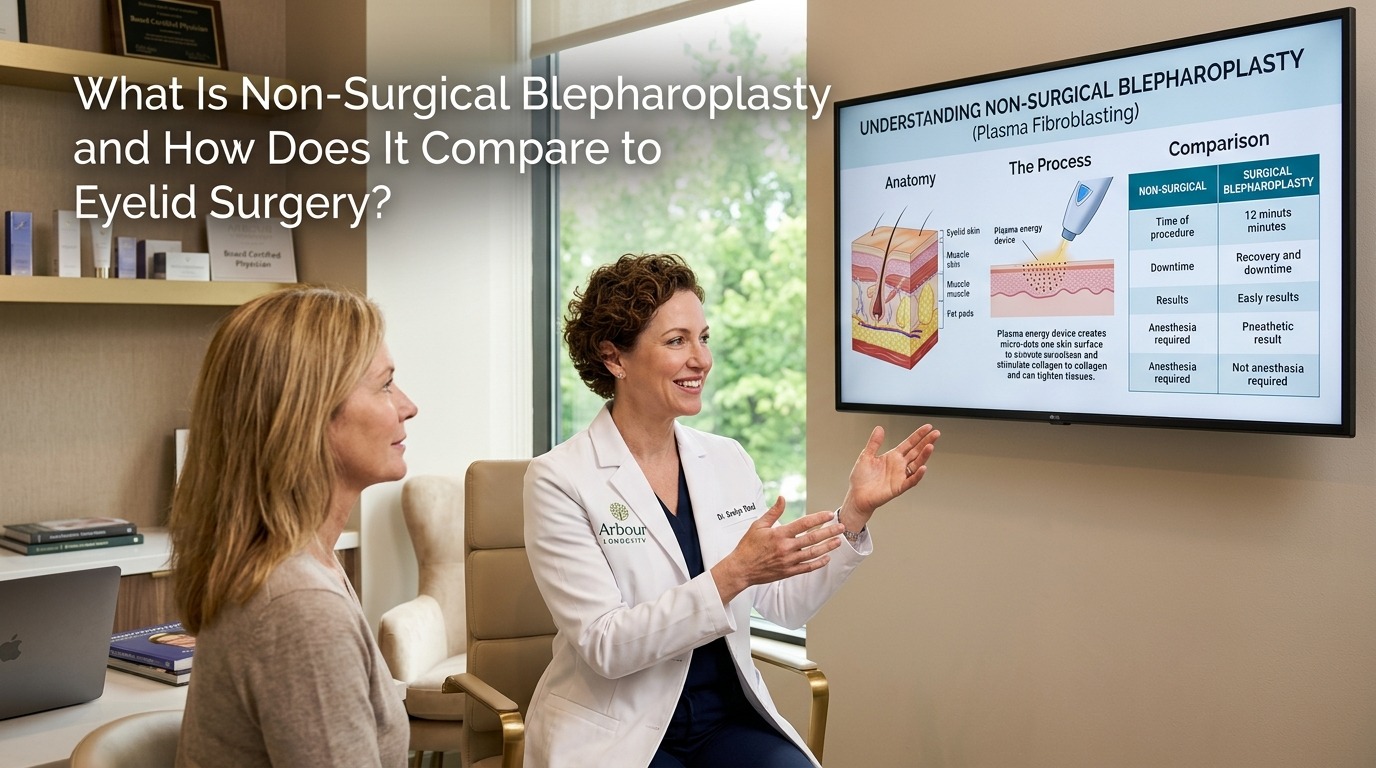
Plexr Blepharoplasty uses the FDA-cleared Plexr Plus plasma device (it works with ionized gas, not a blade). The device creates a grid of tiny, deliberate micro-injuries in the surface layer of the eyelid skin. Each point sublimates (turns to vapor) a microscopic amount of tissue. That is what makes the skin contract right away. Each point then scabs over as a small carbon dot while the skin underneath rebuilds. Plasma eyelid treatment of this kind is one of the established non-surgical options for upper eyelid aging (Theodorelou-Charitou et al., JPRAS, 2021).
So the crusting is not a complication. It is the treatment working, and it is the most predictable part of the timeline. Knowing that changes how the first week feels.
The day-by-day healing timeline
Day 0 - treatment day
Numbing cream goes on well before we start. For most people the treatment itself is tolerable: a warm, prickling feeling. Right afterward the treated skin looks pink with a fine pattern of dark dots. The eyelids feel tight and warm, a bit like mild sunburn. You can drive yourself home. For the rest of the day, keep the area dry, sleep with your head slightly raised, and skip the gym.

Days 1 to 2 - peak swelling
This is the swollen window, and it is usually worst on waking. Upper lids can look puffy enough to feel dramatic on the second morning. Lower lids swell less, but for slightly longer. Cool (not frozen) compresses help; hold them near the area, not pressed on it. The dots darken and dry down. Most people can work from home comfortably. This is not the day for a client meeting.
Days 3 to 5 - crusts set
Swelling drops noticeably. The carbon dots are now dark, dry, and at their most visible. They are also at their itchiest. This is the make-or-break stage: leave them completely alone. Cleanse with lukewarm water and a bland, fragrance-free cleanser, then pat dry. Apply only what we have given you. Keep hands and hot water away.
Days 5 to 10 - flaking off
The dots begin releasing on their own, usually starting at the outer corners. They come off over several days, not all at once. So a patchy stage is normal and temporary. Underneath, the new skin is pink and slightly shiny. By the end of this window most patients are comfortable back in public and back in makeup.
Weeks 2 to 4 - pinkness fades
Leftover pinkness settles gradually. SPF is now the most important thing you do, every single day. Fresh skin is prone to pigment change (patches of darker skin). Mineral sunscreen and sunglasses are your two best tools. Gentle skincare only until we clear you:
- No retinoids (vitamin A creams such as retinol).
- No acids.
- No scrubs.
- No waxing near the treated area.
Weeks 4 to 8 - the result builds
The immediate tightening you saw on day one is only part of the effect. Collagen (the protein that keeps skin firm) keeps remodeling underneath for weeks. That is why the eye area keeps looking a little smoother and firmer well after the skin looks normal. Do not judge your outcome at week two.
Month 3 - assessment
We re-photograph in the same lighting and compare against your baseline. If more tightening would help, this is when a second session is planned. Not sooner, because the skin is still remodeling before then.
Want a timeline built around your own skin, not averages?
Your $35 first visit at Arbour Longevity in Ann Arbor checks whether this treatment suits your skin, and the $35 is applied toward your plan.
Book your $35 first visit Call (734) 436-3357
Aftercare rules that actually change the outcome
- Do not pick, scratch, or exfoliate the crusts. Every complication we see in the eye area traces back to this. Let them release themselves.
- No makeup on the treated skin until the crusts are gone. Once cleared, mascara on the lashes only. A fresh tube is a sensible precaution.
- SPF daily, indefinitely. Freshly healed skin around the eyes is at its most vulnerable to pigment change. Sun exposure is the main reason it happens.
- Sleep elevated for the first two nights. An extra pillow meaningfully reduces morning puffiness.
- Skip heat and sweat for about a week. Saunas, steam rooms, hot yoga, swimming pools, and heavy training all wait until you have healed.
- Pause active skincare. Retinol, glycolic and salicylic acids, vitamin C serums, and exfoliating tools stay in the drawer until we say otherwise.
- Keep it clean and simple. Lukewarm water, a bland cleanser, and the aftercare product we send you home with. Nothing else.
What is normal, and what is worth a phone call
Normal:
- Tightness and warmth.
- Itching as the crusts dry.
- Uneven swelling between the two sides.
- Pinkness for a few weeks.
- A patchy stage while the dots shed at different rates.

Call us at (734) 436-3357 for:
- Swelling that is increasing rather than decreasing after day three.
- Spreading redness with heat.
- Any yellow discharge.
- Fever.
- Pain that is getting worse rather than easing.
- Any change in your vision.
These are uncommon. We would far rather look at it early than late.
Reducing the risk of pigment change
Temporary darkening of the treated skin is the most common cosmetic nuisance after plasma treatment. It is far more likely in people with deeper skin tones or recent sun exposure. Three things stack the odds in your favor:
- An honest pre-treatment assessment of your skin type and history.
- Strict sun avoidance and daily SPF through healing.
- Not treating skin that is currently tanned.
We discuss all three with you before we book, not after.
How this compares with surgical recovery
Surgical eyelid recovery runs on a different clock:
- Bruising and swelling for roughly 10 to 14 days.
- Sutures (stitches).
- Activity restrictions.
- Scar maturation continuing for three to six months.
Plasma recovery is shorter and involves no incisions. But it is more visible day to day during that first week. It also demands stricter aftercare from you, rather than from a surgeon. Neither is truly no-downtime. The full trade-off in results, candidacy, and cost is laid out in our non-surgical blepharoplasty vs surgery comparison.
Planning your downtime
Book so that days 3 to 7 fall on your quietest stretch. Treating on a Thursday or Friday lets the most visible days land over a weekend. Count back at least three weeks from a wedding, a holiday, or a photographed event. Two weeks is cutting it fine, and nobody enjoys doing the arithmetic afterward. Sunglasses are entirely acceptable cover in the first week. Most people find the school run and the grocery store perfectly manageable by day four.
Frequently Asked Questions
How long do the carbon crusts last?
Typically 5 to 10 days, depending on how you heal and how much area was treated. They release on their own, from the edges inward, over several days.
When can I wear makeup again?
Once every crust has come off on its own and the skin is intact, usually around day 7 to 10. Applying makeup earlier risks both irritation and pigment problems.
How much time off work should I take?
Most people take two to four days if their work is in person, or work from home through the first week. There is no medical need to rest. It is purely about how visible you are willing to be.
Why is one eye more swollen than the other?
Mild asymmetry (one side more swollen than the other) is common and evens out within a few days. Persistent or increasing asymmetry after day three is worth a call.
When can I exercise again?
Light walking straight away. Sweating, hot yoga, swimming, and heavy training wait until the crusts are gone, generally about a week.
Can I use ice on my eyelids?
Use cool compresses held near the area rather than ice pressed onto treated skin. Pressure and friction are what you are avoiding.
How soon can I have a second session?
We assess at about three months. The skin is still remodeling before then. Treating too early means paying for tightening you were going to get anyway.
Does the recovery hurt?
Most patients describe tightness and itching rather than pain, comparable to a mild sunburn. They manage without anything stronger than what we recommend at your visit.
Book your consultation
Every recovery is a little different. The right plan starts with an honest look at your eyelid anatomy and skin type. Your first consultation at Arbour Longevity is $35, applied toward your treatment, with Gandhi Bhattarai, FNP-BC, PMHNP-BC, Anti-Aging/Functional Medicine BC. Book your $35 first visit online, or call (734) 436-3357.
Arbour Longevity - 2217 Packard St #15, Ann Arbor, MI 48104 - (734) 436-3357 - Thursday through Monday, 10:00 to 19:00. Closed Tuesday and Wednesday. Serving Ann Arbor, Dexter, Saline, Plymouth, Ypsilanti, Canton, Northville, and Southeast Michigan.
References
- Theodorelou-Charitou SA, Xanthos T, Nikas IP, Ntinioti T. New era in upper eyelid rejuvenation: A brief overview of non-surgical blepharoplasty techniques. J Plast Reconstr Aesthet Surg. 2021;74(7):1633-1701. doi:10.1016/j.bjps.2021.01.008
This article is educational and does not replace individualized medical advice. Reference retrieved via PubMed.

Gandhi Bhattarai, FNP-BC, PMHNP-BC, Anti-Aging/Functional Medicine BC
Triple board-certified nurse practitioner and founder of Arbour Longevity in Ann Arbor. Every article is written from clinic practice and reviewed against current guidelines.
✓ Medically reviewed · Last updated August 21, 2026
How we reviewed this article
Arbour Longevity articles are written by the treating clinician, checked against primary sources (peer-reviewed journals, FDA labeling, Endocrine Society and other specialty guidelines) and re-reviewed when guidance changes. See our editorial policy. Spotted an error? Email info@arbourlongevity.com.
This article is educational and is not a substitute for individualized medical advice. Whether a treatment is appropriate for you is determined during consultation.
Your symptoms have a cause. Let’s find it.
Book a $35 first visit in Ann Arbor. It’s a 30–45 minute consultation with Gandhi Bhattarai, applied toward your plan. Serving Ann Arbor, Ypsilanti, Saline, Dexter, Chelsea, and Michigan by telehealth.




.webp)

