

Switching From Semaglutide to Tirzepatide: How It Works
Key takeaways
- Switching makes sense for four reasons, and a true plateau at your maximum tolerated dose is the clearest.
- Most published switching data runs one way, from a GLP-1 medication to tirzepatide.
- Your dose does not carry across. There is no milligram-for-milligram conversion between the two.
- Expect the first eight weeks to be a dose-building period, not a continuation of where you were.
- Protein at every meal matters most during the switch, because muscle is most at risk then.

You have been on semaglutide for months. The first 20 pounds came off. Then the scale stopped moving, the nausea never settled, or your coverage changed. Now you are asking the question we hear every week in clinic. Should I switch to tirzepatide, and what actually happens if I do?
Looking for the straight comparison instead? Read Semaglutide vs. Tirzepatide for Weight Loss: A Head-to-Head Comparison for the full head-to-head. It covers how each drug works, average weight loss in the trials, side effects, and what each one costs in Michigan. This article picks up where that one ends: what the switch between the two medications actually involves.
The short version: switching is a normal, planned clinical decision. It is not a restart of your whole program. You do not carry your milligram dose across. Tirzepatide begins at its own starting dose and steps up on its own schedule. Appetite control usually dips for a few weeks before it improves, and the scale often flattens during that window. Knowing that in advance is most of what keeps people from quitting during the handover.
The four reasons people actually switch
- A true plateau at the target dose. A plateau (weight that has stopped changing) is not a slow month. It means three or more months at the maximum dose you can tolerate. In that time, neither your weight nor your body composition (how much of your weight is muscle versus fat) has changed.
- Side effects that never settled. Nausea, reflux, or constipation that stayed disruptive after the dose-building phase should have ended.
- Coverage or access changed. A formulary shift (a change in your insurer's list of covered drugs) can make your current medication the harder one to get. The other one becomes the easier one.
- Your medical picture changed. New or worsening type 2 diabetes can pull the decision one way. So can newly documented cardiovascular disease (disease of the heart and blood vessels).
Notice what is not on that list: someone in your group chat lost more weight on the other one. Different starting points, different doses, different nutrition, different timelines.
What the evidence says about switching
Most published switching data runs in one direction. It moves from a GLP-1 receptor agonist (a drug that mimics a gut hormone to curb appetite; semaglutide is one) to tirzepatide. And it is encouraging.
- A computer model predicted that switching to tirzepatide could lower both HbA1c and body weight further. HbA1c is your average blood sugar over the past three months. The model was built on the SUSTAIN, AWARD and SURPASS trial programs. It looked at patients moving from approved maintenance doses (the dose you stay on long term) of semaglutide or dulaglutide to tirzepatide. That held even at the lowest maintenance dose of 5 mg. Predicted weight loss was 6.5 to 12.1 kg by week 66. That range spans the 5, 10 and 15 mg doses (Urva et al., Current Medical Research and Opinion, 2024).
- A small clinical series of 15 patients with type 2 diabetes points the same way. They switched from semaglutide 1.0 mg because of inadequate weight loss. Those moved up to tirzepatide 10 mg had a significant HbA1c reduction (-0.7%) and a trend toward weight loss (-6.6 kg) over three months. The group held at 7.5 mg showed no significant change. In other words, under-dosing after a switch is a real way to waste the switch (Kurinami et al., Endocrinology and Metabolism, 2025). This was a retrospective series (a look back at existing patient records, not a planned trial).
- Background context comes from the head-to-head SURMOUNT-5 trial. There, tirzepatide produced greater average weight loss than semaglutide (Aronne LJ, et al. NEJM 2025).
Two honest limits. The switching studies above are a simulation and a small retrospective series. They are not large randomized switching trials (studies where people are assigned by chance to one drug or the other). They point a direction; they do not promise a number. There is also far less published data on moving from tirzepatide back to semaglutide. That decision leans more on clinical judgment and on your heart history.
You do not carry your dose across
This is the single most misunderstood part of switching. There is no milligram-for-milligram conversion between semaglutide and tirzepatide. They are different molecules that act on different receptor combinations, and their dose ladders are unrelated. Tirzepatide starts at its own starting dose and steps up on its own schedule. It does not matter how high you had climbed on semaglutide.
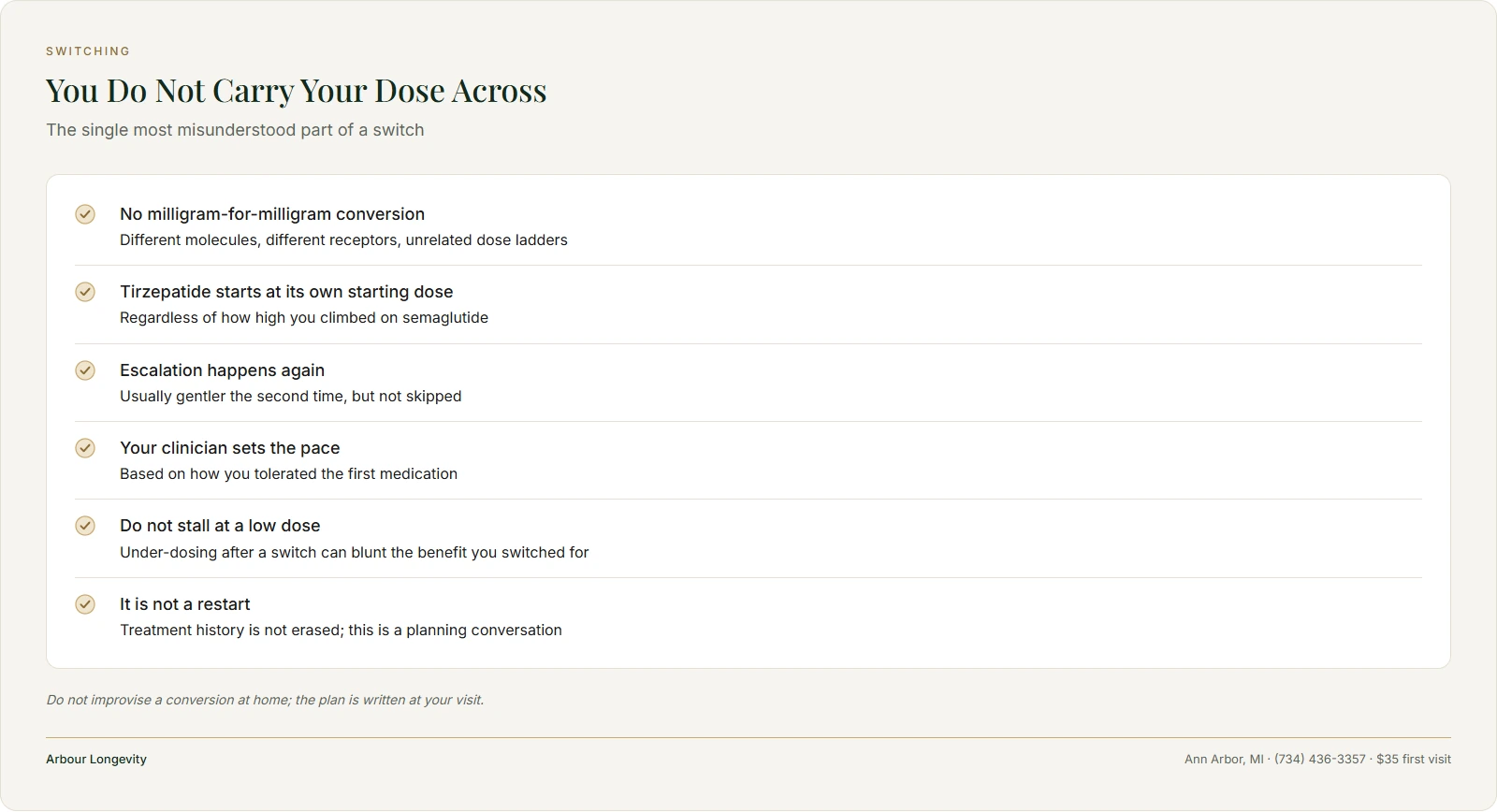
What that means in practice: the dose-building phase happens again. Clinicians call this titration (adjusting the dose step by step). It is usually gentler the second time, because your gut has already adapted to incretin-based therapy (medications that mimic gut hormones). But it is not skipped. Your clinician decides how fast to climb based on how you tolerated the first medication. And, as the series above suggests, stalling too long at a low maintenance dose can blunt the benefit you switched for.
Want to know what this would mean for you?
Your first visit at Arbour Longevity in Ann Arbor is $35 and includes a metabolic workup and a plan that fits your life. It is applied toward your treatment plan.
Book your $35 first visit Call (734) 436-3357
The first eight weeks after a switch
Week 1. You take your last dose of the old medication. Then you start the new one on the day your next weekly dose would have been due. Appetite suppression from the old medication tapers off over roughly the same week the new one is starting low. So hunger often comes back noticeably. This is the week people panic. It is expected.
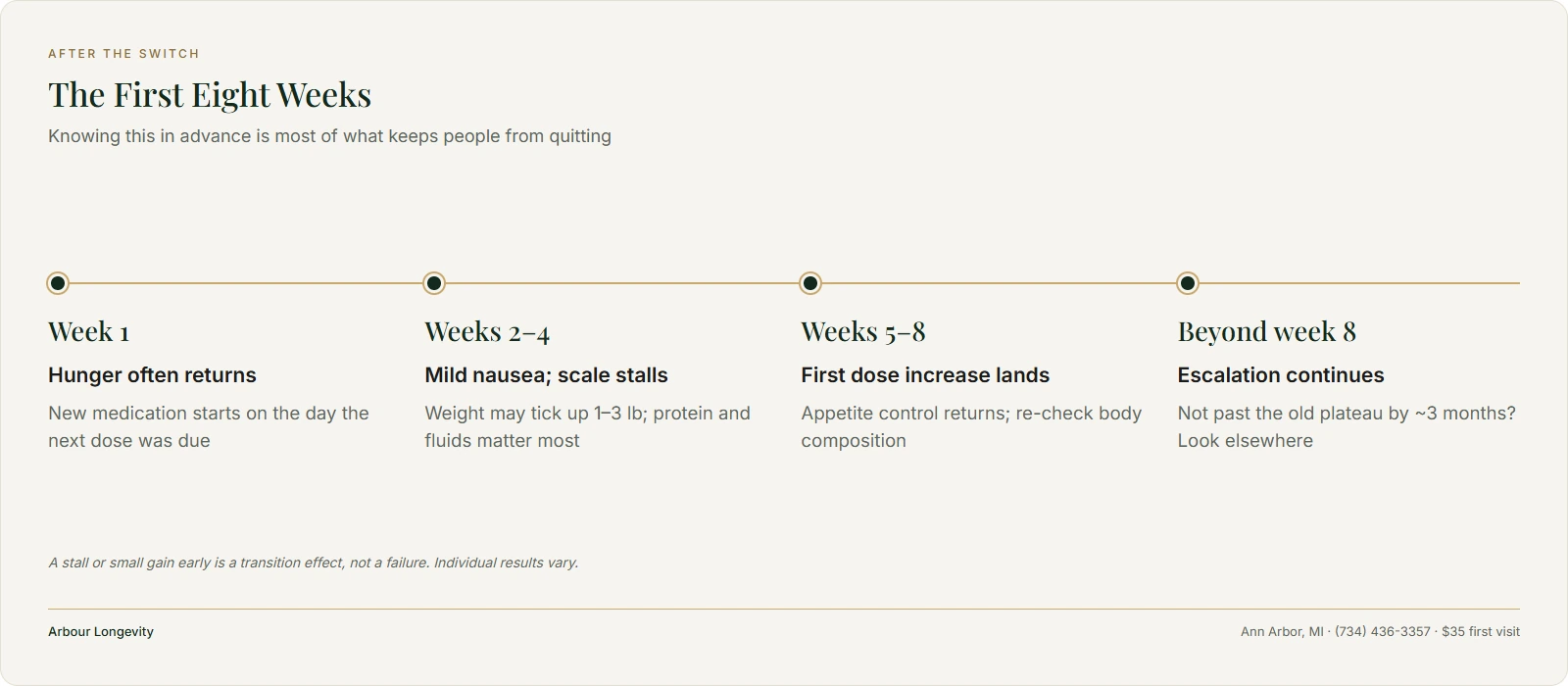
Weeks 2 to 4. Mild nausea, early fullness, or constipation can reappear as the new medication takes hold. Weight commonly stalls or ticks up one to three pounds. Protein and fluid intake matter more here than at any other point.
Weeks 5 to 8. The first dose increase lands. Appetite control typically returns to at least where it was, and for most people it exceeds it. This is where we re-check body composition rather than just weight. The number on the scale lags what is actually happening.
Beyond week 8. Dose increases continue until you reach your effective dose. Have you passed your previous plateau by roughly three months at a comparable dose? If not, the switch is not the answer, and we look elsewhere.
- Thyroid (the gland that sets your metabolic speed).
- Cortisol (your main stress hormone).
- Sleep.
- Alcohol.
- Protein intake.
- Resistance training.
- Medications that work against you.
Switching the other direction: tirzepatide to semaglutide
It happens less often, but there are good reasons for it. Established cardiovascular disease is the strongest one. Semaglutide has dedicated heart-outcomes evidence in people with overweight or obesity and existing heart disease (Lincoff AM, et al. SELECT. NEJM 2023). Coverage is the second most common reason. Persistent side effects that did not improve at a lower tirzepatide dose are the third. The same rule applies in reverse. You restart on the semaglutide ladder rather than matching your previous dose, and you plan for a few unglamorous weeks.
Managing the transition well
- Protein first, every meal. The transition window is when muscle is most at risk, because intake often drops while activity stays the same.
- Keep resistance training going. Two or three sessions a week protects lean mass through the dip.
- Smaller, lower-fat meals during the climb. Fat and volume are the two biggest drivers of nausea on incretin therapy.
- Get ahead of constipation. Fluids, fiber, and magnesium before it becomes a problem, not after.
- Weigh weekly, not daily. Daily weights during a switch tell you almost nothing useful and cost you a lot of morale.
- Do not skip the check-in. Most failed switches we see were failed titrations. Someone stayed at a starting dose for months because no one adjusted it.
When a switch is not the answer
Before we change medications, we rule out the things that look like a plateau but are not.
- You have not actually reached your target dose yet.
- Protein intake has quietly dropped below what preserves muscle.
- Sleep or alcohol has changed.
- Thyroid or iron status has drifted.
- The weight is stable, but body composition is still improving. That is a win being read as a failure.
Changing medications does not fix any of those. It also costs you two months of dose-building to find out.
How we handle a switch at Arbour Longevity
A switch at our clinic follows the same steps every time.
- An honest intake conversation.
- Current labs and body composition before we change anything.
- A written titration plan with a defined check-in schedule.
- Coaching through the transition weeks, so the dip does not become a discontinuation.
Our medical weight loss program is $299 per month. Here is what it includes.
- The medication.
- Careful dose titration.
- Four coaching sessions a month.
- Ongoing labs and monitoring.
If a switch is not what you need, we will tell you that instead of selling you one.
Frequently Asked Questions
Do I have to start over at the lowest dose when I switch?
You start on the new medication's own ladder rather than matching your previous dose. There is no equivalent-dose conversion between the two. The climb is usually easier the second time, since your body has already adapted to this class of medication. Your clinician sets the pace based on how you tolerated the first one.
How long should I wait between my last old dose and my first new dose?
In most cases the new medication simply starts on the day the next weekly dose would have been due. There is no washout period in between. Your clinician confirms the timing based on your dose, your tolerance, and any other medications you take.
Will I gain weight during the switch?
A stall or a small gain in the first two to four weeks is common. The old medication is clearing while the new one is still at a starting dose. It is a transition effect, not a failure. Protein, fluids, resistance training, and a prompt first dose increase carry you through it.
Can I switch if the reason is side effects rather than a plateau?
Yes, and it is one of the better reasons to switch. Tolerance to these medications is individual. People who struggled on one sometimes do noticeably better on the other. We usually try adjusting the dose, the climb speed, and meal composition first. Those steps solve a large share of side-effect problems without changing medications at all.
Does switching mean my first medication failed?
No. Weight regulation is a chronic condition managed over years. Needing a different tool at some point is ordinary. Many patients switch once and stay on the second medication long term.
Which one will my insurance cover after a switch?
Coverage varies by plan and changes often, and a switch usually needs a fresh authorization. We handle the paperwork and give you the self-pay number up front, so there are no surprises. Cost details for both medications are in our full semaglutide vs. tirzepatide comparison.
Thinking about a switch? You can book your $35 first visit at Arbour Longevity, 2217 Packard St #15, Ann Arbor, MI 48104, or call (734) 436-3357. We are open Thursday through Monday, 10am to 7pm, and closed Tuesday and Wednesday.
References
- Urva S, Levine JA, Schneck K, Tang CC. Model-based simulation of glycaemic effect and body weight loss when switching from semaglutide or dulaglutide to once weekly tirzepatide. Curr Med Res Opin. 2024;40(4):567-574. doi:10.1080/03007995.2024.2322072
- Kurinami N, et al. Early Dose Escalation of Tirzepatide after Switching from Semaglutide in Type 2 Diabetes Mellitus. Endocrinol Metab (Seoul). 2025;40(6):1012-1015. doi:10.3803/EnM.2025.2420
- Aronne LJ, et al. Tirzepatide as Compared with Semaglutide for the Treatment of Obesity (SURMOUNT-5). NEJM 2025.
- Lincoff AM, et al. Semaglutide and Cardiovascular Outcomes in Obesity without Diabetes (SELECT). NEJM 2023;389:2221-2232.
This article is educational and does not replace individualized medical advice. Article references retrieved via PubMed.

Gandhi Bhattarai, FNP-BC, PMHNP-BC, Anti-Aging/Functional Medicine BC
Triple board-certified nurse practitioner and founder of Arbour Longevity in Ann Arbor. Every article is written from clinic practice and reviewed against current guidelines.
✓ Medically reviewed · Last updated June 8, 2026
How we reviewed this article
Arbour Longevity articles are written by the treating clinician, checked against primary sources (peer-reviewed journals, FDA labeling, Endocrine Society and other specialty guidelines) and re-reviewed when guidance changes. See our editorial policy. Spotted an error? Email info@arbourlongevity.com.
This article is educational and is not a substitute for individualized medical advice. Whether a treatment is appropriate for you is determined during consultation.
Your symptoms have a cause. Let’s find it.
Book a $35 first visit in Ann Arbor. It’s a 30–45 minute consultation with Gandhi Bhattarai, applied toward your plan. Serving Ann Arbor, Ypsilanti, Saline, Dexter, Chelsea, and Michigan by telehealth.






.webp)

