
Key takeaways
- SHBG is a protein that holds onto your testosterone and estrogen and keeps them from working until they're released.
- Two people with the exact same total testosterone can feel completely different depending on their SHBG.
- A total testosterone test without an SHBG test is only half the picture.
- Low SHBG is an early warning sign of insulin resistance (when your body stops responding well to insulin) and metabolic problems.
- High SHBG, often from age, birth control pills, or an overactive thyroid, can leave you with low "usable" hormone even when totals look fine.

If you're a man or woman in your 40s or 50s and your testosterone or estrogen came back "normal," but you still feel tired, foggy, or flat, there's a blood test you were probably never told about. It's called SHBG. It often explains the gap between what your labs say and how you actually feel.
SHBG stands for sex hormone binding globulin. In plain terms, it's a protein your liver makes that grabs onto your sex hormones (mainly testosterone and estrogen) and holds them in the bloodstream. While a hormone is held by SHBG, your body can't use it. Only the "free" hormone, the part that isn't held, actually does anything. So SHBG decides how much of your hormone is available to you, no matter what the total number says.
What is SHBG, and why does it matter?
Think of your hormones as money. Your total testosterone is the cash in your account, but SHBG is money that's locked away. You can see it on the statement, but you can't spend it. Only the "free" hormone is money you can actually use today.
Here's how locked-up it really is. In men, about 65% of testosterone is held tightly by SHBG. About 33% is held loosely by another protein (albumin) and can still be used. Only 1–2% is truly free. In women, even less is free. That's why your SHBG level can completely change how a "normal" hormone result feels in real life.
This is the whole point: someone who only checks total testosterone is reading one number and assuming the other half of the equation doesn't exist. It does. If you've been told your labs are fine but you don't feel fine, this is often where the answer hides. It's a theme we cover in why your labs look normal but you feel terrible.
What's a normal SHBG level, and what's optimal?
Lab "normal" ranges are wide, roughly 10–57 for men and 19–144 for premenopausal women (measured in nmol/L, the standard unit). But those ranges lump healthy and unhealthy people together, so "in range" doesn't always mean "ideal."
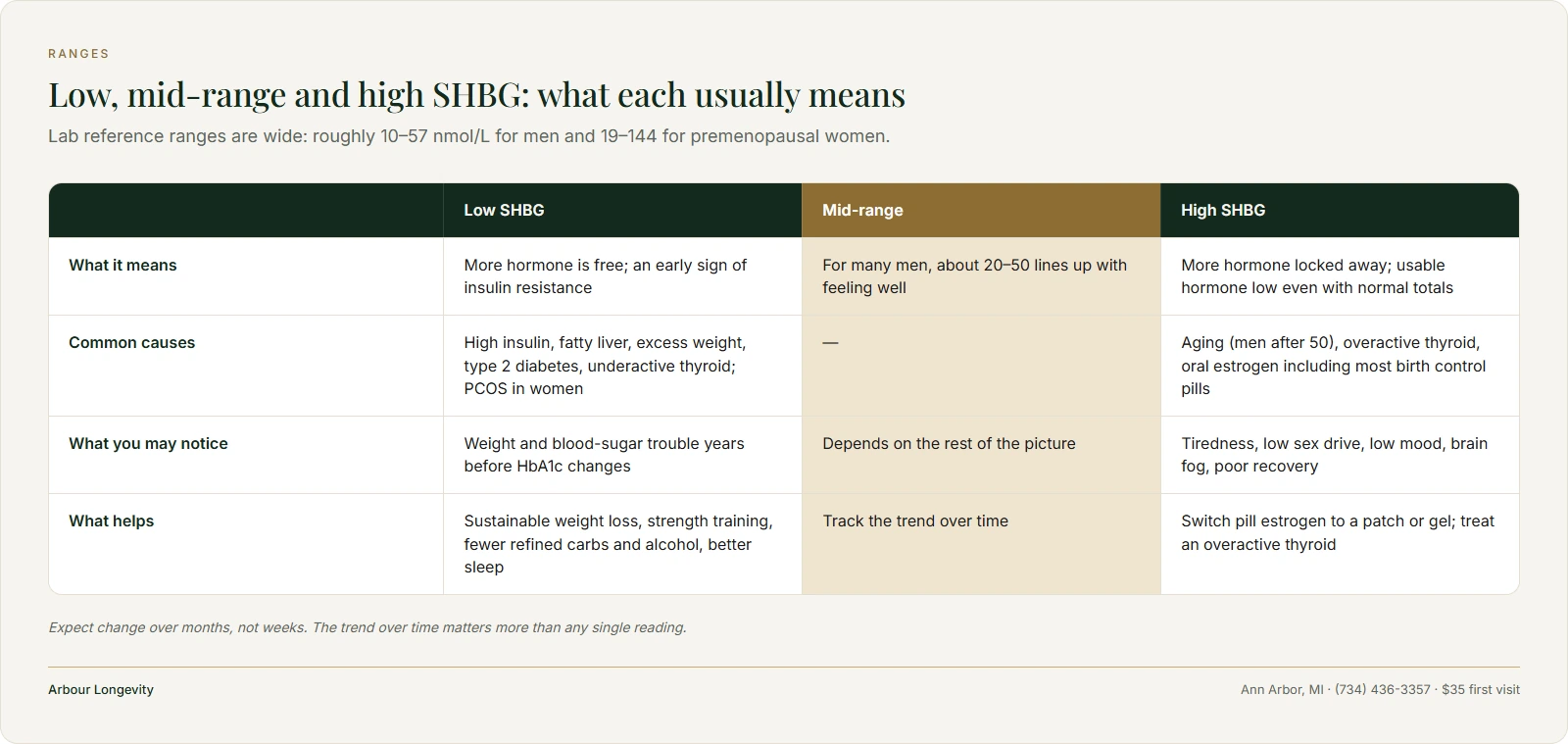
In practice, for many men a level somewhere in the middle (about 20–50) tends to line up with feeling well, depending on the rest of the picture. In women it's more variable, because periods, birth control, menopause, and thyroid all push it around. The most useful thing isn't a single reading. It's the trend over time, and how SHBG lines up with your other labs.
SHBG is most powerful when read alongside other tests, not alone. Paired with total testosterone, it tells us your free (usable) hormone. Paired with a fasting insulin test, it hints at your metabolic health. It's one of several markers we walk through in the 5 blood tests your doctor isn't ordering.
What does low SHBG mean?
Low SHBG is one of the earliest and clearest signs of insulin resistance, a state where your body has to pump out extra insulin to keep blood sugar normal. High insulin and a fatty liver both tell the liver to make less SHBG, so the level drops.
This matters because low SHBG often shows up years before standard sugar tests (like HbA1c, a 3-month blood sugar average) go abnormal. In large studies, low SHBG predicts future type 2 diabetes, heart disease, and fatty liver.
It can also be misleading. A man with a low total testosterone but very low SHBG might still have an okay free level. That means the real problem is metabolic. The fix starts with addressing insulin resistance, not jumping straight to testosterone. In women, low SHBG raises usable testosterone and is a classic finding in PCOS (polycystic ovary syndrome). PCOS is a common hormone condition that can cause irregular periods, acne, and unwanted hair growth. Other causes of low SHBG include extra weight, type 2 diabetes, fatty liver, an underactive thyroid, and some medications.
What I see in clinic: a low SHBG on a new patient's labs is one of the first things that makes me slow down. I look at the whole metabolic picture (weight, sleep, alcohol, activity) rather than just the hormones. The good news is that SHBG often climbs back up as insulin resistance improves with weight loss, strength training, better sleep, and, when appropriate, medication.
Want to know your own SHBG?
A $35 first visit includes SHBG with free and total testosterone, so your panel can finally be read properly.
Book your $35 first visit Call (734) 436-3357
What does high SHBG mean?
High SHBG is the opposite trap. More of your hormone is locked away, so even a normal-looking total leaves you with too little usable hormone. People often feel the classic low-hormone symptoms (tiredness, low sex drive, low mood, brain fog, poor recovery) while their totals look perfectly fine on paper.
The most common causes are aging (SHBG tends to creep up in men after 50) and an overactive or over-treated thyroid. The one most people miss is estrogen taken by mouth, including most birth control pills. When estrogen is swallowed, it passes through the liver first and tells it to make a lot more SHBG. Levels can double, triple, or more.
This explains a very common story we see: a younger or middle-aged woman with low energy, low libido, and low mood whose standard labs are "normal." Her total testosterone may even look high. But her free, usable testosterone is at rock bottom, because the birth control pill drove her SHBG way up. Switching away from oral estrogen often helps over time, though SHBG can stay high for months after stopping. (Low libido is rarely one single thing; more on that in low libido in women.)
Why does SHBG matter so much for testosterone therapy?
Because total testosterone is a poor guide to what your body actually feels, and SHBG is usually the reason for the mismatch. A man with high SHBG can have a healthy-looking total and still feel awful, because his free level stays low. He often needs a different dosing approach. A man with low SHBG from insulin resistance may not need testosterone at all; fixing the metabolic problem can bring his own levels back up.
The same logic applies to women. It's closely tied to the balance between hormones rather than any single value, something we dig into in why the estradiol-to-testosterone ratio matters. The bottom line: SHBG isn't optional. It often decides whether hormone therapy works, fails, or causes surprises.
How does SHBG change with age?
In men, SHBG slowly rises after 40 and more steeply after 60. That's a big reason free testosterone drops faster than total testosterone as men age. Many older men have an "okay" total but a clearly low free level. If that sounds like your energy story, fatigue after 40 covers the fuller picture.
In women, SHBG moves around more across life. It goes up in pregnancy, on the pill, and with an overactive thyroid. It goes down with PCOS, extra weight, and rising insulin resistance. A meaningful change over time, without an obvious reason, is worth investigating.
How do we use SHBG at Arbour Longevity?
Every hormone workup at our Ann Arbor clinic includes SHBG along with total testosterone, estrogen, free hormone calculations, thyroid, and metabolic markers. We use it three ways:
- To calculate your free (usable) hormone.
- To flag early metabolic risk when it's low.
- To plan treatment, because high, normal, and low SHBG each call for a different approach.
Most importantly, we track it over time, because the trend tells us more than any single snapshot.
What can you do to improve your SHBG?
A lot of SHBG is genetic, but a meaningful part is in your control. To raise a low SHBG (the usual goal with insulin resistance, fatty liver, or PCOS), the highest-impact steps are:
- Losing excess weight in a sustainable way.
- Strength training.
- Cutting back on refined carbs and alcohol.
- Improving sleep.
- Treating a fatty liver or underactive thyroid.
To lower a very high SHBG, options are narrower. They include switching from pill-form estrogen to a patch or gel, easing up on extreme endurance training, and treating an overactive thyroid. Either way, expect change over months, not weeks.
Frequently Asked Questions
Why didn't my regular doctor order an SHBG test?
Most primary care visits check only total testosterone or total estrogen, mostly due to time and insurance billing habits. SHBG is needed to make sense of those numbers, and it's one of the first tests we add in a longevity workup.
Is high SHBG dangerous?
Not by itself. High SHBG matters because it lowers your usable hormone and can cause low-hormone symptoms even when your totals look normal. The cause behind it, like oral estrogen or an overactive thyroid, may need attention.
Is low SHBG dangerous?
Low SHBG is mainly a warning sign. It's linked to insulin resistance, fatty liver, type 2 diabetes, and heart disease. The risk comes from those conditions, but a low SHBG is often the earliest hint that they're developing.
Can my SHBG go back to normal?
Often, yes. SHBG responds to weight, body composition, liver health, thyroid function, alcohol, and sleep. Many people see it move in the right direction within three to twelve months of fixing the underlying cause.
Will birth control pills affect my SHBG forever?
No, but the effect can linger. The pill raises SHBG a lot, and it can stay elevated for several months after stopping. Most people drift back toward baseline within six to twelve months; a few take longer and need a closer look.
Does testosterone therapy change SHBG?
Yes. Testosterone therapy usually lowers SHBG, more so at higher doses and with pill forms. That's a key reason we track free hormone, total hormone, and SHBG together rather than relying on the total alone.
How often should I retest SHBG?
For most people on stable hormone therapy, every six to twelve months with the rest of the panel. If you're actively treating insulin resistance or fine-tuning hormones, sooner.
Can supplements change SHBG?
A little. Vitamin D, magnesium, and omega-3s may have modest effects through better overall metabolic health, and high-dose boron can lower it in some studies. But the biggest, most reliable changes come from body composition, sleep, training, and liver health, not from any single pill.
Take the Next Step
If your hormone labs say "normal" but your symptoms say otherwise, SHBG is one of the first things to check. We'll review your existing labs, find what's missing, and map out the next step. Book your $35 first visit or call (734) 436-3357. Arbour Longevity is at 2217 Packard St #15, Ann Arbor, MI 48104, open Thursday through Monday, 10am to 7pm.
References
- Goldman AL, et al. Role of sex hormone-binding globulin in the free hormone hypothesis and the relevance of free testosterone in androgen physiology. 2024.
- Mayo Clinic Laboratories. Sex Hormone-Binding Globulin, Serum: Test Catalog Overview.
- Le TN, et al. Sex hormone binding globulin and insulin resistance. 2024.
- MedlinePlus. SHBG Blood Test.
This article is educational and does not replace individualized medical advice.

Gandhi Bhattarai, FNP-BC, PMHNP-BC, Anti-Aging/Functional Medicine BC
Triple board-certified nurse practitioner and founder of Arbour Longevity in Ann Arbor. Every article is written from clinic practice and reviewed against current guidelines.
✓ Medically reviewed · Last updated June 8, 2026
How we reviewed this article
Arbour Longevity articles are written by the treating clinician, checked against primary sources (peer-reviewed journals, FDA labeling, Endocrine Society and other specialty guidelines) and re-reviewed when guidance changes. See our editorial policy. Spotted an error? Email info@arbourlongevity.com.
This article is educational and is not a substitute for individualized medical advice. Whether a treatment is appropriate for you is determined during consultation.
Your symptoms have a cause. Let’s find it.
Book a $35 first visit in Ann Arbor. It’s a 30–45 minute consultation with Gandhi Bhattarai, applied toward your plan. Serving Ann Arbor, Ypsilanti, Saline, Dexter, Chelsea, and Michigan by telehealth.





.webp)

