

Testosterone Therapy and Mental Health: Mood & Anxiety
Key takeaways
- Testosterone affects mood, drive and thinking, not just sex drive and muscle.
- Low testosterone is strongly linked to low mood, irritability, anxiety and brain fog.
- The mood benefit of TRT is real but smaller than marketing suggests.
- Symptoms alone are not a diagnosis. A full lab panel is needed before treatment.
- If depression or anxiety is the main problem, it needs its own treatment too.
You wake up flat. The coffee doesn’t touch it. Work that used to feel sharp now feels like wading through wet sand. The patience you had for your kids, your partner and your inbox is gone. You have read the depression checklists. Maybe you have even tried an antidepressant. But something keeps nagging at you: what if this isn’t only in my head?
For a lot of men, it isn’t. Testosterone (the main male sex hormone) drives sex drive, muscle, energy and mood. The link between testosterone therapy and mental health is one of the most overlooked pieces of the puzzle in standard care. Hormones and mood feed each other in a loop. And the symptoms of low testosterone look almost the same as the symptoms of depression. Low energy. Low drive. Irritability. Brain fog. Sound familiar?
Here is what makes this guide different. At Arbour Longevity in Ann Arbor, hormone care is led by Gandhi Bhattarai, FNP-BC, PMHNP-BC. Gandhi is triple board certified in family medicine, psychiatric mental health, and anti-aging and functional medicine. That matters here. The testosterone-mood question sits right where those fields meet. Most providers see only one part of it.
This guide covers four things:
- What testosterone actually does to your brain.
- Which mental symptoms point to a hormone problem rather than, or alongside, a mood disorder.
- What the research really says about TRT (testosterone replacement therapy: prescribed testosterone that brings low levels back to a healthy range) for depression and anxiety.
- How to get properly evaluated.
No hype and no shortcuts. Just the clinical picture as it stands.
How Does Testosterone Actually Affect Your Mood and Brain?
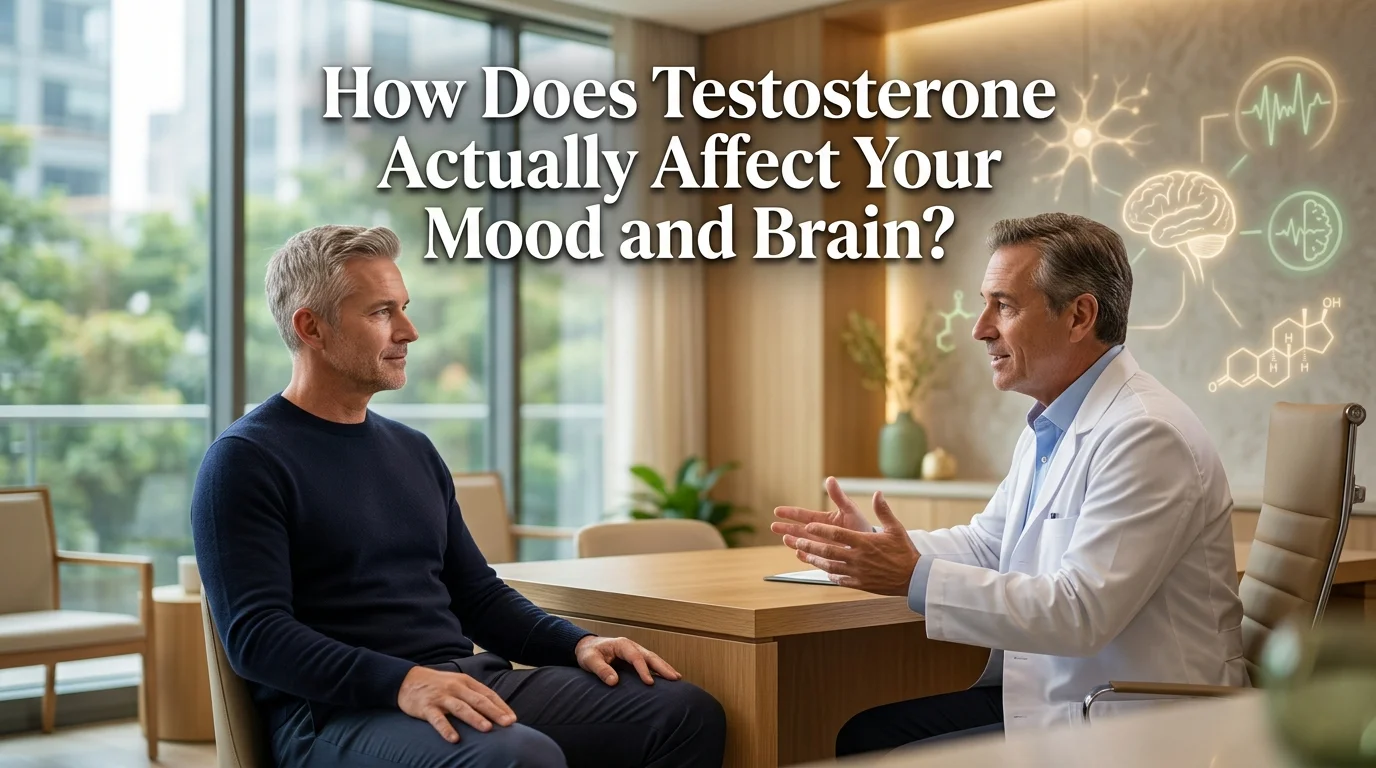
Most people file testosterone under "sex drive and muscle." That is a fraction of what it does. Testosterone is a neuroactive hormone (a hormone that works directly inside the brain). That is where its effect on mood, motivation and mental clarity comes from.
What Does Testosterone Do in the Brain Beyond Sex Drive?
Your brain is dotted with receptors that testosterone plugs into. When levels are healthy, those receptors stay active in the regions that govern emotion, drive and stress. When levels drop, those same regions go quieter. You feel it as anything from a shorter fuse to a flatter outlook.
Which Brain Regions Depend on Testosterone?
Testosterone works largely through the androgen receptor (the docking site that lets a cell respond to testosterone). These receptors are dense in the amygdala and the hippocampus. Those structures handle emotional processing, fear and memory. Testosterone is part of the wider endocrine system (your network of hormone-making glands). It helps keep these circuits running the way they should. When the hormone runs short, the receptor signal weakens. The result can be low mood, blunted motivation and a sense that your emotional baseline has slipped.
How Does Testosterone Affect Dopamine, Serotonin and Motivation?
Here is where it gets practical. Testosterone interacts with the brain’s key mood chemicals. It supports healthy dopamine (the brain chemical behind motivation, reward and that "let’s go" feeling). It also influences serotonin (the brain chemical tied to emotional stability). This is neurotransmission (how brain cells send signals to each other) in action. When testosterone is low, the chemistry that drives motivation and steadiness gets disrupted. That is a big reason men with low T so often describe a loss of drive that willpower cannot fix. It isn’t laziness. It’s chemistry.
Can Low Testosterone Change Your Brain Chemistry and Stress Response?
Yes, and the stress angle is the part most people miss. Testosterone and your stress system are in constant conversation. When one goes off, it drags the other with it.
How Do Testosterone and Cortisol Interact?
Cortisol (your main stress hormone) has a push-pull relationship with testosterone. High cortisol tends to suppress testosterone. Healthy testosterone helps buffer the body against stress. This is the biological basis of stress resilience (your capacity to absorb pressure without tipping into anxiety or burnout). When testosterone is low, that buffer thins out. Ordinary stressors start to feel heavier than they should. This is also why Arbour Longevity measures AM cortisol (a morning blood test of your stress hormone) as part of its core hormone panel. The two only make sense read together.
Why Does Chronic Stress Lower Testosterone and Worsen Mood?
Picture a man grinding through a brutal stretch at work. Long hours, poor sleep, no recovery. His cortisol stays high for months. That sustained stress load suppresses his testosterone. Lower testosterone flattens his mood and his stress tolerance (how much pressure you can take before it wears you down). The same workload now feels even worse, which keeps cortisol high. It is a self-reinforcing spiral. Breaking it usually means looking at the hormones, not just the to-do list.
What Are the Mental Symptoms of Low Testosterone?
This is the "is this me?" section. If you landed here quietly wondering whether your mind feels off, read closely. The low testosterone mental symptoms are real and clear-cut. They are also often mistaken for something else.

What Does Low Testosterone Depression Feel Like?
Low-T depression rarely looks like dramatic sadness. It is quieter than that. The color drains out of things you used to enjoy. Fatigue persists no matter how much you sleep. A sense of indifference sets in that is hard to put into words. The link between testosterone and depression is well documented. Major depressive disorder (the clinical diagnosis for lasting depression) shares many features with low testosterone:
- Low energy and fatigue.
- Low libido (sex drive).
- Poor concentration and focus.
- Disrupted sleep.
Without lab work, the two are hard to tell apart. Many men spend years treating one while the other is driving the bus.
Can Low Testosterone Cause Anxiety and Irritability?
It can. Low testosterone is most often linked with low mood. But plenty of men report the opposite-feeling symptoms: a constant low-grade edginess, a shorter temper, and a wired-but-tired anxiety they cannot explain. Testosterone supports emotional regulation (your ability to manage your feelings and reactions). So a shortfall can leave you reactive. You snap at small things. Tasks that never fazed you now feel overwhelming. For some men this even shows up as social anxiety (unease in social settings they once handled easily). Low testosterone does not replace a diagnosis of an anxiety disorder (anxiety that persists and disrupts daily life). But it can absolutely fuel one.
Is Testosterone Behind Your Brain Fog and Lack of Motivation?
If one symptom sends men searching, it is the fog. The link between testosterone and brain fog is one of the most common complaints in hormone medicine. It is that frustrating inability to hold a thought, find a word, or focus for long. The motivation drop comes with it. The link between testosterone and motivation runs straight back to the dopamine pathways covered earlier. When drive disappears, it is often the chemistry talking.
Arbour Longevity’s own clinical checklist for men flags a familiar cluster of signs. Here are the most common mental and cognitive ones.
- Persistent brain fog: poor concentration and memory lapses that affect cognition (thinking, memory and focus) day to day.
- Loss of motivation and competitive drive: projects stall, ambition fades, and even your sense of purpose can feel dulled.
- Mood changes and low motivation: not acute sadness, but a flat, joyless baseline.
- Irritability and a short fuse: small frustrations trigger outsized reactions.
- Poor stress tolerance: everyday pressure feels heavier, and recovery takes longer.
- Fatigue that sleep doesn’t fix: paired with the mental symptoms, this is a classic low-T pattern.
The pattern matters more than any single symptom. As the clinic puts it, more than three of these together is clinically significant. That is the point where it is worth looking at your full hormonal picture rather than explaining each one away.
Low Testosterone vs. Clinical Depression: How Do You Tell the Difference?
You don’t have to choose between "it’s my hormones" and "it’s depression." It is often both, and they amplify each other. But the distinction guides treatment, so it is worth knowing how they differ.
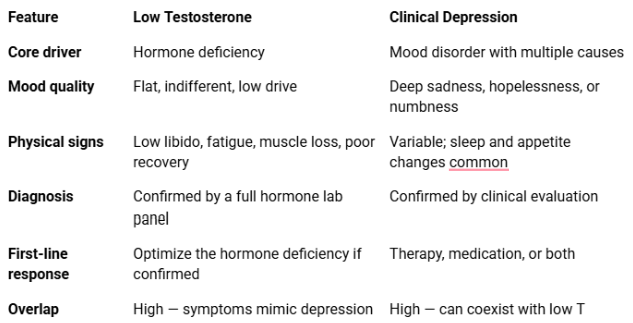
The honest takeaway: a checklist cannot separate these for you. Full bloodwork and a proper clinical conversation can. A clinician trained in both hormones and mental health is uniquely placed to untangle them.
When Should Mental Symptoms Prompt a Hormone Test?
Low mood, anxiety or brain fog may come packaged with the physical hallmarks of low T:
- Dropping libido.
- Unexplained fatigue.
- Loss of muscle.
- Poor sleep.
- Slower recovery from workouts.
That combination is your cue to get tested. It is even more worth doing if you have tried an antidepressant and feel only partly better. An untreated hormone deficiency is a common reason mental-health treatment stalls. Arbour Longevity’s free Hormone Score Quiz takes about two minutes and gives you a tailored starting point.
Want to know what this would mean for you?
Your first visit at Arbour Longevity in Ann Arbor is $35 and includes a full hormone panel. It is applied toward your treatment plan.
Book your $35 first visit Call (734) 436-3357
Does Testosterone Therapy Improve Mood, Anxiety, and Cognition?
Now the question you actually came for. I will be straight with you, because this is where most commercial pages oversell and lose your trust. The evidence is real but nuanced. Testosterone therapy is not a happiness drug. Anyone who pitches it that way is doing you a disservice. But for the right man, the mental and emotional benefits can be large.

What Does the Research Say About TRT for Depression?
Research into TRT for depression has grown a lot, and one theme keeps coming up: who you treat matters most. The benefit is closely tied to whether a real deficiency exists in the first place.
Does TRT Work Differently in Men With Low vs. Normal Testosterone?
In men with confirmed low testosterone, therapy has been linked with meaningful improvement in mood and depressive symptoms. The logic is simple. You are correcting a deficiency that was feeding the problem.
In men whose testosterone is already in a healthy range, the mood benefit largely disappears. This is the single most important point in the whole debate. It is why testosterone therapy psychological effects depend so heavily on an accurate diagnosis. TRT corrects a deficiency. It is not a general-purpose mood enhancer. This is also where Arbour Longevity’s "optimize, don’t just test" philosophy earns its keep. The goal is not to hit an average number for your age. It is to reach the range where you feel and function at your best, confirmed by labs and tracked over time.
The research is not all positive, either. Some studies have raised concerns. That is exactly why this belongs with a clinician who weighs your own risk profile and monitors you, rather than a one-size-fits-all protocol.
Can TRT Help With Treatment-Resistant Depression?
One of the more promising areas is treatment-resistant depression (depression that has not responded to antidepressants). In some men with low testosterone, adding hormone treatment to their existing care has moved the needle when medication alone stalled. It is not a guaranteed fix. It is not a replacement for psychiatric care. But it is a real reason to check hormones in men whose depression has not responded as expected. This is also the kind of case where a triple board certified clinician, one who understands both the psychiatric and the hormonal side, adds real value.
Can TRT Help With Anxiety and Emotional Regulation?
For men with low testosterone, restoring healthy levels often brings a steadier emotional baseline. That means less reactivity, a longer fuse, and better emotional regulation. Men often describe feeling "more like themselves": calmer, less on edge, better able to handle pressure. The research on TRT for anxiety is thinner than the depression data. So it is fairer to call anxiety relief a common reported benefit of correcting a deficiency, not a proven primary use. The gain in emotional resilience (your ability to bounce back from stress) that many men feel is real. But it is a downstream effect of fixing the hormone problem.
Does Testosterone Therapy Improve Focus, Memory, and Executive Function?
This is where many men feel the most dramatic change. As the brain fog lifts, focus, mental sharpness and cognitive performance (how well you think and process information) often improve. For many, the return of executive function (planning, prioritizing and follow-through) is what they notice first.
TRT and Cognitive Benefits: What Is Proven and What Isn’t?
TRT cognitive benefits get exaggerated constantly. So let me draw the line clearly.
- Reasonably supported: In deficient men, correcting low testosterone is linked with better mood, energy, motivation and subjective mental clarity, and better quality of life overall.
- Promising but not settled: Direct, lasting gains in specific cognitive domains such as verbal memory or spatial ability. Some studies show benefit; others are mixed.
- Not established: TRT to prevent cognitive decline, or to boost cognition in men with normal testosterone. Claims about cognitive longevity here run ahead of the evidence.
The men who see real TRT and executive function gains are mostly those who were deficient to begin with. The takeaway is the same for mood and cognition alike: benefit tracks with deficiency.
How Quickly Can You Expect Mood Changes on Testosterone Therapy?
Patience matters here. The testosterone therapy mood changes do not all arrive at once. Each benefit has its own timeline. Based on what Arbour Longevity sees in practice, here is a realistic sequence.
What Is a Realistic Timeline for Energy, Mood and Quality of Life?
- Weeks 2–4: Energy and sleep are usually the first to improve. Many men notice the fog starting to clear.
- Weeks 6–12: Mood, emotional well-being, libido, body composition (muscle versus fat) and cognitive changes usually become clear as levels stabilize.
- Months 3–6: Full optimization, where lab markers and symptoms line up, usually lands here. Expect dose and protocol tweaks along the way. This is where the broader TRT and quality of life gains, including stress resilience and confidence, take hold.
If you expect an overnight switch-flip, you will be disappointed. The men who do best treat it as a steady reset, not an instant cure.
What Are the Risks and Limits of Using TRT for Mental Health?
This section is non-negotiable. No responsible discussion of testosterone therapy leaves it out.
Hormone therapy has a strong safety record when a qualified clinician prescribes and monitors it. Monitoring is the operative word. TRT can affect red blood cell counts, fertility and other markers. That is why Arbour Longevity builds regular lab monitoring into every protocol and follows a "never set and forget" approach. Just as important: TRT is not a treatment for depression or anxiety in men with normal testosterone. It is never a stand-in for psychiatric care when that is what is needed. For many men the right answer is hormone treatment and mental-health support working together. Again, that is the advantage of a clinician certified in all three fields.
If you ever feel hopeless for days on end or have thoughts of harming yourself, please do not wait on a hormone work-up. Reach out to a doctor or a crisis line right away. Hormones may be part of your picture, but acute distress deserves immediate care.
The bottom line: testosterone therapy can be life-changing for the right man, and the wrong choice for another. The only way to know which you are is a proper evaluation.
How to Get Started With Testosterone Therapy in Ann Arbor, Michigan
If you have read this far, you are probably past the "is this real?" stage. You are into "what do I actually do about it?" Here is the path.
How Is Low Testosterone Properly Diagnosed?
You cannot diagnose low testosterone from symptoms alone. They overlap too heavily with depression, thyroid issues, sleep disorders and ordinary burnout. Proper diagnosis is the foundation everything else rests on.
What Lab Panel and Symptom Evaluation Should You Expect?
Your regular doctor likely ran TSH (the brain’s signal to your thyroid gland) and total testosterone, then called it a day. That is not enough to act on with confidence. Arbour Longevity orders a complete panel, because treating hormones without full context is guesswork. A thorough work-up usually includes:
- Total and free testosterone: the main male hormone driving energy, libido, muscle and mood. Free testosterone is the share your body can actually use.
- SHBG (sex hormone binding globulin): a protein that binds testosterone in the blood and decides how much is actually available to your tissues.
- Estradiol (E2) (the strongest form of estrogen): important for mood, cognition, bone, and heart and blood-vessel health in men, not just women.
- DHEA-S and pregnenolone: adrenal reserve and the precursor hormones upstream of testosterone and cortisol.
- AM cortisol: your stress response, and the missing piece in most mood evaluations.
- Full thyroid panel (TSH, Free T3, Free T4, Reverse T3): thyroid dysfunction mimics low-T symptoms, and standard panels miss it.
- Metabolic safety markers (CBC, CMP, lipids, HbA1c, IGF-1): your baseline for safe, monitored treatment.
That lab picture is then read in the context of your symptoms and goals. A number on a page only means something when it is matched to how you actually feel and function.
What Does Medically Supervised TRT Look Like at Arbour Longevity?
At Arbour Longevity, hormone care runs on one framework: optimize, don’t just normalize. "Normal for your age" is not the goal. Optimal is. Gandhi Bhattarai, FNP-BC, PMHNP-BC, directs every treatment plan. Every protocol includes ongoing lab monitoring, with adjustments as your body responds. Testosterone therapy for mental health and mood is not a set-it-and-forget-it prescription. It is an ongoing relationship that tracks your bloodwork, your symptoms and your goals. Hormones, mental health and metabolic health (how well your body turns food into energy) are assessed together, not in isolation. So mood and cognition are treated as part of a bigger picture, not an afterthought.
Why Does Hormone Therapy for Mental Health Need the Right Clinician?
The internet is full of clinics that will sell you testosterone after a single questionnaire. Avoid them. Hormone therapy touches your brain chemistry, your mood, your cognition and your emotional stability. It demands real medical oversight:
- A complete diagnostic panel.
- Tailored dosing.
- Regular monitoring.
- A clinician who will change course if your labs or symptoms call for it.
That kind of oversight is rare. It is also what makes Arbour Longevity well suited to this question. One provider is triple board certified in family medicine, psychiatric mental health, and anti-aging and functional medicine, all under one roof.
Is Testosterone Therapy Right for Your Mood and Mental Health Goals?
Does your low mood, anxiety, brain fog or stalled motivation come bundled with the physical signs of low testosterone? Has standard mental-health treatment left you only partway better? If so, a proper hormone evaluation is one of the most useful next steps you can take. Whether or not TRT turns out to be the answer, you will finally have a clear picture instead of a guess.
How Do You Book a Hormone Consultation in Ann Arbor or by Telehealth?
You don’t have to keep wondering whether your hormones are quietly running your mood. Arbour Longevity offers hormone consultations in person in Ann Arbor and via telehealth statewide across Michigan. It is a private, 45-minute visit with Gandhi. It covers what matters to you, what is going on in your body, and the shortest path to the outcome you want. Your first visit starts at $35, and the consultation fee is applied toward your treatment.
If the fog, the flatness and the lost drive in this article sounded like your last several months, that is worth a conversation.
Ready to find out whether your mood has a hormonal root worth treating? Book your $35 first visit with Arbour Longevity online, or call (734) 436-3357.
Frequently Asked Questions
Can low testosterone cause depression and anxiety?
Low testosterone is strongly linked with depressive symptoms, and many men also report anxiety and irritability. The symptoms overlap heavily with major depressive disorder and anxiety disorder. So the only reliable way to know if hormones are involved is a full lab panel plus a clinical evaluation. Ideally, that is done with a clinician trained in both hormones and mental health.
Does TRT actually improve mood, or is that just hype?
For men with truly low testosterone, TRT is linked with real gains in mood, motivation and emotional well-being. For men with normal levels, that benefit largely disappears. The improvement corrects a deficiency. It is not a general mood booster, which is why accurate diagnosis is everything.
How long does it take for testosterone therapy to affect mood?
At Arbour Longevity, most patients notice energy and sleep improving within 2–4 weeks. Mood, libido, body composition and cognitive changes usually become clear at 6–12 weeks. Full optimization usually lands at 3–6 months as the protocol is fine-tuned.
Can testosterone therapy help with treatment-resistant depression?
In some men with low testosterone whose depression has not responded to antidepressants, adding hormone treatment has helped. It is not a guaranteed fix or a replacement for psychiatric care. But it is a strong reason to check testosterone in men whose depression has stalled.
Will TRT help my brain fog and focus?
For deficient men, lifting low testosterone often clears brain fog and improves focus, mental clarity and executive function. Direct, lasting gains in specific memory tasks are less certain. And there is no good evidence that TRT boosts cognition in men with normal testosterone.
Is it safe to use testosterone therapy for mental health?
It has a strong safety record when a qualified clinician prescribes and monitors it. Arbour Longevity builds regular lab monitoring into every protocol and never "sets and forgets." It still carries real considerations. It should never replace mental-health care when that is what is needed.
How do I know if my symptoms are low testosterone or just depression?
You often cannot tell them apart from symptoms alone. They share many features and often occur together. If low mood comes with low libido, fatigue, muscle loss and poor recovery, that combination points toward getting your hormones tested. Arbour Longevity’s two-minute Hormone Score Quiz is a simple place to start.
Do you offer hormone consultations by telehealth?
Yes. Initial and follow-up hormone consultations are available via telehealth for patients throughout Michigan. Lab work is ordered to your nearest LabCorp or Quest. In-person visits are at the Ann Arbor clinic.
This article is for educational purposes only and is not medical advice. Results vary from person to person. Talk with a qualified clinician about your own health.

Gandhi Bhattarai, FNP-BC, PMHNP-BC, Anti-Aging/Functional Medicine BC
Triple board-certified nurse practitioner and founder of Arbour Longevity in Ann Arbor. Every article is written from clinic practice and reviewed against current guidelines.
✓ Medically reviewed · Last updated August 21, 2026
How we reviewed this article
Arbour Longevity articles are written by the treating clinician, checked against primary sources (peer-reviewed journals, FDA labeling, Endocrine Society and other specialty guidelines) and re-reviewed when guidance changes. See our editorial policy. Spotted an error? Email info@arbourlongevity.com.
This article is educational and is not a substitute for individualized medical advice. Whether a treatment is appropriate for you is determined during consultation.
Your symptoms have a cause. Let’s find it.
Book a $35 first visit in Ann Arbor. It’s a 30–45 minute consultation with Gandhi Bhattarai, applied toward your plan. Serving Ann Arbor, Ypsilanti, Saline, Dexter, Chelsea, and Michigan by telehealth.






.webp)

