

Bioidentical Hormone Lab Testing and Monitoring: Which Labs, What the Numbers Mean, Ann Arbor
Key takeaways
- Labs do three jobs before BHRT: rule out look-alike conditions, set a baseline, and later confirm absorption and catch overexposure.
- Menopause is diagnosed from your bleeding pattern and symptoms, not from a hormone level.
- Estrogen is dosed to symptoms; testosterone is the one hormone we keep inside a set range.
- We use blood (serum) tests, not saliva, because saliva levels do not equal free hormone in blood.
- Your first visit is $35, applied toward your plan; labs are billed separately by LabCorp or Quest.
Most people arrive at hormone therapy with a question about molecules and leave with a question about numbers. Which labs are actually worth drawing? What does each one mean? How often should they be repeated once you are on treatment? And the question almost nobody is asked directly: what can a hormone level not tell you?
This page is the testing and monitoring guide. It covers the baseline panel we draw before bioidentical (same molecular structure as the hormone your body makes) hormone therapy. It explains what each marker is doing there and how the follow-up schedule works. It also explains why we use serum rather than saliva, and where a lab result should not be the thing making the decision.
Looking for the bioidentical versus synthetic comparison? That question is answered in full in BHRT vs HRT: What the Difference Actually Is, and What the Evidence Shows. It covers what "bioidentical" means at the molecular level, how estradiol and micronized progesterone differ from conjugated equine estrogens and medroxyprogesterone acetate. It also covers what the Women's Health Initiative actually reported, and why route matters. This page picks up where that one ends, at the lab slip.
The short version. Labs do three jobs. They rule out the conditions that imitate hormone decline. They establish a baseline to measure change against. And once you are on treatment, they confirm absorption and flag unintentionally high exposure. They do not diagnose menopause in most women, they do not set your estrogen dose, and they do not tell you how you feel.
Why We Test at All
There is a version of hormone care where a symptom questionnaire leads straight to a prescription. There is another where a lab panel is treated as a scoreboard to be maximized. Neither is right. Testing earns its place for three specific reasons.
To rule things out. Fatigue, brain fog, low mood, weight change and low libido are the shared end point of a dozen conditions. Thyroid disease, anemia, poorly controlled glucose, high prolactin and depression all present this way. Prescribing hormones into an undiagnosed thyroid problem does not fix the thyroid problem.
To create a baseline. A single hormone level on its own is nearly impossible to interpret. The same number six weeks after starting treatment, next to your symptom notes, is genuinely useful. Most of a baseline panel's value comes later.
To keep exposure where it belongs. This is the safety function, and it is the one that matters most over time.
What a Baseline Panel Covers
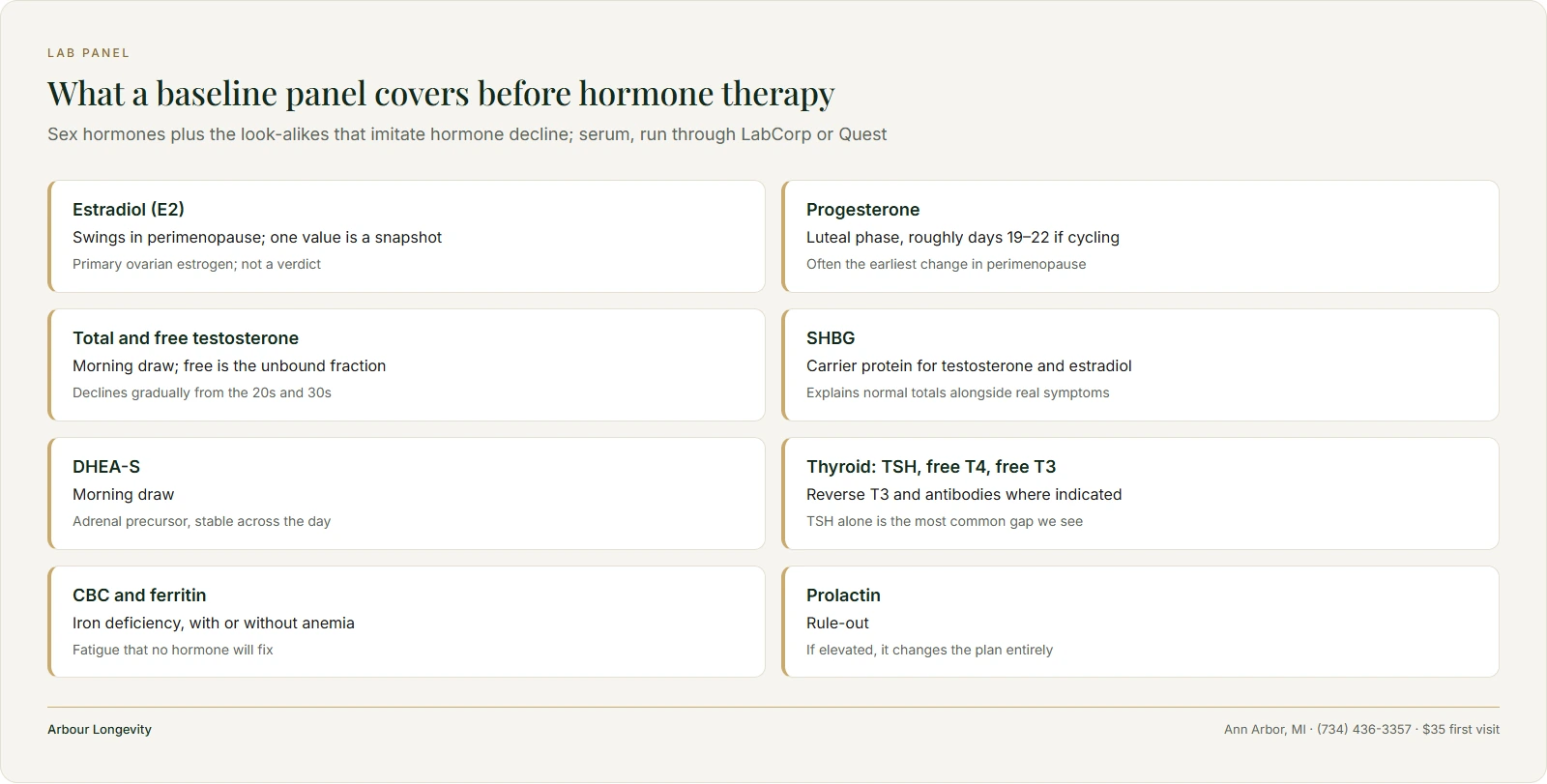
Sex hormones
- Estradiol (E2). The main estrogen made by the ovaries. In perimenopause (the years of shifting hormones before periods stop) it swings rather than falls steadily. One value is a snapshot of a moving target, not a verdict.
- Progesterone. The hormone that balances estrogen. It depends on ovulation, so if you still cycle it is read against where you are in your cycle. Falling progesterone is often the earliest change in perimenopause.
- Total and free testosterone. Women make testosterone (the main male sex hormone, in smaller amounts) in the ovaries and adrenal glands. Levels fall slowly from the 20s and 30s onward. Free testosterone is the share not bound to carrier proteins, so your body can use it.
- SHBG (sex hormone-binding globulin). The carrier protein that decides how much of your testosterone and estradiol is actually available to tissue. Oral estrogen and some oral contraceptives raise SHBG, which lowers free hormone even when totals look fine. This is why a "normal" total testosterone can sit alongside real symptoms.
- DHEA-S. An adrenal hormone your body converts into testosterone and estrogen. It is more stable across the day than DHEA itself.
- FSH and LH. The pituitary's signals telling the ovaries to make hormones. They are useful in specific situations, such as suspected early menopause or a picture that does not fit the age. They are not required to make the diagnosis in most women.
The look-alikes
- Thyroid (the gland that sets your metabolic speed): TSH, free T4, free T3, and where indicated reverse T3 and thyroid antibodies. A TSH alone is the single most common gap we see in panels done elsewhere.
- Prolactin. A high prolactin (a pituitary hormone) can flatten desire and disrupt cycles. It changes the plan entirely if present.
- CBC and ferritin. Iron deficiency, with or without anemia, produces fatigue that no hormone will fix. Heavy perimenopausal bleeding makes this common and easy to miss.
- Metabolic panel, lipids, fasting glucose and A1c. A1c is your average blood sugar over the past three months. Together these give the baseline heart and metabolic picture, and they are part of assessing whether hormone therapy suits you.
- Vitamin D. Relevant to bone health alongside estrogen.
- AM cortisol. The stress hormone, checked where the history suggests it, in the context of sleep and stress rather than as a standalone verdict.
What sits alongside the bloodwork
Blood pressure, weight and body composition, a structured symptom inventory, and your current mammogram status. Plus a full personal and family history: clotting events, stroke, migraine with aura, breast and other estrogen-sensitive cancers, and heart disease. These carry as much weight in the plan as any number on the panel.
Want your own numbers, not averages?
Your $35 first visit ends with a specific recommendation on which of these labs are worth drawing for you, and the fee is applied toward your plan.
Book your $35 first visit Call (734) 436-3357
Diagnosis Is Clinical, Not a Number
This is the part that most often surprises people. Menopause staging is built mainly on bleeding patterns, not on hormone levels. The standard framework is the Stages of Reproductive Aging Workshop + 10 consensus. It simplified the bleeding criteria for the early and late menopausal transition. It also recommended applying the staging regardless of a woman's age, ethnicity, body size or lifestyle (Harlow et al., J Clin Endocrinol Metab, 2012, DOI). Your cycle history is the primary instrument. Labs support it.
The same logic applies to low desire. The International Society for the Study of Women's Sexual Health guideline says a total testosterone level should not be used to diagnose hypoactive sexual desire disorder. It should be used as a baseline for monitoring (Parish et al., J Sex Med, 2021, DOI). A low number does not make the diagnosis, and a normal one does not exclude it.
Serum, Not Saliva
Saliva testing is widely marketed alongside custom-compounded (pharmacy-mixed) hormone preparations, often to justify a bespoke ratio. The problem is a specific technical one. A review in Climacteric on misconceptions about bioidentical hormone therapy notes that compounding pharmacies often use saliva testing to measure hormones. It also notes the misconception that salivary hormone levels equal the free hormone fraction in blood (Stanczyk et al., Climacteric, 2021, DOI). They are not the same measurement. A plan built on treating them as interchangeable is built on sand.
We use serum, run through LabCorp or Quest Diagnostics, so results are comparable over time and against published reference data.
Monitoring on Treatment: What Changes, and When
The 4 to 6 week recheck
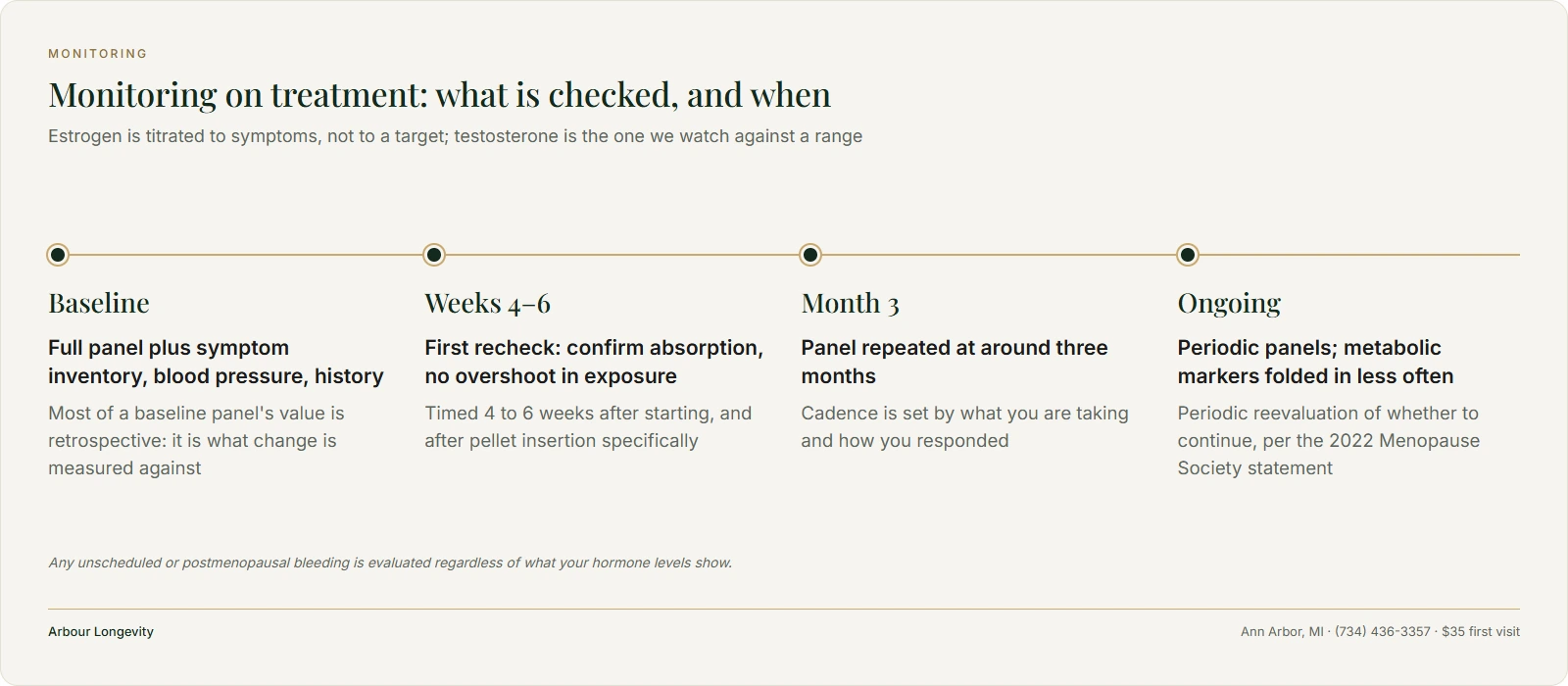
The first follow-up panel comes 4 to 6 weeks after starting, and after pellet (rice-sized hormone implant under the skin) insertion specifically. Its job is narrow and important. It confirms you are absorbing what you were prescribed, and it confirms exposure has not overshot. Symptom notes from those weeks are read alongside it.
Estrogen: dosed to symptoms, not to a target
Systemic estrogen dosing follows your symptoms and your tolerance. A level confirms absorption and screens for unintentionally high exposure. It is not a score to be raised. This matters in practice, because chasing a number is how people end up on more hormone than they need. Systemic estrogen cuts the frequency of hot flashes and night sweats by roughly 75 percent, and oral and transdermal routes work about equally well for that (Crandall et al., JAMA, 2023, DOI). So if symptoms are controlled, the dose is doing its job whatever the number says.
Testosterone: the one we do watch against a range
Testosterone is the exception. Here the guideline is explicit. Patients should be checked for signs of androgen excess, and total testosterone kept within the normal premenopausal range (Parish et al., 2021, DOI). The target is a normal young-woman level, not a male level. The Global Consensus Position Statement endorsed by eleven international societies frames it the same way (Davis et al., J Clin Endocrinol Metab, 2019, DOI).
Progestogen and the uterine lining
If you have a uterus and take systemic estrogen, a progestogen is part of the plan. Protecting the uterine lining is a clinical question, not a lab question. Any unscheduled or postmenopausal bleeding is evaluated regardless of what your hormone levels show. No lab result overrides that.
The ongoing schedule
After the early recheck, the rhythm is set by what you are taking and how you responded. Commonly that means a panel at around three months, then periodically after that, with metabolic markers folded in less often. The 2022 Menopause Society position statement recommends that treatment be individualized with periodic reevaluation of whether to continue (Menopause, 2022, DOI). Monitoring is what makes that reevaluation real rather than theoretical.
How to Time Your Draw
- If you are still cycling, progesterone is usually drawn in the luteal phase (the second half of the cycle), roughly days 19 to 22 of a 28-day cycle. Tell us your cycle dates rather than estimating.
- Morning draws for testosterone, DHEA-S and cortisol, since these follow a daily rhythm.
- Fasting for glucose, A1c and lipids.
- On treatment, be consistent. Same interval after your cream, patch or injection each time. Comparing a trough to a peak produces a change that is not real.
- Bring your medication list, including supplements. Biotin in particular can interfere with some immunoassays; we will tell you when to hold it.
What Labs Cannot Tell You
Three honest limits.
They cannot tell you how you feel. Two women with identical estradiol levels can have completely different symptom burdens. Treatment follows the symptom.
They cannot resolve perimenopause. During the transition, levels move week to week. A single estradiol drawn on a Tuesday describes Tuesday. This is why the cycle history carries the diagnostic weight (Harlow et al., 2012, DOI).
They cannot substitute for a risk conversation. Whether hormone therapy suits you turns on how far you are from your final period, your clotting and vascular history, whether you still have a uterus, and your breast history. None of that appears on a panel. The evidence behind those judgements is laid out in our BHRT vs HRT guide.
How This Works at Arbour Longevity
Your first visit is $35, applied toward your treatment plan. It includes a full evaluation and a specific recommendation on which labs are worth drawing for you, not a maximal panel by default. Labs are ordered through LabCorp or Quest and billed separately by the lab. Depending on your plan, part of a panel may be covered even though the clinic is cash-pay. HSA and FSA funds are accepted.
If you want the full program cost and visit schedule, that is set out in BHRT for women over 40: what it costs and your first three months. For the treatment itself, see hormone replacement therapy in Ann Arbor, our work as a menopause specialist in Ann Arbor, and longer-term hormone optimization.
Frequently Asked Questions
Do I need a blood test to know if I am in menopause?
Usually not. Menopause staging rests mainly on bleeding patterns, and the STRAW + 10 framework is built around them (Harlow et al., 2012, DOI). Labs are more useful for ruling out look-alike conditions and for setting a baseline than for making the diagnosis itself.
Why did my provider only check TSH?
A TSH alone is the standard screening approach in general practice, and it catches a lot. It can also miss conversion and antibody issues that a fuller picture would show: free T4, free T3, and where indicated reverse T3 and thyroid antibodies. Thyroid symptoms overlap almost completely with hormone decline symptoms. So we look at the fuller picture before blaming hormones.
Is saliva testing useful?
We use serum. Salivary hormone levels are often presented as equal to the free hormone fraction in blood, and that equivalence is a misconception (Stanczyk et al., 2021, DOI). Serum results are comparable over time and against published data.
My estradiol is "normal" but I feel terrible. What now?
Then the number is not the useful piece of information. Look at SHBG and free hormone rather than totals alone. Look at thyroid, ferritin and prolactin, at sleep and at medications. Treatment decisions follow symptoms and tolerance, not a target value.
How often will I need labs once I am stable?
Commonly a panel at the 4 to 6 week mark, again at around three months, then periodically. The interval depends on what you are taking, how you responded, and whether anything changes. Reevaluation is meant to be periodic rather than annual by habit (Menopause, 2022, DOI).
Can I bring labs from another provider?
Yes, and please do. Prior results are genuinely valuable because they give us a trend rather than a point. We will tell you what, if anything, still needs repeating.
Hormone Consultations in Ann Arbor
Gandhi Bhattarai, FNP-BC, PMHNP-BC, Anti-Aging/Functional Medicine BC is a triple board certified nurse practitioner and founder of Arbour Longevity. We are at 2217 Packard St #15, in the Eastover Professional Center, Ann Arbor, MI 48104. We are open Thursday through Monday, 10am to 7pm, closed Tuesday and Wednesday. Parking is free and directly outside, with no meters and no structure. Suite 15 is down a flight of stairs; if stairs are difficult for you, please call (734) 436-3357 before your visit.
The first visit is $35, applied toward your treatment plan, and lasts 30 to 45 minutes. Cash pay, HSA and FSA accepted. Book your $35 first visit online or call (734) 436-3357.
References
According to PubMed, the clinical evidence cited on this page includes:
- Harlow SD, Gass M, Hall JE, et al. Executive summary of the Stages of Reproductive Aging Workshop + 10. J Clin Endocrinol Metab. 2012;97(4):1159-1168. PMID: 22344196. DOI: 10.1210/jc.2011-3362
- Parish SJ, Simon JA, Davis SR, et al. ISSWSH Clinical Practice Guideline for the Use of Systemic Testosterone for Hypoactive Sexual Desire Disorder in Women. J Sex Med. 2021;18(5):849-867. PMID: 33814355. DOI: 10.1016/j.jsxm.2020.10.009
- Davis SR, Baber R, Panay N, et al. Global Consensus Position Statement on the Use of Testosterone Therapy for Women. J Clin Endocrinol Metab. 2019;104(10):4660-4666. PMID: 31498871. DOI: 10.1210/jc.2019-01603
- Stanczyk FZ, Matharu H, Winer SA. Bioidentical hormones. Climacteric. 2021;24(1):38-45. PMID: 33403887. DOI: 10.1080/13697137.2020.1862079
- Crandall CJ, Mehta JM, Manson JE. Management of Menopausal Symptoms: A Review. JAMA. 2023;329(5):405-420. PMID: 36749328. DOI: 10.1001/jama.2022.24140
- The 2022 hormone therapy position statement of The North American Menopause Society. Menopause. 2022;29(7):767-794. PMID: 35797481. DOI: 10.1097/GME.0000000000002028
Clinical information here is drawn from articles retrieved from PubMed and provided for education. It is not medical advice, a diagnosis, or a promise of any result.

Gandhi Bhattarai, FNP-BC, PMHNP-BC, Anti-Aging/Functional Medicine BC
Triple board-certified nurse practitioner and founder of Arbour Longevity in Ann Arbor. Every article is written from clinic practice and reviewed against current guidelines.
✓ Medically reviewed · Last updated August 17, 2026
How we reviewed this article
Arbour Longevity articles are written by the treating clinician, checked against primary sources (peer-reviewed journals, FDA labeling, Endocrine Society and other specialty guidelines) and re-reviewed when guidance changes. See our editorial policy. Spotted an error? Email info@arbourlongevity.com.
This article is educational and is not a substitute for individualized medical advice. Whether a treatment is appropriate for you is determined during consultation.
Your symptoms have a cause. Let’s find it.
Book a $35 first visit in Ann Arbor. It’s a 30–45 minute consultation with Gandhi Bhattarai, applied toward your plan. Serving Ann Arbor, Ypsilanti, Saline, Dexter, Chelsea, and Michigan by telehealth.






.webp)

