
Dysport vs Botox vs Daxxify: What's the Difference?
Key takeaways
- All three are botulinum toxin type A. They relax the same muscles but differ in spread, units and duration.
- Botox is the longest-established option and the reference point for most comparisons.
- Dysport spreads a little more, which can suit broader areas such as the forehead.
- Daxxify is the newest and is chosen mainly for a longer gap between treatments.
- Units are not interchangeable between brands, so never compare price per unit across products.
How Do Neurotoxins Work?
Botox, Dysport, Daxxify, Xeomin and Jeuveau are all neurotoxins (shots that relax the small muscles behind expression lines). Each one contains botulinum toxin type A, a purified protein. It blocks the release of acetylcholine (the chemical a nerve uses to tell a muscle to contract). It does this at the neuromuscular junction (the spot where nerve meets muscle). The muscle relaxes for a time.
Frown lines, forehead lines and crow's feet are dynamic wrinkles (lines made by repeated muscle movement). When those muscles relax, the skin above them smooths out and the lines soften.
The products differ in their formulas. Three things vary:
- The proteins that surround or stabilize the active toxin.
- The molecular weight of what is in the vial.
- How each product is made.
Those formula gaps are why each product has its own dosing units. They are also why the questions below have no one-size-fits-all answers.
What Is Botox? (OnabotulinumtoxinA)
Botox is made by Allergan, now part of AbbVie. Its generic name is onabotulinumtoxinA. In 2002 it became the first botulinum toxin approved for cosmetic use in the United States. It is still the best known and most studied of the group.
Key Facts
- Onset: 3 to 5 days, with full effect at 10 to 14 days.
- Duration: 3 to 4 months on average.
- Spread: Stays more contained, with less diffusion (drift of the product away from the needle point).
- Molecular weight: 900 kDa in its complexed form.
- FDA cosmetic approvals: Glabellar lines (the frown lines between the brows), forehead lines and crow's feet, plus many medical uses.
Where It Fits
Botox's precise, contained action suits areas where control matters most. Around the eyes and the brow, even slight over-spread can cause a heavy eyelid. Its long track record also gives it the most safety data of any product in this group. Pricing at Arbour Longevity is $13 per unit. See our Botox page for details.
What Is Dysport? (AbobotulinumtoxinA)
Dysport is made by Galderma. Its generic name is abobotulinumtoxinA. It received FDA approval for cosmetic use in 2009. Its formula carries less associated protein than Botox. That is one reason it acts differently in the tissue.
Key Facts
- Onset: 1 to 3 days.
- Duration: 3 to 4 months for most patients.
- Spread: More diffusion from the needle point.
- Molecular weight: 500-900 kDa, with less associated protein.
- Dosing: Its own unit system. It cannot be swapped with any other product.
Onset with Dysport has been recorded within 12 hours in some cases. How long the effect lasts depends on muscle mass, patient age, sex and injection technique. Both findings come from a review of onset and duration across these products (Nestor, Ablon and Pickett, Aesthetic Surgery Journal, 2017; DOI: 10.1093/asj/sjw282).
Where It Fits
Dysport's wider spread is useful across larger areas such as the forehead. There the goal is an even result across a wide field. More spread can mean fewer needle points across a broad area. But it also asks more of the injector. The product has to be placed so that spread works for you, not against you.
What Is Daxxify? (DaxibotulinumtoxinA)
Daxxify is made by Revance Therapeutics. Its generic name is daxibotulinumtoxinA. It received FDA approval for glabellar lines in 2022. What sets it apart is its formula. Daxxify pairs the toxin with a stabilizing peptide excipient (an inactive helper made from a short protein chain). That peptide is called RTP004 (Gallagher et al., Toxins, 2023; DOI: 10.3390/toxins15010060). Fabi et al. also describe it as botulinum toxin type A made with a novel peptide excipient (Dermatologic Surgery, 2021; DOI: 10.1097/DSS.0000000000002531). That peptide replaces the albumin-based stabilizer used in the older products. It is the formula change that sets Daxxify apart from them.
Key Facts
- Peak effect: Weeks 2 to 4 in the pivotal trials (the main studies that supported FDA approval).
- Duration: Median (midpoint) of 24 weeks in the SAKURA Phase 3 program (see below).
- Molecular weight: 150 kDa core neurotoxin, without complexing proteins (the extra proteins bundled around the active toxin).
- Trial dose for glabellar lines: 40 units. That is a Daxxify unit, not a Botox or Dysport unit.
Who Makes Daxxify?
Daxxify is made by Revance Therapeutics. Its approval rested on the SAKURA Phase 3 clinical program, run at many US centers. Those results are published in Plastic and Reconstructive Surgery, the Journal of the American Academy of Dermatology and Dermatologic Surgery. Those papers are cited throughout this article and listed in full at the end.
Dysport vs Botox: How the Two Compare
This is the matchup patients ask about most, so it deserves a careful answer. Both products are botulinum toxin type A. They work the same way. What differs is the formula, how far each spreads, and the unit system each is dosed in.
What Is the Difference Between Dysport and Botox?
Botox is onabotulinumtoxinA, approved for cosmetic use in 2002. Dysport is abobotulinumtoxinA, approved in 2009. Botox carries more associated protein and a higher complexed molecular weight. Dysport carries less. In practice, Dysport tends to spread further from the needle point. Botox tends to stay put. Neither is better by nature. Wider spread helps across a wide forehead and is a risk near the brow. Tighter spread is the reverse.
Each product also has its own potency assay (the lab test that defines how strong one unit is). So a Dysport unit and a Botox unit are simply different measures. That one fact explains most of the confusion here. It is also why per-unit prices cannot be compared across products.
Does Dysport Last Longer Than Botox?
The evidence does not show that one outlasts the other at an equal dose. A preclinical (lab, not human) study dosed Botox and Dysport to produce the same strength of effect. The effect then lasted the same time for both. The authors concluded that duration tracks the potency of the dose given, not the brand on the vial (Kutschenko et al., Neuroscience Letters, 2016; DOI: 10.1016/j.neulet.2016.06.001). That study was done in mice. So it describes the pharmacology (how the drug acts in the body) rather than a cosmetic result.
In humans, the Nestor review above names muscle mass, age, sex and injection technique as the factors that move duration (DOI: 10.1093/asj/sjw282). In other words, how long your result lasts has more to do with you and your plan. It has less to do with which of these two products was used.
Onset is a different question from duration, and there the products do differ. Dysport is usually the faster of the two to show an effect. As noted above, onset within 12 hours has been recorded with Dysport in some cases.
Is Dysport Better Than Botox?
Neither product is proven better. A review compared Botox, Dysport and Xeomin. It states directly that efficacy (how well a treatment works) is similar when the products are properly dosed (Scaglione, Toxins, 2016; DOI: 10.3390/toxins8030065). A Cochrane systematic review (a study that pools and grades the results of many trials) went wider. It covered 65 randomized controlled trials (studies where people are assigned by chance to treatment or placebo) and nearly 15,000 people. It found that all the major products work compared with placebo (an inactive look-alike treatment). It also stressed that head-to-head comparisons must account for the unequal dosing systems (Camargo et al., 2021; DOI: 10.1002/14651858.CD011301.pub2).
So the honest answer is that the choice is not about which product is better on paper. It depends on:
- The area being treated.
- How much spread you want there.
- How quickly you want to see a change.
- How you have responded to either product in the past.
How Many Units of Dysport vs Botox?
No conversion ratio is printed on either product's FDA-approved label. The two unit systems come from different potency assays, so they cannot be swapped one for one.
The published ratios that do exist come from medical use, not cosmetic use, and should be read that way. A systematic review of randomized trials in movement disorders looked at the question. It found that a Botox-to-Dysport ratio between 1:2.5 and 1:3.0 gave comparable safety and efficacy. A 1:4 ratio produced too many side effects that patients could not tolerate (Dashtipour et al., Movement Disorders Clinical Practice, 2015; DOI: 10.1002/mdc3.12235). The Scaglione review reached a similar conclusion for spasticity (muscle stiffness), cervical dystonia (neck muscle spasms) and blepharospasm (eyelid spasms). It added that a ratio higher than 3:1 risks overdosing Dysport (DOI: 10.3390/toxins8030065).
The key caveat comes from a review by De Boulle, Fagien, Sommer and Glogau (Clinical Interventions in Aging, 2010; DOI: 10.2147/cia.s9338). The FDA required distinct nonproprietary names (generic names) for these products for one reason. It wanted to signal that they cannot be swapped. Dosing cannot rest on any single conversion ratio. Your injector sets your dose for your face and your goals. It is not math you should be doing at home.
Not sure which one fits you?
Your first visit at Arbour Longevity in Ann Arbor is $35 and includes an honest assessment of what will and will not help. It is applied toward your treatment plan.
Book your $35 first visit Call (734) 436-3357
Daxxify vs Botox: How the Two Compare
Dysport and Botox differ mainly in spread and unit system. The Daxxify matchup is mostly about duration. The SAKURA Phase 3 program is the evidence to look at.
How Long Does Daxxify Last?
Two pivotal placebo-controlled trials, SAKURA 1 and SAKURA 2, enrolled 609 people. Combined clinician and patient ratings tracked how long frown lines stayed none or mild. The median was 24.0 weeks in SAKURA 1 and 23.9 weeks in SAKURA 2. Lines did not return to baseline (the starting point) for a median of 27.7 and 26.0 weeks (Carruthers et al., Plastic and Reconstructive Surgery, 2020; DOI: 10.1097/PRS.0000000000006327). A pooled look at the same two trials found a median of 24.0 weeks (Bertucci et al., Journal of the American Academy of Dermatology, 2020; DOI: 10.1016/j.jaad.2019.06.1313).
The larger repeat-treatment study, SAKURA 3, covered 2,691 people (Fabi et al., Dermatologic Surgery, 2021; DOI: 10.1097/DSS.0000000000002531). The median time to return to moderate or severe lines was again 24 weeks. At week 24, 32% or more of people still had a rating of none or mild.
Two things in those numbers deserve a careful read. A median of roughly 24 weeks is about six months. That is why Daxxify is discussed as a twice-a-year option. But a median is a midpoint. Half of the trial patients had a shorter result than that. Your own duration is personal, and no one can promise it in advance.
How Long Does Daxxify Take to Work?
In SAKURA 3, peak response came between weeks 2 and 4. Response rates were above 96% on the clinician-rated scale after each of three treatments. Peak rates were 92% or more on the patient-rated scale (DOI: 10.1097/DSS.0000000000002531). As with any product in this group, you will usually notice something before the peak. The fair time to judge your result is at two weeks, not day three.
Is Daxxify Better Than Botox?
SAKURA 1 and SAKURA 2 compared Daxxify with placebo, not with Botox. So they do not answer this head to head. Bertucci et al. do report that earlier Phase 2 data showed Daxxify lasting longer than Botox (DOI: 10.1016/j.jaad.2019.06.1313).
Duration, then, is where Daxxify stands out, and it is the reason to consider it. If you want fewer visits per year, that is a real gap. If you want a shorter trial while you decide whether you like the look, a shorter-acting product is arguably the better fit. Neither is the better product in general.
Is Daxxify Safe?
The SAKURA 3 safety report covered 2,691 people who had up to three treatments (Green et al., Dermatologic Surgery, 2021; DOI: 10.1097/DSS.0000000000002463). Treatment-related adverse events (side effects) occurred in 17.8% of people. Most were mild and cleared on their own. Eyelid ptosis (a drooping eyelid) occurred in 0.9% of treatments. No serious side effects were linked to the treatment.
Gallagher et al. pooled immunogenicity (immune-response) data across the SAKURA trials (Toxins, 2023; DOI: 10.3390/toxins15010060). Of 2,737 people who could be assessed, 21 (0.8%) formed treatment-related binding antibodies to Daxxify. No one formed neutralizing antibodies (the kind that can stop a product from working). Everyone who did form binding antibodies still reached none or mild lines at week 4. As with any shot, whether a product suits you is a talk for you and your injector. That includes your medical history and any past reaction to one of these products.
Daxxify vs Dysport: How the Two Compare
No published trial has tested Daxxify head to head against Dysport. So this matchup has to be built from each product's own evidence, not a direct contest.
The clearest contrast is timing. Dysport is the faster of the two to take effect, with onset recorded within 12 hours in some cases (DOI: 10.1093/asj/sjw282). Daxxify reaches peak response between weeks 2 and 4. But it carries a median duration of around 24 weeks in the SAKURA trials (DOI: 10.1097/DSS.0000000000002531). Dysport is typically retreated every 3 to 4 months. Broadly: Dysport shows up sooner, Daxxify stays longer.
The second contrast is spread. Dysport diffuses more from the needle point, which suits wide fields like the forehead. The third is formula. Dysport contains the toxin with its complexing proteins. Daxxify contains the 150 kDa core neurotoxin with a stabilizing peptide excipient (DOI: 10.3390/toxins15010060).
Their units cannot be compared, and no published conversion ratio exists between them. Anyone quoting you one is guessing.
Daxxify vs Xeomin: How the Two Compare
This is the most interesting matchup of the set. Daxxify and Xeomin reach a similar place by different routes. Both deliver the 150 kDa core neurotoxin without the complexing proteins found in Botox and Dysport.
Xeomin contains only the 150 kDa neurotoxin, with no complexing proteins, and those proteins have no therapeutic function (Frevert, Toxicon, 2009; DOI: 10.1016/j.toxicon.2009.03.010). A review of five years of clinical use adds three points (Dressler, European Journal of Neurology, 2012; DOI: 10.1111/j.1468-1331.2011.03559.x).
- Xeomin's smaller molecule does not mean a difference in diffusion.
- Its potency labeling is identical to that of Botox.
- With no complexing proteins, it has a longer shelf life and easier temperature handling.
That first point is worth underlining, because it is a common myth. A smaller molecule in the vial does not mean the product travels further in the tissue.
On dosing, the clinical development program used a 1:1 dose ratio between Xeomin and Botox. It found no gap between the two in onset, duration or fading of effect (Jost, Blümel and Grafe, Drugs, 2007; DOI: 10.2165/00003495-200767050-00003). The Scaglione review reports the same 1:1 clinical conversion ratio with a similar side-effect profile (DOI: 10.3390/toxins8030065). Xeomin is the one product in this group whose dosing maps cleanly onto Botox.
So here is the practical gap. Xeomin acts broadly like Botox on dosing and duration, with a formula stripped of complexing proteins. Daxxify also uses the core neurotoxin, but pairs it with the RTP004 peptide excipient. It also carries the much longer median duration reported in the SAKURA trials. If duration is what you are after, that is the point that matters.
Botox vs Dysport vs Daxxify: Full Comparison Table
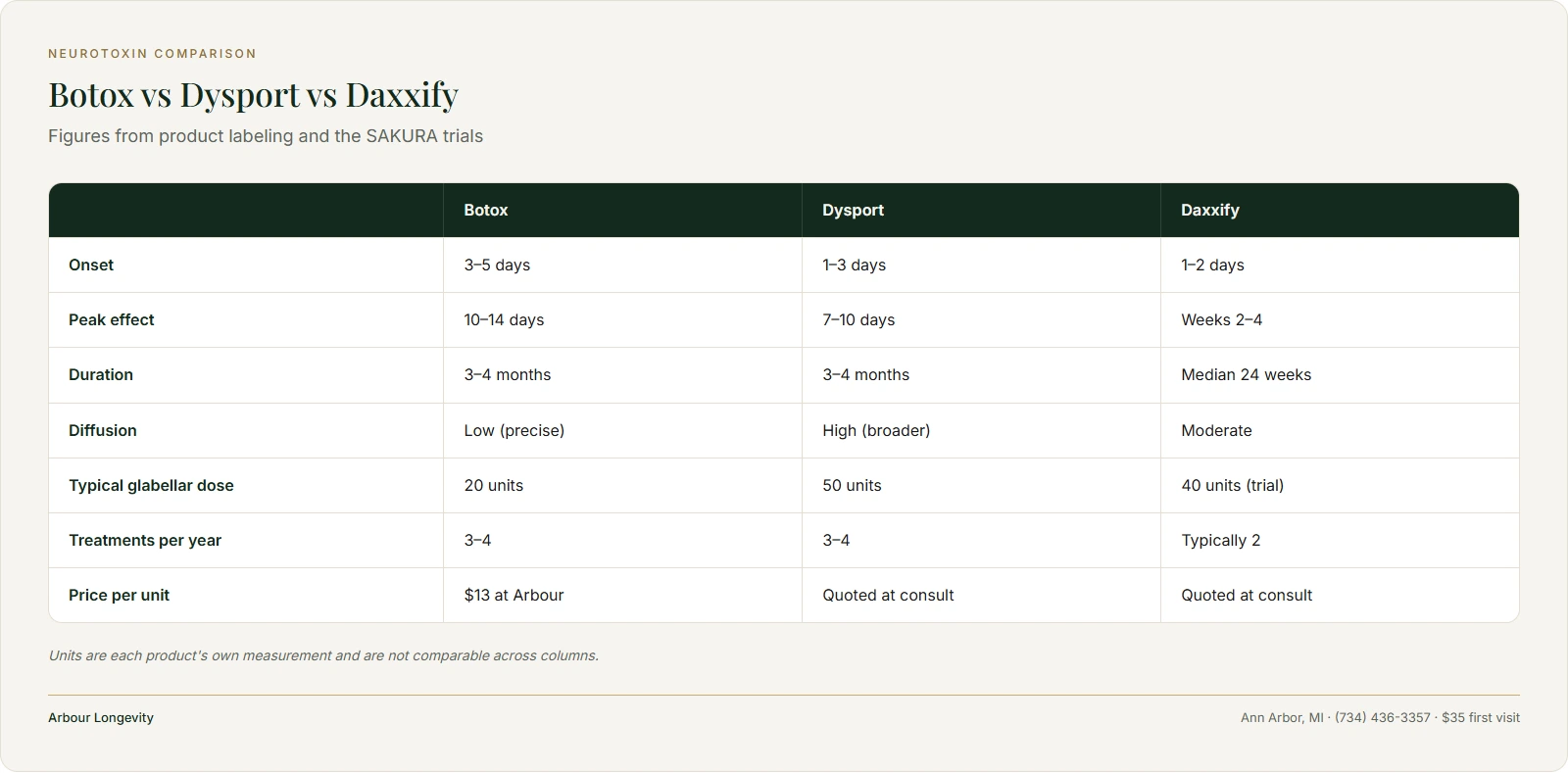
| Feature | Botox | Dysport | Daxxify |
|---|---|---|---|
| Generic Name | OnabotulinumtoxinA | AbobotulinumtoxinA | DaxibotulinumtoxinA |
| Manufacturer | AbbVie (Allergan) | Galderma | Revance Therapeutics |
| FDA Cosmetic Approval | 2002 | 2009 | 2022 |
| Onset of Action | 3-5 days | 1-3 days | 1-2 days |
| Peak Effect | 10-14 days | 7-10 days | Weeks 2-4 (SAKURA 3) |
| Duration | 3-4 months | 3-4 months | Median 24 weeks (SAKURA) |
| Diffusion/Spread | Low (precise) | High (broader) | Moderate |
| Typical Glabellar Dose | 20 units | 50 units | 40 units (trial dose) |
| Unit Equivalence | 1x (reference) | No labeled ratio | Not interchangeable |
| Contains Human/Animal Protein | Yes (human serum albumin) | Yes (human serum albumin) | No (peptide excipient) |
| Treatments Per Year | 3-4 | 3-4 | Typically 2 |
| Ideal Treatment Areas | Precise areas (crow's feet, brow shaping) | Broad areas (forehead), fast results | All areas; patients wanting fewer visits |
Units in the table above are each product's own units. They are not comparable across columns.
How Much Does Daxxify Cost?
Pricing works one of two ways: per unit, or per treatment area. Botox at Arbour Longevity is $13 per unit, as shown on our Botox page. We quote current pricing for Daxxify, Dysport, Xeomin and Jeuveau at your first visit, rather than posting figures that go stale. You will have the number before anything is drawn up.
The more useful point is how to compare. Each product uses its own unit system. So a per-unit price in one product tells you nothing about a per-unit price in another. A 40-unit Daxxify glabellar dose and a 20-unit Botox glabellar dose are not two versus one of the same thing. They are two different measures. The only comparison that means anything is the total cost of a treatment that gets your result. Then compare the cost across a year.
Is Daxxify More Expensive Than Botox?
Per treatment, Daxxify is usually priced above Botox. Across a year the math changes. The SAKURA trials report a median duration of around 24 weeks for Daxxify, against the 3-to-4-month gap typical of Botox. For many patients that means two visits a year instead of three or four. Whether that lands cheaper, dearer or level for you depends on your dose and how often you return. It is a sum worth doing out loud at your first visit rather than guessing at.
Your first visit at Arbour Longevity is $35, and that fee is applied toward your treatment plan.
Why the Units Are Not Interchangeable
This is the single most misunderstood point in the whole comparison, so it is worth stating plainly. One unit of Botox is not one unit of Dysport, and neither is one unit of Daxxify. Each product's units are defined by its own potency assay. They are different scales, the way a mile and a kilometer are different scales. The catch is that the conversion factor between these products is not fixed and not printed on the label.
The De Boulle review notes that the FDA required distinct generic names for these products to make that visible. It also warned that dosing cannot rest on any single conversion ratio (DOI: 10.2147/cia.s9338). The Cochrane review makes the same point from the evidence side. Comparisons across products only mean something once the unequal dosing systems are accounted for (DOI: 10.1002/14651858.CD011301.pub2).
The upshot for you is simple. Comparing clinics on cost per unit alone will mislead you unless you are comparing the same product. A quoted unit count only means something next to the product name.
All Five Neuromodulators, Under One Roof in Ann Arbor
Most practices stock one or two of these products and fit every patient to what is in the fridge. Arbour Longevity stocks all five FDA-approved neuromodulators (another name for these muscle-relaxing shots): Botox, Daxxify, Dysport, Xeomin and Jeuveau.
That matters for a specific reason. Everything above describes real gaps between these products, in spread, onset, duration and formula. Those gaps only help you if your provider can act on them. A clinic that carries Botox alone can tell you Daxxify lasts longer and then treat you with Botox anyway. Carrying all five turns this comparison into a real choice. That includes using different products in different areas of the same face. It also means you can change product between visits if your first result was not quite what you wanted.
Gandhi Bhattarai, FNP-BC, PMHNP-BC, Anti-Aging/Functional Medicine BC is a triple board certified nurse practitioner. She performs every injection herself. You can read more about neurotoxin treatment on our Botox page. Our Skin Longevity + Botox and dermal fillers pages show how injectables fit with our other work.
How to Choose: Questions to Ask Your Provider
The right product for you depends on your goals, your face and what you prefer. Worth asking:
- How often am I willing to come in? If fewer visits is the priority, Daxxify's longer median duration is the evidence to weigh.
- How quickly do I need to see a change? Dysport is the faster of these products to show an effect.
- Which area is being treated? Spread that helps across a forehead can work against you near the brow.
- Do I have a formula preference? Daxxify and Xeomin both use the core neurotoxin without complexing proteins. Daxxify uses a peptide excipient in place of an albumin-based stabilizer.
- How did I respond last time? Your own history with a product is better evidence for your face than any general chart.
- What will this cost across a year, not just today? Ask for the yearly number, in the product you are actually being treated with.
Frequently Asked Questions
Can I switch between neurotoxins?
Yes. Many patients try different products to find their best fit. You can switch between Botox, Dysport, Daxxify, Xeomin and Jeuveau when you are due for retreatment. Some patients prefer different products for different treatment areas.
Do neurotoxins prevent wrinkles from forming?
Regular treatment reduces the repeated muscle movements that etch dynamic wrinkles into the skin over time. Starting before deep lines form is a common way to prevent them in aesthetic medicine. It is often called preventive Botox or baby Botox.
What happens if I stop getting neurotoxin treatments?
Your muscles slowly return to normal and lines come back over time. You will not look worse than you did before treatment.
Are neurotoxin treatments painful?
Most patients describe the sensation as a brief pinch. The needles are very fine, and treatment takes about 10 to 15 minutes. Topical numbing cream or ice can be applied beforehand if you are sensitive.
How do I know I am getting authentic product?
Arbour Longevity buys every product directly from the makers through authorized distributors. We never use counterfeit, diluted or gray-market products.
Book Your Neurotoxin Consultation in Ann Arbor
Choosing between Botox, Dysport, Daxxify, Xeomin and Jeuveau is a choice worth making with someone who stocks all five. That provider has no reason to steer you toward one. Gandhi Bhattarai, FNP-BC, PMHNP-BC, Anti-Aging/Functional Medicine BC, will assess your face and talk through your goals. She will then recommend a product and plan based on the evidence.
Arbour Longevity is at 2217 Packard St #15, in the Eastover Professional Center, Ann Arbor, MI 48104. We are open Thursday through Monday, 10am to 7pm. Your first visit is $35, applied toward your treatment plan. Book your $35 first visit online, or call (734) 436-3357.
References
- Nestor M, Ablon G, Pickett A. Key parameters for the use of abobotulinumtoxinA in aesthetics: onset and duration. Aesthet Surg J. 2017;37(suppl_1):S20-S31. DOI: 10.1093/asj/sjw282
- Dashtipour K, Chen JJ, Espay AJ, Mari Z, Ondo W. OnabotulinumtoxinA and abobotulinumtoxinA dose conversion: a systematic literature review. Mov Disord Clin Pract. 2015;3(2):109-115. DOI: 10.1002/mdc3.12235
- Scaglione F. Conversion ratio between Botox, Dysport, and Xeomin in clinical practice. Toxins (Basel). 2016;8(3):65. DOI: 10.3390/toxins8030065
- De Boulle K, Fagien S, Sommer B, Glogau R. Treating glabellar lines with botulinum toxin type A-hemagglutinin complex: a review of the science, the clinical data, and patient satisfaction. Clin Interv Aging. 2010;5:101-118. DOI: 10.2147/cia.s9338
- Kutschenko A, Manig A, Reinert MC, Mönnich A, Liebetanz D. In-vivo comparison of the neurotoxic potencies of incobotulinumtoxinA, onabotulinumtoxinA, and abobotulinumtoxinA. Neurosci Lett. 2016;627:216-221. DOI: 10.1016/j.neulet.2016.06.001
- Carruthers JD, Fagien S, Joseph JH, et al. DaxibotulinumtoxinA for injection for the treatment of glabellar lines: results from each of two multicenter, randomized, double-blind, placebo-controlled, phase 3 studies (SAKURA 1 and SAKURA 2). Plast Reconstr Surg. 2020;145(1):45-58. DOI: 10.1097/PRS.0000000000006327
- Bertucci V, Solish N, Kaufman-Janette J, et al. DaxibotulinumtoxinA for injection has a prolonged duration of response in the treatment of glabellar lines: pooled data from two multicenter, randomized, double-blind, placebo-controlled, phase 3 studies (SAKURA 1 and SAKURA 2). J Am Acad Dermatol. 2020;82(4):838-845. DOI: 10.1016/j.jaad.2019.06.1313
- Fabi SG, Cohen JL, Green LJ, et al. DaxibotulinumtoxinA for injection for the treatment of glabellar lines: efficacy results from SAKURA 3, a large, open-label, phase 3 safety study. Dermatol Surg. 2021;47(1):48-54. DOI: 10.1097/DSS.0000000000002531
- Green JB, Mariwalla K, Coleman K, et al. A large, open-label, phase 3 safety study of daxibotulinumtoxinA for injection in glabellar lines: a focus on safety from the SAKURA 3 study. Dermatol Surg. 2021;47(1):42-46. DOI: 10.1097/DSS.0000000000002463
- Gallagher CJ, Bowsher RR, Clancy A, et al. Clinical immunogenicity of daxibotulinumtoxinA for injection in glabellar lines: pooled data from the SAKURA phase 3 trials. Toxins (Basel). 2023;15(1):60. DOI: 10.3390/toxins15010060
- Frevert J. Xeomin is free from complexing proteins. Toxicon. 2009;54(5):697-701. DOI: 10.1016/j.toxicon.2009.03.010
- Dressler D. Five-year experience with incobotulinumtoxinA (Xeomin): the first botulinum toxin drug free of complexing proteins. Eur J Neurol. 2012;19(3):385-389. DOI: 10.1111/j.1468-1331.2011.03559.x
- Jost WH, Blümel J, Grafe S. Botulinum neurotoxin type A free of complexing proteins (XEOMIN) in focal dystonia. Drugs. 2007;67(5):669-683. DOI: 10.2165/00003495-200767050-00003
- Camargo CP, Xia J, Costa CS, et al. Botulinum toxin type A for facial wrinkles. Cochrane Database Syst Rev. 2021;7(7):CD011301. DOI: 10.1002/14651858.CD011301.pub2
This article is for educational purposes only and is not medical advice. Results vary from person to person. Talk with a qualified provider about whether any treatment is right for you.

Gandhi Bhattarai, FNP-BC, PMHNP-BC, Anti-Aging/Functional Medicine BC
Triple board-certified nurse practitioner and founder of Arbour Longevity in Ann Arbor. Every article is written from clinic practice and reviewed against current guidelines.
✓ Medically reviewed · Last updated August 19, 2026
How we reviewed this article
Arbour Longevity articles are written by the treating clinician, checked against primary sources (peer-reviewed journals, FDA labeling, Endocrine Society and other specialty guidelines) and re-reviewed when guidance changes. See our editorial policy. Spotted an error? Email info@arbourlongevity.com.
This article is educational and is not a substitute for individualized medical advice. Whether a treatment is appropriate for you is determined during consultation.
Your symptoms have a cause. Let’s find it.
Book a $35 first visit in Ann Arbor. It’s a 30–45 minute consultation with Gandhi Bhattarai, applied toward your plan. Serving Ann Arbor, Ypsilanti, Saline, Dexter, Chelsea, and Michigan by telehealth.





.webp)

