

Key takeaways
- Midlife brain fog is usually a hormone and metabolic signal, not a character flaw or "just aging."
- Estrogen, progesterone, testosterone, thyroid, and blood sugar all directly affect how clearly you think.
- It shows up as word-finding trouble, slower processing, forgetting why you walked into a room, and afternoon crashes.
- When the underlying hormones and metabolism are corrected, thinking usually recovers, often within weeks.

If you're in your late 30s through your 50s and have always been sharp, but now the words come slower and names go missing, you're not imagining it. Focus that used to be automatic takes real effort. It's usually not "just stress." Brain fog has a real biological cause. Most often it's a signal that your hormones and metabolism have shifted, and that's treatable.
Why "it's just stress" is usually the wrong answer
When a 42-year-old says "my memory isn't what it was," the usual response is stress, sleep, screens, anxiety, or age. Then comes "your labs are normal." Those things matter. But the hidden message, that it's a behavior problem and not a body problem, is often wrong.
Three clues point to biology. Pattern: brain fog rarely comes alone. It travels with changes in sleep, mood, weight, sex drive, and energy. Timing: it clusters at exactly the age hormones start shifting. Response: when we fix the hormones and metabolism, thinking reliably improves. If it were purely stress, that wouldn't happen. But it does. This is the same "normal labs, real symptoms" gap covered in why your labs look normal but you feel terrible.
What your hormones do for your brain
These aren't "just" reproductive hormones. They run your brain too.
- Estrogen boosts blood flow to the brain and supports memory and focus. When it drops or swings, the mental cost is immediate.
- Progesterone (the bioidentical form) calms the brain and deepens sleep. Better sleep means clearer thinking the next day.
- Testosterone (in both men and women) drives motivation, focus, and word fluency. In women it's the most commonly missed hormone behind "I don't feel like myself."
- Thyroid sets the speed of every brain cell. Even a low-but-"normal" level can slow you down, and the usual TSH-only test misses it.
- Blood sugar and insulin: your brain runs on glucose, so the post-lunch "foggy head" is often a blood-sugar swing.
In perimenopause and in men's testosterone decline, several of these shift at once. The brain is running on weaker inputs from several directions. That's the fog. It often overlaps with fatigue after 40 and, for women, perimenopause.
Not sure if this is you?
A 30–45 minute consultation and a full hormone, thyroid and blood-sugar panel to find what is driving the fog, with the $35 applied toward your plan.
Book your $35 first visit Call (734) 436-3357
The brain is remodeling, not breaking
Brain imaging during the menopause transition shows real, temporary changes in areas tied to memory and focus, along with reduced blood flow. Research also shows the brain can recover and adapt afterward. In plain terms, midlife brain fog is a signal that your biology has shifted and needs support. It is not the start of a long decline. Supporting the hormones, sleep, and metabolism gives the brain what it needs to bounce back.
Men get this too, and miss it more
Men's testosterone drops about 1-2% a year from their early thirties. By their late forties many are "in range" but well below their own baseline. The fog shows up as lower drive, slower word recall, less mental edge, and afternoon mental fatigue. Many describe it as running at 70-80%. Most men chalk it up to age and never check. Knowing your testosterone, free testosterone, SHBG (the protein that binds your hormones), thyroid, and blood sugar is the highest-leverage move for a busy man in his forties.
What I see in clinic: the high performer, the founder, attorney, or surgeon, notices it first because the job demands the most brainpower. Yet they are the most likely to blame stress. When the hormone and metabolic gaps are corrected, they often describe getting back something they didn't realize they'd lost.
What the workup and recovery look like
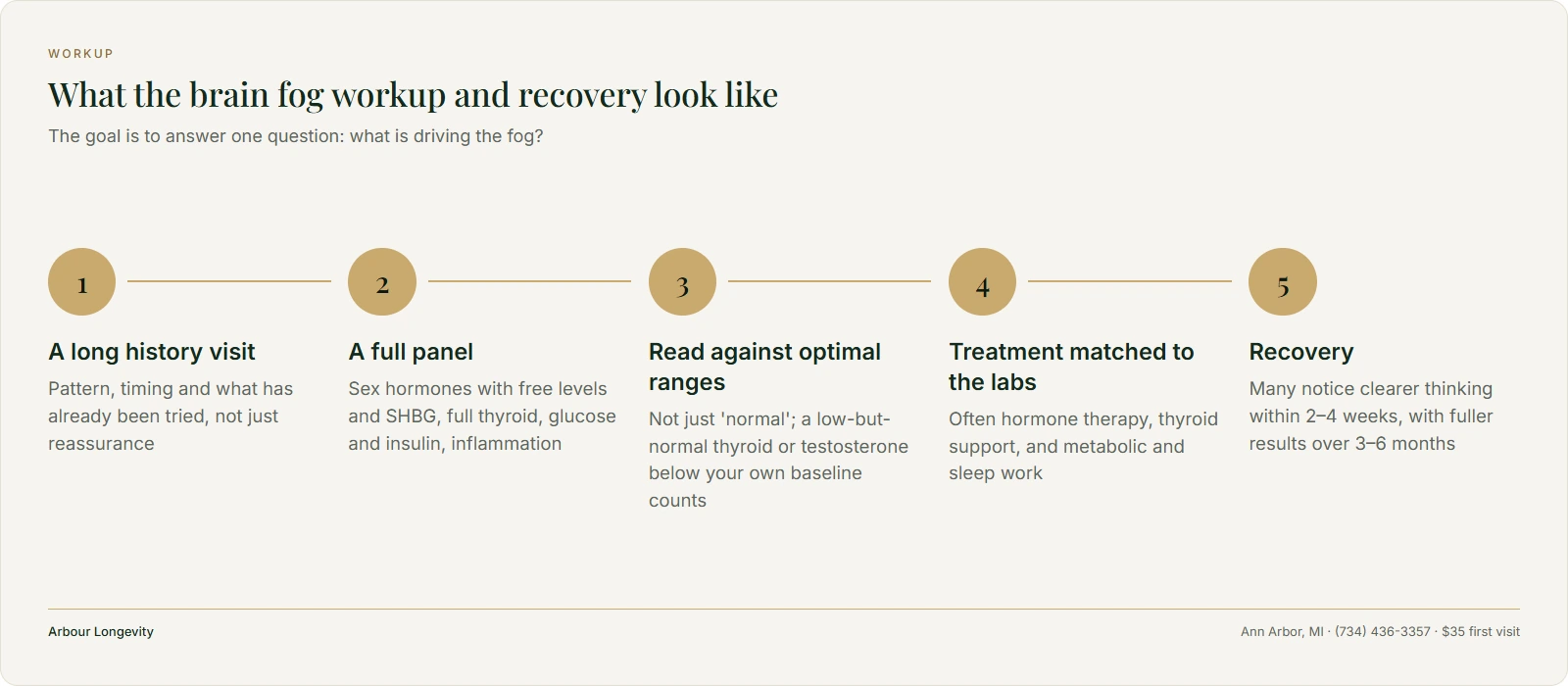
The goal is to answer one question: what's driving the fog? That means a long history visit plus a full panel read against optimal ranges, not just "normal." The panel covers sex hormones with free levels and SHBG, a complete thyroid panel, blood-sugar and insulin markers, inflammation, and key nutrients. Treatment is matched to what the labs show, often hormone therapy, thyroid support, and metabolic and sleep work. Many people notice clearer thinking within 2-4 weeks, with fuller results over 3-6 months.
Frequently Asked Questions
Is brain fog a sign of dementia?
For most people in their 40s and 50s, no. Midlife brain fog is usually tied to hormone and metabolic shifts and improves when those are addressed. Persistent or worsening memory loss should always be evaluated. But fog that comes with sleep, mood, and energy changes is a different, treatable pattern.
Can perimenopause cause brain fog before my periods change?
Yes. Estrogen and progesterone can swing for years before periods become irregular. Those swings affect focus and memory while cycles still look normal.
Will hormone therapy actually help my thinking?
When labs and symptoms line up, correcting the underlying hormones and metabolism reliably improves focus, word recall, and mental energy. It's not a guarantee for everyone, and it works best alongside sleep, nutrition, and exercise.
Why does my brain fog get worse after lunch?
That afternoon crash is often a blood-sugar swing. A meal high in fast carbs spikes then drops your glucose, and your brain, which runs on glucose, feels it. More protein and fiber at lunch usually helps.
How fast does brain fog improve with treatment?
Many people notice better sleep within a week or two and clearer thinking within 2-4 weeks. Fuller improvement comes over 3-6 months as the plan is fine-tuned.
The next step
If midlife brain fog has been showing up and the standard reassurance hasn't matched your experience, the right next step is a proper workup. The $35 first visit at Arbour Longevity is built for exactly this conversation. Book your $35 first visit or call (734) 436-3357. We're at 2217 Packard St #15, Ann Arbor, MI 48104, open Thursday through Monday, 10am to 7pm.
References
- Maki PM, Henderson VW. Cognition and the menopause transition. Menopause (review).
- Mosconi L, et al. Menopause-related brain changes on neuroimaging.
- The Menopause Society. Menopause and cognition resources (2024-2025).
This article is educational and does not replace individualized medical advice.

Gandhi Bhattarai, FNP-BC, PMHNP-BC, Anti-Aging/Functional Medicine BC
Triple board-certified nurse practitioner and founder of Arbour Longevity in Ann Arbor. Every article is written from clinic practice and reviewed against current guidelines.
✓ Medically reviewed · Last updated June 8, 2026
How we reviewed this article
Arbour Longevity articles are written by the treating clinician, checked against primary sources (peer-reviewed journals, FDA labeling, Endocrine Society and other specialty guidelines) and re-reviewed when guidance changes. See our editorial policy. Spotted an error? Email info@arbourlongevity.com.
This article is educational and is not a substitute for individualized medical advice. Whether a treatment is appropriate for you is determined during consultation.
Your symptoms have a cause. Let’s find it.
Book a $35 first visit in Ann Arbor. It’s a 30–45 minute consultation with Gandhi Bhattarai, applied toward your plan. Serving Ann Arbor, Ypsilanti, Saline, Dexter, Chelsea, and Michigan by telehealth.






.webp)

