

Low Libido Treatment Beyond Hormones: Medications, Pain, Sleep and Non-Hormonal Options, Ann Arbor
Key takeaways
- When hormone therapy has not restored desire, subtract first: medication effects, pain, sleep, mood, thyroid and iron are common and fixable.
- Testosterone has real evidence for postmenopausal women, but a normal or low blood level neither rules low desire in nor out.
- Bremelanotide (PT-141) is FDA-approved for premenopausal women and gives moderate, not dramatic, gains.
- PRP and the O-Shot are reasonable to discuss, with a small and low-quality evidence base to date.
- Sex therapy is a named treatment arm, not a consolation prize.
Start with the map. If you have not yet worked out which layers are in play for you, read our main guide first: Low Libido in Women: Why It Is Multifactorial and How to Address It. It covers the whole system, hormones, brain chemistry, comfort, mood, sleep, medications and relationship, and how to sort which is driving yours. This page is the next step: what to do when the hormone layer has been addressed and desire still has not returned.
The short version. Before adding anything, subtract. The fixable factors, medication effects, pain, sleep, mood, thyroid and iron, come first, because they are common and nothing layered on top works well until they are handled. After that there are brain-acting options, regenerative options and psychosexual therapy, each with a different weight of evidence behind it. We say which is which.
First, Subtract
The international process-of-care algorithm for low desire in women is clear about order. A biopsychosocial assessment of fixable factors comes first. Treatment then begins with education and changing those factors. Only then, if needed, does further treatment follow: sex therapy, brain-acting agents, or hormone therapy guided in part by menopausal status (Clayton et al., Mayo Clin Proc, 2018, DOI).
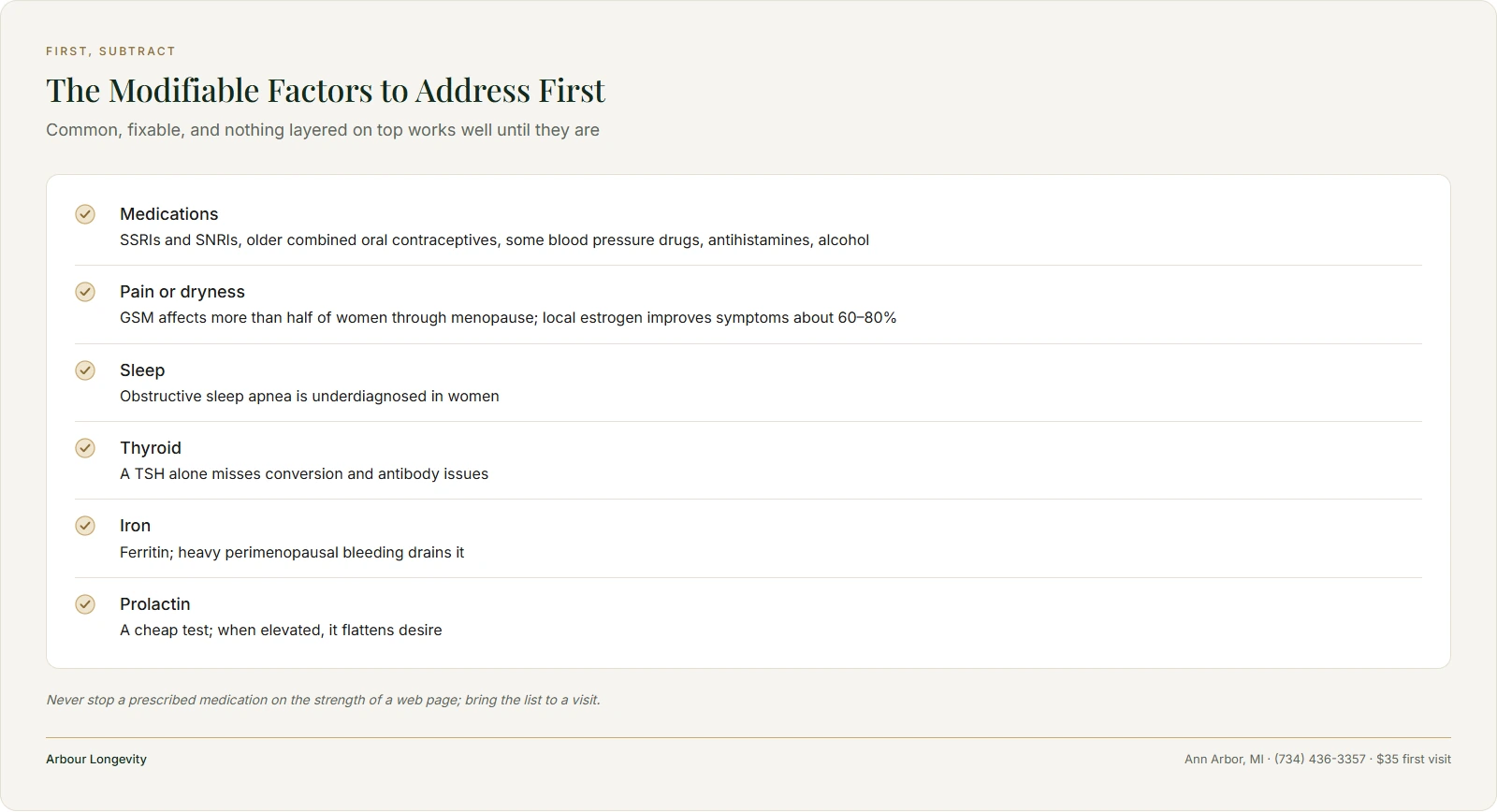
That order matters in practice. Adding a second medication on top of an unaddressed cause is how people end up on four things and no better.
When Pain or Dryness Is the Actual Barrier
This is the single most common reason a hormone protocol appears not to work. If sex is uncomfortable, desire does not survive it. The expectation of discomfort suppresses interest long before anything happens.
Genitourinary syndrome of menopause (the modern term for vaginal atrophy) affects more than half of women through the transition, and it is one of the more treatable problems in this whole field. Low-dose vaginal estrogen improves symptom severity by about 60 to 80 percent, vaginal prasterone by 40 to 80 percent, and oral ospemifene by 30 to 50 percent (Crandall et al., JAMA, 2023, DOI). Local therapy is low-dose and works on tissue where it is applied, which is a different proposition from body-wide hormone therapy.
Pain that does not fit that picture needs its own exam rather than being folded into a desire conversation. A specific site, pain on entry versus deep pain, pain with a clear onset. Pelvic floor muscle dysfunction, vestibular pain and skin conditions of the vulva all present as "low libido" until someone looks. Our guide to sexual pain in women covers the causes and treatments.
Medications That Suppress Desire
Worth reviewing line by line before anything is added:
- SSRIs and SNRIs. The most common culprit we see. Options include a dose adjustment, a switch to an antidepressant with fewer sexual side effects, adding a second medication, or strengthening therapy so medication can be reduced. Because psychiatric mental health is one of the three certifications here, that adjustment happens in-house rather than as a referral.
- Combined oral contraceptives, especially older versions, which raise SHBG (a protein that binds hormones so tissues cannot use them) and lower the free hormone available to tissue. The effect can persist for a while after stopping.
- Certain blood pressure medications, including some beta blockers and older agents.
- Antihistamines and anticholinergics, which reduce lubrication.
- Alcohol, in more than modest amounts, which breaks up sleep and blunts arousal even when it feels like it does the opposite.
Never stop a prescribed medication on the strength of a web page. Bring the list to a visit and it gets reviewed properly.
Sleep, Thyroid, Iron and Prolactin
These are the four that most often explain a hormone protocol that did not deliver.
Sleep sits upstream of everything, and obstructive sleep apnea is badly underdiagnosed in women, whose presentation is often fatigue and low mood rather than loud snoring. Broken sleep suppresses desire directly and through every other route.
Thyroid disease imitates hormone decline almost perfectly. A TSH alone is the usual screen, and it misses conversion and antibody issues that a fuller picture would show.
Iron deficiency, with or without anemia, is common in perimenopause because bleeding is often heavy, and it produces exactly the exhaustion that ends interest. Ferritin is the marker.
Prolactin, when raised, flattens desire and changes the whole plan. It is a cheap test and it is worth doing.
How each of these markers is drawn, timed and read is set out in our guide to hormone lab testing and monitoring.
Tried hormones and still stuck?
A 30-45 minute first visit that reviews your medications, sleep, thyroid, iron and prolactin before anything new is added, with the $35 applied toward your plan.
Book your $35 first visit Call (734) 436-3357
When Testosterone Is the Right Tool, and When It Is Not
Testosterone has real evidence behind it for the right patient. The Global Consensus Position Statement, endorsed by eleven international societies, supports low, female-dose testosterone for postmenopausal women with distressing low desire (Davis et al., J Clin Endocrinol Metab, 2019, DOI). A systematic review in The Journal of Sexual Medicine found the strongest evidence in postmenopausal women, where randomized trials showed robust gains in sexual desire with skin-applied testosterone (DOI: 10.1093/jsxmed/qdag206).
Two honest qualifications. First, the clinical practice guideline recommends skin-applied testosterone for women whose low desire is not mainly related to fixable factors or other conditions such as relationship or mental health problems. That is exactly why the subtraction step comes first. The guideline describes the benefit as moderate (Parish et al., J Sex Med, 2021, DOI). Second, a total testosterone level should not be used to diagnose low desire. It is a baseline for monitoring, kept within the normal premenopausal range (Parish et al., 2021, DOI). A normal number does not rule the diagnosis out, and a low one does not rule it in.
If you have had a well-monitored trial at a proper dose for six to twelve weeks and nothing changed, that is useful information. It often means the driver is elsewhere.
Brain-Acting Options
Bremelanotide (PT-141)
Bremelanotide is FDA-approved for premenopausal women with hypoactive sexual desire disorder (HSDD, low desire that causes distress). It acts on melanocortin receptors in the brain rather than on hormones or blood flow, and it is given as an as-needed injection under the skin.
The evidence is two identical phase 3 randomized, double-blind, placebo-controlled trials known as RECONNECT. In them, 1,267 premenopausal women with HSDD were randomized to bremelanotide 1.75 mg or placebo (an inactive look-alike) for 24 weeks. Both trials showed real gains in sexual desire and real reductions in distress about low desire compared with placebo, with a favorable safety profile. The most common side effects were nausea, flushing and headache, mostly mild or moderate (Kingsberg et al., Obstet Gynecol, 2019, DOI). The responder definitions used in those trials were developed and validated beforehand in a phase 2b dose-ranging study (Althof et al., J Sex Med, 2019, DOI).
Read the effect sizes rather than the headline. These were real gains, and they were moderate rather than transformative. That is a reasonable thing to want, and it is worth knowing in advance.
Regenerative Options: PRP and the O-Shot
PRP (platelet-rich plasma, a concentrate of your own blood platelets) is injected into the front vaginal wall and nearby tissue, with the aim of supporting tissue quality, blood flow and sensitivity.
Here is the evidence as it stands. A systematic review (a study that pools the results of many trials) of PRP for female sexual dysfunction and stress urinary incontinence found that PRP improved the Female Sexual Function Index, the Vaginal Health Index and the Female Sexual Distress Score across the included studies. The typical protocol was 2 mL injected into the front vaginal wall once a month for three months. The same authors are direct that the level of current evidence is low because of weaknesses in the available studies, and that better research is needed (Dankova et al., Biomedicines, 2023, DOI). A separate randomized comparison in postmenopausal women with vulvovaginal atrophy found both PRP and hyaluronic acid injection effective. Hyaluronic acid showed the greater gain on sexual function scores, with no complications in either group (Ragy et al., Arch Dermatol Res, 2025, DOI).
Our position: PRP is a reasonable option to discuss, especially alongside local therapy for tissue quality. It should be chosen with the actual state of the evidence in front of you rather than a promise. Arbour Longevity offers it as part of the sexual wellness program.
Therapy, and Why It Is Not the Consolation Prize
Sex therapy is one of the named treatment arms in the international process of care, alongside brain-acting agents and hormone therapy: behavior therapy, cognitive behavior therapy and mindfulness (Clayton et al., 2018, DOI). It is not what you are offered when the medical options run out.
For many women desire is responsive rather than spontaneous. It arrives after arousal begins, once the conditions are right. When that is the pattern, the useful step is often about conditions, attention and context rather than about a molecule. Depression, anxiety, past trauma and long-running stress all belong here too, and they are treatable.
Putting It Together
A workable sequence, roughly:
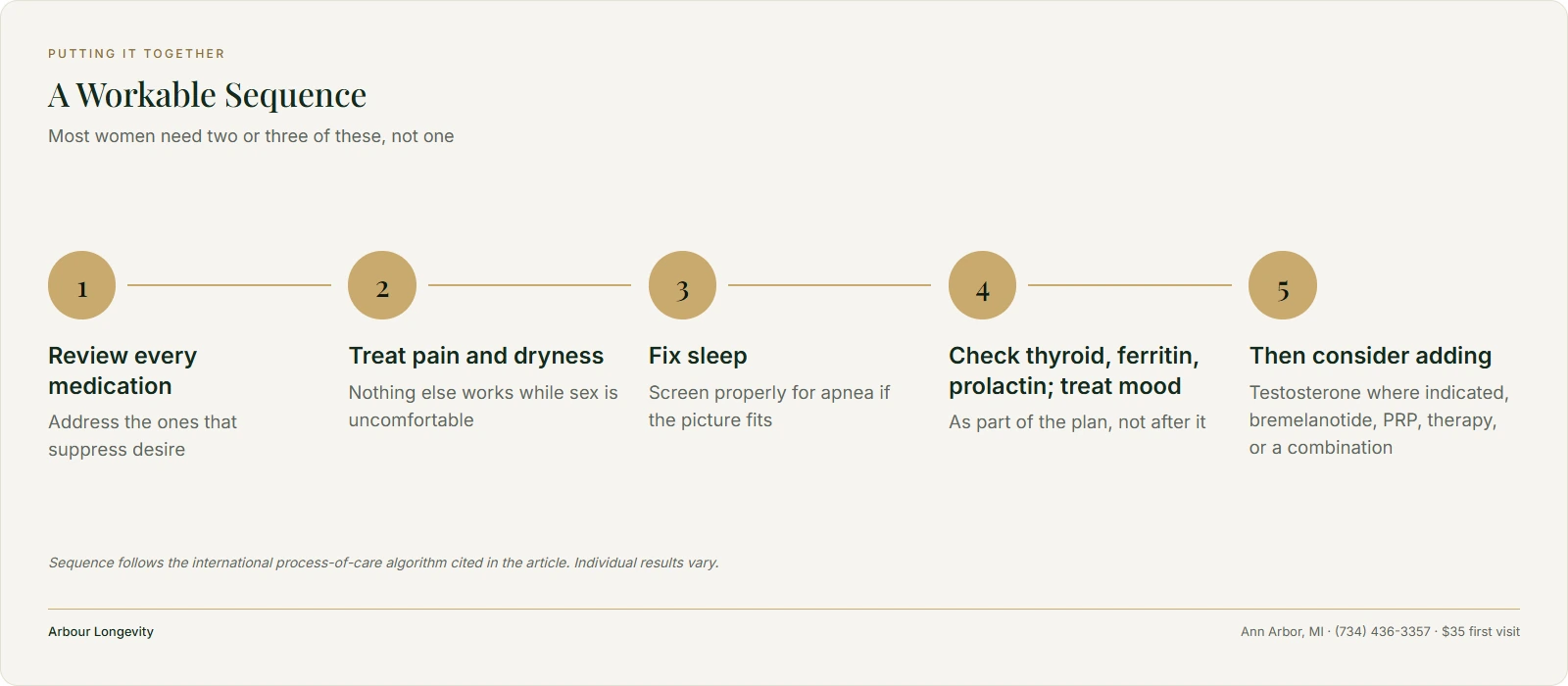
- Review every medication, and address the ones that suppress desire.
- Treat pain and dryness directly, because nothing else works while sex is uncomfortable.
- Fix sleep, and screen properly for apnea if the picture fits.
- Check thyroid fully, plus ferritin and prolactin.
- Treat mood and stress as part of the plan rather than after it.
- Then, and only then, consider adding: testosterone where it is indicated, a brain-acting option, a regenerative option, therapy, or a combination.
Most women need two or three of these, not one. That is the honest shape of it.
Frequently Asked Questions
I tried testosterone and nothing happened. What now?
A well-monitored trial at a proper dose that produced nothing after six to twelve weeks is useful information: it points away from the hormone layer. The next step is a careful review of medications, pain, sleep, thyroid, ferritin, prolactin and mood, which is where the answer often is.
Is bremelanotide the same thing as testosterone?
No. It works on melanocortin receptors in the brain rather than through hormones. It is taken as needed rather than every day. It is FDA-approved for premenopausal women with HSDD on the strength of two phase 3 randomized trials (Kingsberg et al., 2019, DOI).
Does the O-Shot work?
Studies to date report gains in Female Sexual Function Index, Vaginal Health Index and distress scores. The authors of the systematic review are equally clear that the evidence base is small and has weaknesses (Dankova et al., 2023, DOI). It is a reasonable option to consider with that framing, not a guaranteed result.
Do I have to stop my antidepressant?
No. A dose adjustment, a switch to an agent with fewer sexual side effects, or a second medication are all options. Mood is managed alongside desire rather than traded against it.
Could this just be my relationship?
Sometimes, partly, and it is asked about directly rather than assumed. Biologically driven low desire also occurs in strong relationships, and it can strain them in ways that look like the relationship is the cause. Sorting that out is the point of a proper assessment. The full picture is in our main guide to low libido in women.
How long before I know whether something is working?
Sleep and lifestyle changes shift things over 2 to 8 weeks. Local vaginal estrogen takes 4 to 8 weeks. Testosterone takes 6 to 12 weeks for full effect. Bremelanotide acts within roughly 45 minutes to 2 hours per dose. PRP effects develop over several weeks. We set the review date at the start rather than waiting to see.
Talk to Someone About It
Nothing on this page is medical advice for you specifically, and none of it needs to be decided alone. The first visit is $35, applied toward your treatment plan. It is a full evaluation with a recommendation on which labs and next steps make sense, not a product pitch.
Gandhi Bhattarai, FNP-BC, PMHNP-BC, Anti-Aging/Functional Medicine BC, is a triple board certified nurse practitioner and founder of Arbour Longevity, 2217 Packard St #15, in the Eastover Professional Center, Ann Arbor, MI 48104. Open Thursday through Monday, 10am to 7pm, closed Tuesday and Wednesday. Parking is free and directly outside, with no meters and no structure. Suite 15 is down a flight of stairs; if stairs are difficult for you, please call (734) 436-3357 before your visit.
Call (734) 436-3357 or book your $35 first visit, confidentially, online. Cash pay, HSA and FSA accepted.
References
According to PubMed, the clinical evidence cited on this page includes:
- Clayton AH, Goldstein I, Kim NN, et al. The International Society for the Study of Women's Sexual Health Process of Care for Management of Hypoactive Sexual Desire Disorder in Women. Mayo Clin Proc. 2018;93(4):467-487. PMID: 29545008. DOI: 10.1016/j.mayocp.2017.11.002
- Crandall CJ, Mehta JM, Manson JE. Management of Menopausal Symptoms: A Review. JAMA. 2023;329(5):405-420. PMID: 36749328. DOI: 10.1001/jama.2022.24140
- Davis SR, Baber R, Panay N, et al. Global Consensus Position Statement on the Use of Testosterone Therapy for Women. J Clin Endocrinol Metab. 2019;104(10):4660-4666. PMID: 31498871. DOI: 10.1210/jc.2019-01603
- Parish SJ, Simon JA, Davis SR, et al. ISSWSH Clinical Practice Guideline for the Use of Systemic Testosterone for Hypoactive Sexual Desire Disorder in Women. J Sex Med. 2021;18(5):849-867. PMID: 33814355. DOI: 10.1016/j.jsxm.2020.10.009
- Kingsberg SA, Clayton AH, Portman D, et al. Bremelanotide for the Treatment of Hypoactive Sexual Desire Disorder: Two Randomized Phase 3 Trials. Obstet Gynecol. 2019;134(5):899-908. PMID: 31599840. DOI: 10.1097/AOG.0000000000003500
- Althof S, Derogatis LR, Greenberg S, et al. Responder Analyses from a Phase 2b Dose-Ranging Study of Bremelanotide. J Sex Med. 2019;16(8):1226-1235. PMID: 31277966. DOI: 10.1016/j.jsxm.2019.05.012
- Dankova I, Pyrgidis N, Tishukov M, et al. Efficacy and Safety of Platelet-Rich Plasma Injections for the Treatment of Female Sexual Dysfunction and Stress Urinary Incontinence: A Systematic Review. Biomedicines. 2023;11(11):2919. PMID: 38001920. DOI: 10.3390/biomedicines11112919
- Ragy S, Kahky HE, Elfakkar NMZ, et al. Injection of hyaluronic acid versus platelet rich plasma for treatment of vulvovaginal atrophy in post-menopausal females. Arch Dermatol Res. 2025;317(1):305. PMID: 39853463. DOI: 10.1007/s00403-025-03820-z
- Furlan VA, Hammad MAM, Quesada S, et al. Testosterone therapy for female sexual dysfunction: a systematic review. J Sex Med. 2026;23(8). DOI: 10.1093/jsxmed/qdag206
- Heald A, Illangasekera Y, Rehman H, et al. Changes in serum testosterone concentration following application of testosterone gel in post-menopausal women with HSDD. Clin Endocrinol (Oxf). 2026;105(1):77-84. DOI: 10.1111/cen.70119
- Ashour AM. Clinical trial evidence on emerging pharmacological therapies for hypoactive sexual desire disorder in women. Front Med (Lausanne). 2026;13:1789809. DOI: 10.3389/fmed.2026.1789809
Clinical information here is drawn from articles retrieved from PubMed and provided for education. It is not medical advice, a diagnosis, or a promise of any result.

Gandhi Bhattarai, FNP-BC, PMHNP-BC, Anti-Aging/Functional Medicine BC
Triple board-certified nurse practitioner and founder of Arbour Longevity in Ann Arbor. Every article is written from clinic practice and reviewed against current guidelines.
✓ Medically reviewed · Last updated August 17, 2026
How we reviewed this article
Arbour Longevity articles are written by the treating clinician, checked against primary sources (peer-reviewed journals, FDA labeling, Endocrine Society and other specialty guidelines) and re-reviewed when guidance changes. See our editorial policy. Spotted an error? Email info@arbourlongevity.com.
This article is educational and is not a substitute for individualized medical advice. Whether a treatment is appropriate for you is determined during consultation.
Your symptoms have a cause. Let’s find it.
Book a $35 first visit in Ann Arbor. It’s a 30–45 minute consultation with Gandhi Bhattarai, applied toward your plan. Serving Ann Arbor, Ypsilanti, Saline, Dexter, Chelsea, and Michigan by telehealth.





.webp)

