

Menopause Treatment in Ann Arbor: Reclaim Your Comfort
Key takeaways
- Menopause treatment falls into three groups: bioidentical hormone therapy, non-hormonal and regenerative options, and lifestyle support.
- You do not have to wait until periods stop; starting within ten years of menopause carries the best benefit-to-risk balance.
- Hormone therapy is the most effective option for hot flashes, night sweats and vaginal changes.
- Testosterone, thyroid and cortisol are often missed in women and can drive fatigue, low libido and brain fog.
- Good care protects bone, heart, metabolism and muscle for the decades ahead, not just today's symptoms.

You are waking at 3 a.m. drenched in sweat. You walked into the kitchen and forgot why. Your moods swing without warning. The weight will not move no matter what you do, and sex has started to hurt. If this sounds familiar, you are not imagining it, and you are not "just getting older."
These are real, treatable symptoms of hormone change. The frustrating part is what most women hear next: that their labs are "normal for their age," that they should wait it out, or that nothing can be done. At Arbour Longevity in Ann Arbor, we start from a different place. Normal for your age is not the goal. Optimal is.
This guide walks you through every real treatment option: hormone, non-hormone, and lifestyle. It shows how a tailored, clinician-led plan treats not just the symptoms you feel today, but your strength, clarity, and long-term health for the decades ahead.
What Are Your Menopause Treatment Options?

Treatment falls into three groups: bioidentical hormone therapy (BHRT), non-hormonal and regenerative options, and lifestyle, metabolic, and functional support. Most women do best with a mix, built around their own symptoms, lab results, and goals rather than a default script.
The right starting point depends on what is hurting you most. A woman whose main struggle is severe hot flashes needs a different plan than one battling brain fog, stubborn weight gain, or painful intimacy. That is why good treatment begins with your full picture, not a one-size-fits-all protocol.
When Should You Actually Start Treatment for Menopause Symptoms?
You do not have to wait until your periods stop completely. The perimenopause years (the years of shifting hormones before periods stop) often begin in your early-to-mid 40s. They are often when symptoms hit hardest, as estrogen, progesterone, and testosterone swing and fall.
It may be time to look at the full hormone picture if you notice:
- Hot flashes, night sweats, or trouble regulating temperature
- Irregular, heavy, or missing periods
- Unexplained weight gain, especially around the midsection
- Low sex drive, vaginal dryness, or painful sex
- Anxiety, low mood, or mood swings
- Thinking changes: brain fog, trouble finding words, trouble focusing
- Thinning hair, dry skin, brittle nails
- Fatigue that sleep does not fix
- Loss of bone density or new joint discomfort
Having more than three of these at once matters clinically. Is heavier or more erratic bleeding one of them? Our guide to why your period got heavier after 40 explains which bleeding changes are common in perimenopause and when they need a closer look. There is also a timing reason not to wait. Hormone therapy started closer to menopause, generally before age 60 or within ten years of your final period, has a better balance of benefit and risk. Suffering through it for years is not a badge of honor, and it is not your only option.
Not sure where you stand? Our two-minute Hormone Score Quiz gives you a personal score and your next step.
Bioidentical Hormone Therapy (BHRT): What It Treats and Who It Is For
Bioidentical hormone therapy uses hormones with the same structure as the ones your body makes to restore balance and relieve symptoms. It remains the most effective treatment for hot flashes, night sweats, and the vaginal and urinary changes of menopause. Here it is tailored to your cycle status, symptoms, and health history, from perimenopause through post-menopause.
Unlike a generic prescription, our hormone care for women looks at the whole hormone system, not a single number. We check and, where it helps, improve:
- Estradiol (estrogen): central to hot flashes, mood, thinking, bone density, and heart health
- Progesterone: sleep, calm, and hormone balance
- Testosterone: one of the most missed drivers of fatigue, low sex drive, muscle loss, and poor focus in women
- DHEA and pregnenolone: parent hormones that shape everything downstream
- Thyroid and cortisol: often missed by standard panels, yet central to energy, weight, and mood
Delivery is tailored, too. Bioidentical estradiol and progesterone can be given as pills, skin creams, vaginal, or under-the-tongue forms, based on your needs and wishes. Hormone pellet therapy (rice-sized implants under the skin) gives steady levels for three to six months without daily dosing. There is no single right method, only the one that fits your body and life. For a route-by-route breakdown, see our comparison of how HRT patches, gels, pills, pellets, injections, and vaginal options compare.
Why Testosterone Matters for Women in Menopause
Most providers stop at estrogen and progesterone. That is a missed chance. Low testosterone in women is one of the most overlooked drivers of low sex drive, lasting fatigue, fading mental sharpness, and lost muscle. Our protocols for women include testosterone along with estrogen, progesterone, DHEA, and thyroid: the whole picture, not part of it.
Is Hormone Therapy Safe? Benefits vs. Risks
This is the question that stops most women. Usually the cause is headlines from the early-2000s Women's Health Initiative study. It linked hormone therapy to higher risks and led to strong warning labels.
Here is the important update. In 2025 the FDA took a fresh look at that older data next to newer products, delivery routes, and the age of women being treated. It moved to remove the long-standing boxed warnings from many menopause hormone products. The blanket fear that steered a generation of women away from good treatment has given way to a more careful, personal picture.
That does not mean hormone therapy is risk-free or right for everyone. A balanced view looks like this:
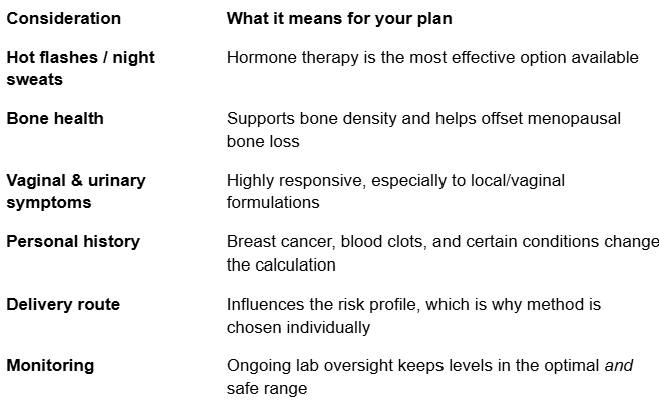
The honest takeaway: when prescribed and monitored by a qualified clinician, BHRT has a strong safety record. Here, every patient gets regular lab checks. We never "set and forget." Your own history still matters. That is exactly why this decision belongs in a thorough clinical conversation, not a comment section.
Non-Hormonal and Regenerative Menopause Treatment
Maybe hormones are not the right fit for you, or you would rather start elsewhere. The range of non-hormone options has never been broader.
For women who cannot or choose not to use hormones, prescription non-hormone drugs now exist for hot flashes. They are a class of brain-targeted drugs: fezolinetant, approved in 2023, and elinzanetant, approved in late 2025. Your clinician can discuss them as part of the wider picture. Beyond drugs, several of the best non-hormone tools are part of a complete plan:
- PT-141 (bremelanotide), FDA-approved for low sexual desire that causes distress (HSDD) in premenopausal women; other uses are discussed only at consultation.
- DHEA, the parent hormone that shapes mood, energy, and sexual wellness
- The O-Shot®, a regenerative PRP procedure for vaginal and sexual health (covered below)
- Functional medicine and health coaching to get at the root drivers behind symptoms
- Medical weight care for the metabolic shifts that come with menopause
These options prove a simple point. Not being a fit for hormones, or not wanting them, does not leave you without real choices.
Can You Treat Menopause Naturally? Lifestyle and Functional Support
Many women want to begin with the gentlest step. Lifestyle and functional support play a real role, above all for milder symptoms:
- Strength training and regular movement to preserve muscle and bone
- Protein-first eating that keeps blood sugar steady
- Limiting triggers like alcohol, caffeine, and spicy foods that set off hot flashes
- Putting sleep and stress relief first
- Targeted IV therapy, such as our Executive Focus and NAD+ drips, to support energy, recovery, and focus
For over-the-counter supplements like black cohosh or soy, the evidence is truly mixed, and quality varies widely. We would rather build your base on what can be measured and tracked, then layer the right treatment on top. Natural steps work best as a base, not a complete fix on their own.
Not sure which option fits you?
A 45-minute first visit and a full female hormone panel will show which of these paths is yours, with the $35 applied toward your plan.
Book your $35 first visit Call (734) 436-3357
How Do You Treat Specific Menopause Symptoms?

Menopause does not show up the same way for everyone. Treating it well means matching the right tool to the symptom that is actually wrecking your days.

How to Relieve Hot Flashes and Night Sweats
Hot flashes and night sweats, known clinically as vasomotor symptoms, are the signature of menopause. They affect roughly 80% of women. They range from mildly annoying to truly crippling, soaking sheets and shattering sleep.
For most women with moderate to severe symptoms, BHRT is the most effective path. It treats the hormone root rather than just managing the surface. Lifestyle changes, cooling tactics, avoiding triggers and paced breathing layer underneath for added relief. If you cannot use hormones, your clinician can discuss non-hormone drug options. The goal is not to simply "cope." It is to truly quiet the symptom.
Treatment for Menopause Brain Fog, Memory, and Focus
This is the symptom almost no one warns you about. The lost words, the dropped trains of thought, the mental slowness: it is real. It is tied to swinging estrogen, which plays a direct role in memory and thinking.
For high-performing women, this can be the most upsetting symptom of all. Leading a meeting and losing the thread. Rereading the same email three times. It is not a character flaw, and it is rarely "just stress."
Our approach addresses it on several fronts at once:
- Restoring hormones, since estrogen, testosterone, and thyroid all support thinking
- Protecting sleep, because much menopause brain fog comes from poor rest
- Supporting metabolic and brain health through food and, where it fits, NAD+ and Executive Focus IV therapy
- Movement, which has well-proven benefits for thinking
Brain fog usually travels with sleep loss, mood changes, and hormone shifts. So treating it works best as part of a connected plan, not on its own.
Menopause Insomnia, Anxiety, and Mood Swings: What Helps
The mood and sleep symptoms of menopause are tightly woven together. Poor sleep fuels anxiety, anxiety worsens sleep, and hormone swings make both worse.
Good treatment often combines three things. Progesterone support helps sleep and calm. Broader hormone balancing eases night sweats and steadies mood. Functional and lifestyle support works on stress and sleep habits. Our founder is triple board certified in family medicine, psychiatric mental health, and anti-aging and functional medicine. So we take the mental-health side of menopause as seriously as the physical one. New or worsening anxiety and low mood during this transition deserve real attention, not a brush-off.
Vaginal Dryness and Sexual Health After Menopause
Falling estrogen thins and dries vaginal tissue, a cluster of changes called genitourinary syndrome of menopause. It can cause dryness, irritation, urgency to urinate, and pain. Unlike hot flashes, it tends to get worse over time rather than fade.
Treatment options for painful sex and low sex drive. The good news is that these symptoms respond well to treatment, and we offer options most clinics do not:
- Bioidentical vaginal estradiol and progesterone to restore tissue health right where it is needed
- The O-Shot®, a private, same-visit procedure. Your own platelet-rich plasma (PRP), a concentrate of your blood platelets, is injected into specific areas to support sensation, arousal, lubrication, and bladder control.
- Testosterone and DHEA support, which often play an overlooked role in sex drive
Low sex drive after menopause is rarely about one thing. It sits where physical comfort, energy, mood, hormones, and connection meet. That is why we treat the whole picture, in private, rather than handing you a single prescription.
Why Personalized Hormone Care Beats One-Size-Fits-All

Here is what separates us from the rushed, ten-minute visit most women have endured. Every treatment is judged within your complete clinical picture. Your hormones, metabolism, mental health, and overall vitality are never separate problems.
This is also where a longevity practice differs from a standard clinic. The aim is not only to quiet today's hot flashes. It is to use this transition as a turning point for the next 30 to 40 years of your health.
How Precision Hormone Therapy Is Tailored to Your Body
Our process is built to remove guesswork:
- Full consultation: a thorough talk about your symptoms, history, goals, and lifestyle, in-office or by telehealth.
- Full hormone panel: a complete lab workup through LabCorp or Quest. It covers estradiol, progesterone, total and free testosterone, a full thyroid picture, DHEA, cortisol, pregnenolone, SHBG, and metabolic markers. Not just TSH. Not just one number.
- Precision protocol design: your plan is built around your own body, choosing the right hormones, the right delivery method, and the right dose for you.
- Ongoing fine-tuning: regular lab checks and dose changes as your body responds, at every stage.
The difference shows up in the details. Two women with the same symptoms might do best on entirely different plans. One might use pellets, another vaginal estradiol and a testosterone cream, based on their body, history, and goals. That tailoring is the entire point.
Treating the Long Game: Bone, Heart, Metabolic, and Muscle Health
Estrogen and testosterone do far more than run your cycle. Their decline touches your bones, heart, metabolism, and muscle. That is why treatment should look beyond symptom relief toward long-term protection of bone density, heart health, metabolism, and muscle.
Menopause, weight gain, and insulin resistance. The stubborn weight gain so many women notice, above all around the middle, is not a willpower problem. Hormone shifts can drive insulin resistance (cells that stop responding to insulin, so blood sugar and belly fat rise) and move fat to the belly.
Treating it well means going beyond "eat less, move more." Our Medical Weight Loss program uses clinician-supervised semaglutide or tirzepatide (GLP-1 therapy). These drugs mimic a gut hormone to curb appetite and steady blood sugar. We pair them with hormone care, strength work and steady-blood-sugar nutrition, targeting root causes, not just the number on the scale.
How treatment supports healthy aging and longevity. This is where menopause care and longevity medicine meet. The choices you make in your late 40s and 50s build over decades: protecting bone, keeping muscle, supporting heart and metabolic health, keeping your mind sharp.
Done well, treatment is not an ending to manage. It is a window to invest in how strong, clear, and capable you will feel at 60, 70, and beyond. That is the difference between simply surviving menopause and using it as a launch point. It is why we call it aging on your own terms.
Start Your Menopause Treatment with Arbour Longevity in Ann Arbor

Have you been told your symptoms are "just part of getting older"? Have you left visits with more questions than answers? You deserve a different conversation. Arbour Longevity is a clinician-led anti-aging and regenerative medicine practice founded by Gandhi Bhattarai, FNP-BC, PMHNP-BC, Anti-Aging/Functional Medicine BC. She is triple board certified in family medicine, psychiatric mental health, and anti-aging and functional medicine.
What to Expect at Your First Consultation
Your first step is a private, 45-minute visit with Gandhi. It covers what matters to you, what is going on in your body, and the shortest path to the outcome you want. We design the right lab panel to give us the full picture before recommending anything. We treat the whole person, never a lab number on its own. Telehealth hormone visits are available statewide across Michigan. Your first visit is $35, and that fee is applied toward your treatment.
Where to Find Us
- Visit: 2217 Packard St #15, Ann Arbor, MI 48104 (inside the Eastover Professional Center, free patient parking)
- Hours: Thursday to Monday, 10am to 7pm (closed Tuesday and Wednesday), by appointment
- Telehealth: available statewide for hormone care across Michigan
- Serving: Ann Arbor, Dexter, Saline, Ypsilanti, Plymouth, Canton, Northville, and Southeast Michigan
Frequently Asked Questions About Menopause Treatment
What is the best treatment for menopause?
There is no single best treatment. It depends on your symptoms, lab results, and goals. BHRT is the most effective option for hot flashes, night sweats, and vaginal changes. Peptides, the O-Shot®, weight care, and lifestyle support each target specific concerns. The best plan is a tailored one built around your full picture.
Is bioidentical hormone therapy safe?
When prescribed and monitored by a qualified clinician, BHRT has a strong safety record. Every patient here gets regular lab checks to keep levels in the optimal and safe range. In 2025, the FDA moved to remove long-standing boxed warnings from many hormone therapy products after a fresh look at older data. Your own history still guides every decision.
Do you offer testosterone therapy for women?
Yes. Low testosterone in women is one of the most missed drivers of fatigue, low sex drive, fading mental sharpness, and muscle loss. Our protocols for women include testosterone along with estrogen, progesterone, DHEA, and thyroid: the whole picture most providers miss.
Can menopause be treated without hormones?
Yes. Non-hormone options include DHEA, the O-Shot® for sexual wellness, functional medicine, medical weight care, and lifestyle support. Prescription non-hormone drugs for hot flashes also exist and can be discussed with your clinician.
How long before I feel results?
Most patients notice early gains in energy and sleep within two to four weeks. Sex drive, body composition, and thinking changes usually show at six to twelve weeks. Full results, where labs and symptoms line up, generally arrive at three to six months, with tweaks along the way.
Does menopause treatment help with brain fog and weight gain?
It can. Brain fog often improves when hormones are restored and sleep is protected. Menopause weight gain responds best to a combined plan: hormone care, strength training, protein-first eating, and, where it fits, our clinician-supervised GLP-1 weight program.
Do you accept insurance, and can I do this via telehealth?
Arbour Longevity is a cash-pay practice. That allows longer visits and treatment choices driven by clinical judgment rather than insurance rules. We accept HSA and FSA funds and give detailed receipts for possible reimbursement. Hormone visits are available by telehealth throughout Michigan; labs are ordered to your nearest LabCorp or Quest.
Book Your Personalized Menopause Treatment Plan
You do not have to push through hot flashes, sleepless nights, brain fog, or anything else menopause has thrown at you. Good, tailored, clinician-led treatment exists, and the sooner you start, the more you can protect for the years ahead. Ready to feel like yourself again? Take the two-minute Hormone Score Quiz, book your $35 first visit, or call (734) 436-3357.
This article is educational and does not replace individualized medical advice. Hormone therapy requires clinical evaluation, lab testing and ongoing monitoring by a licensed provider. Results vary.

Gandhi Bhattarai, FNP-BC, PMHNP-BC, Anti-Aging/Functional Medicine BC
Triple board-certified nurse practitioner and founder of Arbour Longevity in Ann Arbor. Every article is written from clinic practice and reviewed against current guidelines.
✓ Medically reviewed · Last updated August 21, 2026
How we reviewed this article
Arbour Longevity articles are written by the treating clinician, checked against primary sources (peer-reviewed journals, FDA labeling, Endocrine Society and other specialty guidelines) and re-reviewed when guidance changes. See our editorial policy. Spotted an error? Email info@arbourlongevity.com.
This article is educational and is not a substitute for individualized medical advice. Whether a treatment is appropriate for you is determined during consultation.
Your symptoms have a cause. Let’s find it.
Book a $35 first visit in Ann Arbor. It’s a 30–45 minute consultation with Gandhi Bhattarai, applied toward your plan. Serving Ann Arbor, Ypsilanti, Saline, Dexter, Chelsea, and Michigan by telehealth.





.webp)

