

HRT Delivery Methods Compared: How Patch, Gel, Pill, Pellet, Injection and Vaginal Estrogen Differ
Key takeaways
- The delivery route changes clotting risk, how finely the dose can be tuned, and how often you think about treatment.
- Transdermal estradiol (patch or gel) showed no increased clot risk in a UK study of 80,396 women; oral estrogen did.
- Pellets give steady levels for three to six months but cannot be adjusted once inserted, so they suit an established dose.
- Low-dose vaginal estrogen is a local treatment with minimal absorption, not systemic therapy.
- Your progestogen choice, not your estrogen route, is what governed breast-cancer risk in the E3N data.

You have already done the hard part. You have decided that the broken sleep, the 3 a.m. sweats, and the word that vanishes mid-sentence are worth treating, and that hormone therapy belongs on the table. Then the conversation turns practical and slightly bewildering. Patch or gel? Tablet or pellet? Is there an injection? What about the cream you have heard about for vaginal symptoms?
This is the part most articles wave at and move on from. It deserves better, because the delivery route is not packaging. It determines the path a hormone takes into your body and how finely the dose can be tuned once you are on it. It determines how often you think about treatment at all. And in the case of estrogen and clotting, it is one of the few variables you can actually choose.
This guide compares every route in routine use, honestly, including what each one gives up.
Why the Delivery Route Changes More Than Convenience
Two women can take the same hormone, at a comparable dose, and have measurably different experiences depending on how it gets in. The reason is anatomy.
The First-Pass Effect, in Plain Language
Anything you swallow is absorbed from the gut and travels straight to the liver before it reaches the rest of you. The liver processes it on the way through. That is the first-pass effect. For estrogen it matters, because the liver responds to an estrogen load by changing its output of clotting factors, binding proteins, and triglycerides (a blood fat).
A patch, a gel, or a pellet bypasses that first pass entirely. The hormone enters through skin or the tissue just under it and reaches the bloodstream directly. The liver sees ordinary circulating levels rather than a concentrated arrival. Same molecule, different journey, different downstream effects.
What the Clotting Data Actually Shows
This is where the difference stops being theoretical. A large UK study compared routes directly in 80,396 women with a venous thromboembolism (a blood clot in a vein), matched to 391,494 controls. Oral preparations were associated with an increased risk of clot compared with no hormone use (adjusted odds ratio 1.58, 95% CI 1.52 to 1.64). Transdermal preparations were not associated with increased risk at all (adjusted odds ratio 0.93, 95% CI 0.87 to 1.01) (Vinogradova et al., BMJ 2019; PMID 30626577).
Two things deserve saying plainly. First, absolute risk matters as much as relative risk. Clots are uncommon in otherwise healthy women in their fifties, so a relative increase of this size still means a small number of extra events, not a common outcome. Second, that is precisely why route is worth getting right. It is a decision that costs you nothing and is made once.
The same study found estradiol carried lower risk than conjugated equine estrogen within oral preparations. That is another reason the specific molecule and the specific route are both worth naming rather than lumping everything together as "HRT."
Transdermal Estradiol: Patches and Gels
Transdermal delivery means through the skin. It is, for many women, the sensible default starting point.
The Patch
An adhesive patch is worn on the lower abdomen or buttock and changed once or twice weekly depending on the product. Its strengths are steadiness and forgetfulness-proofing. Levels stay flat between changes, and there is no daily step to remember. Its limitations are practical rather than clinical. Adhesive can irritate skin, patches can loosen with heat, swimming, or heavy exercise, and rotating sites matters. Dose adjustment happens in the increments the manufacturer makes, which is usually enough but is not infinitely fine.
Gels, Sprays and Compounded Creams
These are applied daily to the arm, thigh, or abdomen. The advantage over a patch is fine control. Dose can be titrated (adjusted step by step) in small increments, which is genuinely useful in perimenopause when the target is a moving one. Nothing sticks to your skin and nothing shows.
Two things to respect. It has to dry before you dress. And skin-to-skin transfer to a partner, a child, or a pet is a real consideration, so application site and timing get discussed at the visit rather than left to chance. Compounded creams are prepared by a pharmacy to your prescription and have not been reviewed or approved by FDA. That is exactly why sourcing and ongoing lab monitoring matter more, not less, with this route.

Who Transdermal Tends to Suit
Women with any personal or family history that raises clotting concern. Women with migraine with aura. Women carrying extra metabolic risk. And frankly, most women starting out. It is the route with the fewest trade-offs to explain.
Oral Estradiol: The Tablet
A daily tablet is simple, inexpensive, widely stocked, and completely invisible. For a woman with no particular vascular risk who values simplicity, it is a legitimate choice rather than a compromise. It should not be dismissed.
It is also the route with the most trial evidence behind its long-term vascular story. The ELITE trial randomized 643 postmenopausal women to oral 17-beta estradiol or placebo (an inactive look-alike). Carotid artery wall thickening progressed more slowly on estradiol than on placebo in women within six years of menopause, but not in women ten or more years out (Hodis et al., NEJM 2016; PMID 27028912). That is the timing hypothesis in one sentence: when you start appears to matter more than most of the twenty-year-old headlines allowed for. It is also not a promise of cardiac protection. The same trial found no significant difference on cardiac CT measures in either group.
The honest summary of oral: convenient, well studied, and the one route that carries the clotting signal described above. Worth choosing deliberately rather than by default.
Not sure which delivery method suits your life?
A $35 first visit weighs absorption, schedule and monitoring against how you actually live, then recommends one.
Book your $35 first visit Call (734) 436-3357
Pellets: Implanted and Forgotten
A pellet is a small compressed cylinder of hormone inserted just under the skin, usually in the upper buttock, during a brief in-office procedure. It releases steadily for roughly three to six months.
The appeal is obvious and real: nothing to apply, nothing to remember, no daily decision, and very stable levels for months at a stretch. For women who have already found a dose that works and simply want to stop thinking about it, pellets are excellent.
The trade-off is equally real and rarely stated. Once a pellet is in, the dose is fixed until it wears off. There is no dialing back this week and no adjusting next month. That is why pellets suit an established, well-monitored regimen far better than a first attempt, where the whole point of the early months is finding your number. If you want the full picture on this route specifically, we have written it up in hormone pellet therapy pros and cons.
Injections
Injections are most relevant for testosterone, given weekly or twice weekly. They offer precise, reproducible dosing and are inexpensive. Self-injection is far less daunting in practice than it sounds in advance. The trade-off is the peak-and-trough pattern between doses. That is why interval and dose get adjusted together rather than separately, and why more frequent smaller doses often feel steadier than larger doses every two weeks.

Vaginal Estrogen: A Local Route, Not a Systemic One
Low-dose vaginal estrogen belongs in a category of its own. Confusing it with systemic (whole-body) therapy causes a great deal of unnecessary worry.
Delivered as a cream, tablet, or ring, it treats the tissue directly: dryness, burning, painful intercourse, urinary urgency, and recurrent urinary tract infections. Together these are called the genitourinary syndrome of menopause. Systemic absorption at these doses is minimal. In the Women's Health Initiative Observational Study, 45,663 women were followed for a median of 7.2 years. Among vaginal estrogen users, the risks of breast cancer, endometrial cancer, stroke, and clotting events did not differ significantly from non-users (Crandall et al., Menopause 2018; PMID 28816933).
It can be used on its own, or alongside a systemic route when genitourinary symptoms persist even after hot flashes settle, which is common. If pain with intimacy is your main symptom, our piece on sexual pain in women goes further into the options.
The Progestogen Rides Along With Your Route
If you have a uterus, systemic estrogen is paired with a progestogen (progesterone or a synthetic version of it) to protect the uterine lining. Which one you take is a separate decision from your estrogen route, and it is not a trivial one.
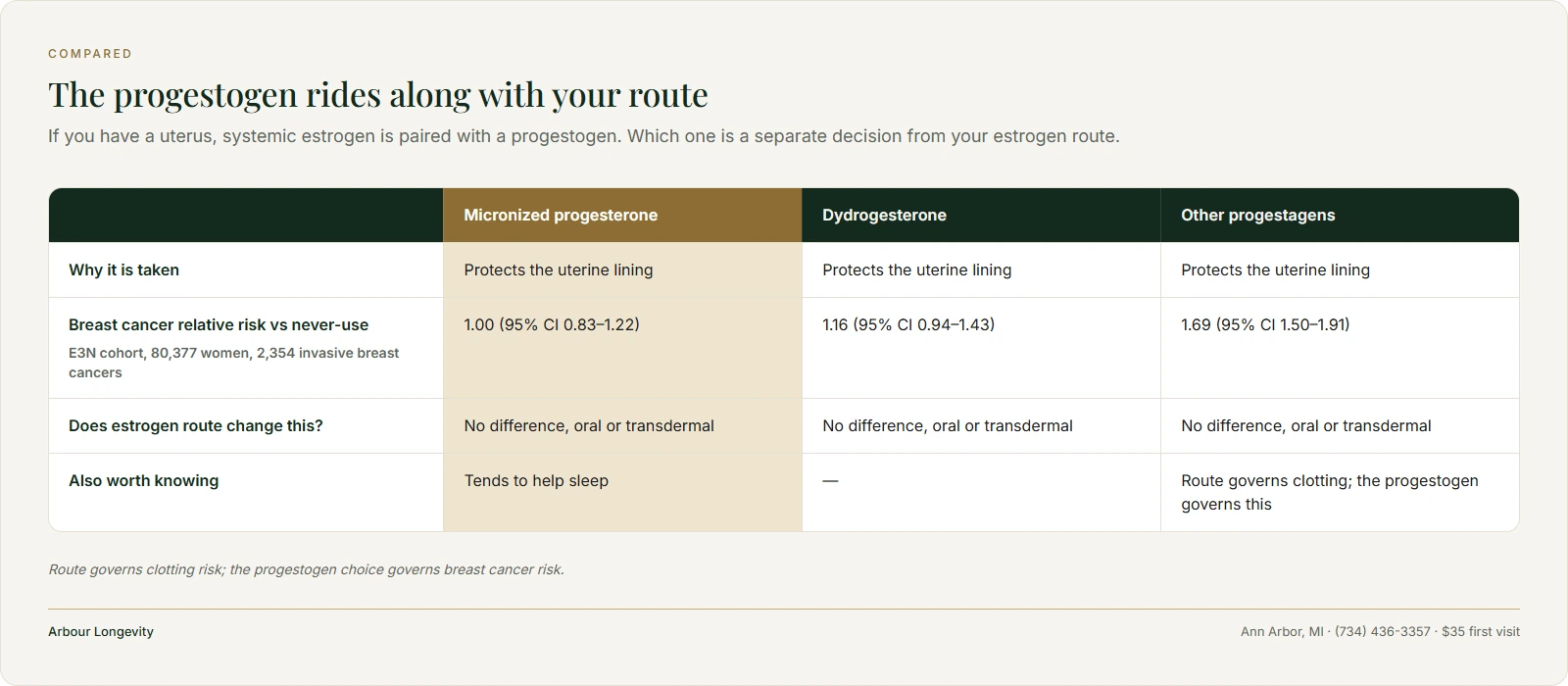
In the French E3N cohort, 80,377 postmenopausal women were followed and 2,354 invasive breast cancers occurred. Compared with never-use, estrogen combined with micronized progesterone showed a relative risk of 1.00 (95% CI 0.83 to 1.22). Estrogen with dydrogesterone showed 1.16 (0.94 to 1.43), and estrogen combined with other progestagens 1.69 (1.50 to 1.91) (Fournier et al., Breast Cancer Res Treat 2008; PMID 17333341). The same analysis found no difference in breast cancer risk by estrogen route, oral or transdermal. That is a useful reminder that route governs clotting and the progestogen choice governs this.
Micronized progesterone also tends to help sleep, which is a welcome side effect rather than the reason for taking it. The wider evidence comparison sits in our BHRT vs HRT guide.
Testosterone Delivery for Women
Testosterone for women is dosed at a small fraction of what a man receives, which makes the delivery method a question of precision. A compounded cream or gel applied daily allows the fine titration that small doses demand. Pellets are used once a stable dose is established. Whichever route, the point is the same: start low, measure, and adjust against how you actually feel rather than against a target number alone.
How Your Route Gets Chosen at Arbour Longevity
Hormone care at Arbour Longevity in Ann Arbor is led by Gandhi Bhattarai, FNP-BC, PMHNP-BC, Anti-Aging/Functional Medicine BC. She is a triple board certified nurse practitioner in family practice, psychiatric mental health, and anti-aging and functional medicine.
Choosing a route is a short conversation built on four things:
- Your clotting and vascular history.
- Whether your dose is likely to need frequent adjustment in the coming months.
- How much daily involvement you want with treatment.
- What your baseline labs show.
Most women start transdermal, settle on a dose over the first two to three months, and only then consider whether a longer-acting route like pellets is worth switching to. Switching is normal, not a failure, and it is easier than people expect.
Monitoring is what makes any route safe. Our guide to bioidentical vs synthetic hormone replacement covers the evidence behind the molecules we use. The practical shape of the first months is set out in BHRT for women over 40.
Visiting Us
An initial consultation is $35, in person in Ann Arbor or by telehealth across Michigan. The ongoing BHRT program is $299 per month. You can reach the clinic at (734) 436-3357. We are open Thursday through Monday, 10am to 7pm, and closed Tuesday and Wednesday.
Parking is free and directly outside, with no meters and no parking structure to navigate. The clinic is Suite 15, down a flight of stairs. Please call ahead if stairs are difficult for you.
Frequently Asked Questions About HRT Delivery Methods
Which HRT delivery method is safest?
For systemic estrogen, transdermal routes have the most reassuring clotting data, with no increased venous thromboembolism risk observed compared with non-use (PMID 30626577). "Safest" still depends on your history, which is why the choice is made one woman at a time rather than by a universal rule.
Can I change methods later?
Yes, and many women do. Routes are switched routinely as symptoms, dosing needs, and life circumstances change. A switch is usually paired with a lab check a few weeks afterwards to confirm the new dose lands where intended.
Do pellets work better than patches or creams?
Not better, differently. Pellets deliver unmatched steadiness and convenience for months at a time. Patches and creams deliver adjustability. Which one wins depends on whether your dose is settled or still being found.
Does the route change how quickly I feel better?
Only modestly. Most women notice sleep and hot flashes improving within a few weeks on any adequately dosed route. What route changes more is how smoothly you get there, and how easily the dose can be corrected if the first attempt is not quite right.
Is vaginal estrogen enough on its own?
If your symptoms are confined to dryness, discomfort with intimacy, or urinary irritation, often yes. If you also have hot flashes, disrupted sleep, or mood changes, a systemic route is usually added. The two are frequently used together.
Does the patch have to be worn all the time?
Yes, it stays on continuously and is replaced on schedule, including in the shower. Rotating the site each time reduces skin irritation.
Book a Hormone Consultation in Ann Arbor
If you are weighing a patch against a pellet, or you are already on hormone therapy and suspect the route is the reason it has never quite settled, that is a solvable problem and a short conversation. You can read more about our approach on our hormone replacement therapy in Ann Arbor page.
When you are ready, book your $35 first visit, in person in Ann Arbor or by telehealth statewide, or call (734) 436-3357.
References
Vinogradova Y, Coupland C, Hippisley-Cox J. Use of hormone replacement therapy and risk of venous thromboembolism: nested case-control studies using the QResearch and CPRD databases. BMJ. 2019;364:k4810. PMID 30626577. doi:10.1136/bmj.k4810
Hodis HN, Mack WJ, Henderson VW, et al. Vascular Effects of Early versus Late Postmenopausal Treatment with Estradiol. N Engl J Med. 2016;374(13):1221-1231. PMID 27028912. doi:10.1056/NEJMoa1505241
Crandall CJ, Hovey KM, Andrews CA, et al. Breast cancer, endometrial cancer, and cardiovascular events in participants who used vaginal estrogen in the Women's Health Initiative Observational Study. Menopause. 2018;25(1):11-20. PMID 28816933. doi:10.1097/GME.0000000000000956
Fournier A, Berrino F, Clavel-Chapelon F. Unequal risks for breast cancer associated with different hormone replacement therapies: results from the E3N cohort study. Breast Cancer Res Treat. 2008;107(1):103-111. PMID 17333341. doi:10.1007/s10549-007-9523-x

Gandhi Bhattarai, FNP-BC, PMHNP-BC, Anti-Aging/Functional Medicine BC
Triple board-certified nurse practitioner and founder of Arbour Longevity in Ann Arbor. Every article is written from clinic practice and reviewed against current guidelines.
✓ Medically reviewed · Last updated August 21, 2026
How we reviewed this article
Arbour Longevity articles are written by the treating clinician, checked against primary sources (peer-reviewed journals, FDA labeling, Endocrine Society and other specialty guidelines) and re-reviewed when guidance changes. See our editorial policy. Spotted an error? Email info@arbourlongevity.com.
This article is educational and is not a substitute for individualized medical advice. Whether a treatment is appropriate for you is determined during consultation.
Your symptoms have a cause. Let’s find it.
Book a $35 first visit in Ann Arbor. It’s a 30–45 minute consultation with Gandhi Bhattarai, applied toward your plan. Serving Ann Arbor, Ypsilanti, Saline, Dexter, Chelsea, and Michigan by telehealth.






.webp)

