

PRP vs Hair Transplant | Comparison for Pattern Hair Loss, Ann Arbor
Key takeaways
- A hair transplant moves follicles you already have; PRP signals to follicles that are still in place. They do different jobs.
- Meta-analyses find PRP increases hair density and thickness in pattern hair loss, though study quality varies.
- One randomized study found PRP given during transplant surgery improved regrowth and satisfaction at six months.
- The choice depends mainly on what is still there: bare areas need a transplant, miniaturizing follicles suit PRP.
- Arbour Longevity offers PRP and refers for transplant surgery when a scalp exam says that is the right conversation.
People researching pattern hair loss usually arrive at the same fork: an injectable treatment like PRP, or surgery. They are often presented as alternatives, which hides the more useful point. They are not doing the same job, and a good deal of the published research looks at combining them.
The short version. A hair transplant moves follicles you already have into areas where you have lost them, relying on a principle called donor dominance (moved hair keeps the traits of where it came from). PRP (platelet-rich plasma) is an injection of your own concentrated platelets into the scalp, studied for its effect on follicles that are still in place. One is surgical redistribution; the other is signaling. We offer PRP; transplant surgery is performed by hair restoration surgeons.
PRP vs Hair Transplant: What Each Procedure Actually Does
A 2025 review in Dermatologic Surgery describes hair transplantation as a minimally invasive procedure for hair loss in men and women, based on donor dominance: transplanted hair keeps its genetic traits in its new location. It is used mainly for androgenetic alopecia (genetic pattern hair loss), and also in end-stage scarring alopecia and as a corrective procedure after trauma or surgery. The review, drawn from 1,030 study abstracts published between 2019 and 2024, reports that both follicular unit extraction and linear strip excision are state-of-the-art methods (Queen and Avram, Dermatol Surg, 2025, DOI).
Donor dominance is the whole logic of the operation. Follicles taken from areas that are not sensitive to the hormonal driver of pattern loss keep that resistance after they are moved. The procedure does not create new follicles; it relocates existing ones, which is why the donor area is a finite resource.
PRP takes a different route. A small volume of your blood is drawn and spun so the platelets concentrate, and that concentrate is injected into the scalp. It acts on follicles that are already there, pushing shrinking follicles back toward a growing phase. Our post on how PRP hair restoration works covers the biology, the session and the timeline in detail.
What the Evidence Shows for PRP in Pattern Hair Loss
A systematic review and meta-analysis (a study that pools the results of many trials) in the Journal of Dermatological Treatment searched seven databases. It included 30 studies covering 687 patients, of which 10 were randomized controlled trials. Twenty-nine studies reported beneficial results and 24 reached statistical significance on a measured outcome. The authors concluded that PRP increases hair density and hair thickness. They called for low risk-of-bias randomized trials to improve treatment protocols and explain the variability among studies (Evans et al., J Dermatolog Treat, 2020, DOI).
A separate systematic review and meta-analysis in Frontiers in Pharmacology focused on female pattern hair loss. It included 42 studies and 1,569 cases with 776 female participants across 16 randomized controlled trials and 26 observational trials. It reported hair density as an odds ratio of 1.61 compared with control groups (95 percent confidence interval 0.52 to 2.70) and 1.11 compared with baseline (95 percent confidence interval 0.86 to 1.37). The authors noted that standard protocols and large-scale randomized trials are still needed to confirm efficacy (Zhou et al., Front Pharmacol, 2021, DOI).
Those confidence intervals include 1, which means that result did not reach statistical significance as reported. We include it because leaving it out would misrepresent the state of the literature. The evidence for PRP in pattern hair loss is positive in direction and inconsistent in strength, and both of those things are true at once.
Not sure whether your follicles are still there to treat?
Your $35 first visit is a scalp exam that tells you honestly whether PRP, a transplant referral or a lab work-up comes first, with the fee applied toward your plan.
Book your $35 first visit Call (734) 436-3357
PRP After Hair Transplant: Where the Two Overlap
The most interesting research question is not which to pick but what happens when both are used. A prospective randomized study in the Journal of Maxillofacial and Oral Surgery enrolled 60 male patients with androgenetic alopecia. Thirty had follicular unit extraction with PRP given during the operation, and 30 had the same procedure without it.
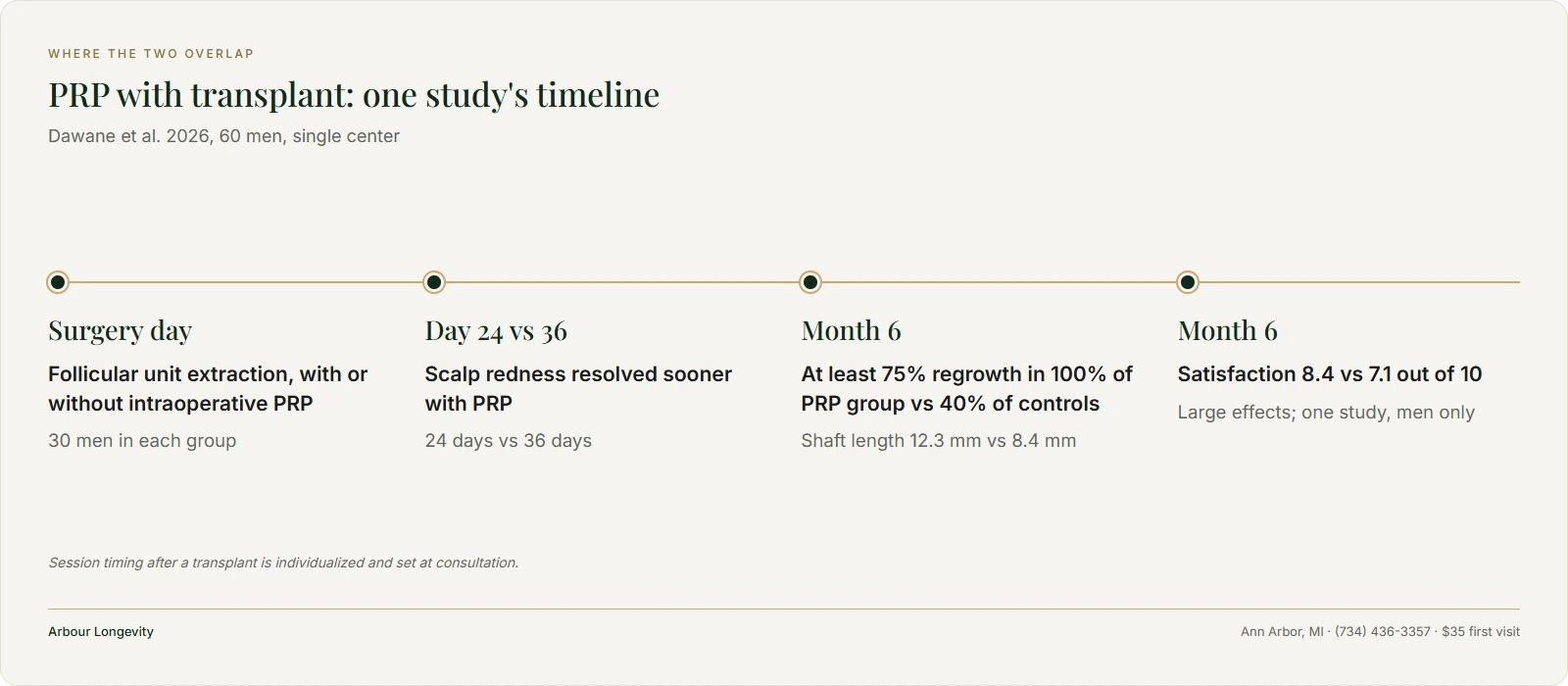
At six months, all patients in the PRP group achieved at least 75 percent regrowth compared with 40 percent of controls (p < 0.000001). Mean hair shaft length at six months was 12.3 mm with PRP versus 8.4 mm without (p < 0.0001). Scalp redness resolved faster in the PRP group, at 24 days versus 36 days (p < 0.0001), and satisfaction scores were higher at 8.4 versus 7.1 (p < 0.0001). The authors' reasoning was that graft survival and early regrowth after transplant can be harmed by poor blood supply and delayed new vessel growth (Dawane et al., J Maxillofac Oral Surg, 2026, DOI).
This is a single-center study of 60 patients, all male, and the effect sizes reported are large. Worth knowing about; not worth treating as settled.
The Practical Differences
- What it does to follicle count. A transplant relocates existing follicles within your scalp and does not add new ones; PRP acts on follicles already present in the treated area.
- Surgical or not. Transplantation is a surgical procedure with a donor site; PRP is an in-office injection using your own blood.
- Donor supply. Transplantation depends on available donor hair, which is finite. PRP does not draw on a donor area.
- Evidence base. Transplantation has decades of surgical literature and a clear mechanism. PRP has a substantial but mixed trial literature, with reviews consistently calling for standard protocols (Evans et al., 2020; Zhou et al., 2021).
- Ongoing loss. Neither addresses the underlying driver of pattern hair loss on its own. That is why the transplant review notes that medical management alongside surgery has improved results (Queen and Avram, 2025, DOI).
What the Choice Depends On
Chiefly on what is still there. A transplant addresses areas where follicles are gone; PRP is studied in follicles that are still present but shrinking. That is a difference in the biology of the situation rather than a preference, and it is assessed by examining the scalp, not by reading about it.

It also depends on what is driving the loss in the first place. Thyroid disease, iron status, hormonal shifts and medications all contribute to hair loss, and neither procedure addresses them. We run labs before starting any in-office hair treatment for exactly that reason. Our posts on hair loss in women and the blood tests most people are not getting cover that ground.
Frequently Asked Questions
Is a hair transplant better than PRP?
They are not measured against each other in the published literature, because they address different situations. A transplant relocates follicles into areas that have lost them, while PRP is studied in follicles that are still present. There is no randomized head-to-head trial to point to.
Can PRP replace a hair transplant?
PRP does not relocate follicles, so it cannot do what a transplant does mechanically. The meta-analyses report increases in hair density and thickness in pattern hair loss (Evans et al., 2020, DOI), which is a different outcome from restoring a bare area.
Does PRP help after a hair transplant?
One prospective randomized study of 60 male patients reported higher regrowth rates, longer mean hair shaft length and faster resolution of scalp redness at six months in the group receiving PRP during follicular unit extraction (Dawane et al., 2026, DOI). It is one study, at one center, in men only.
How many PRP sessions are needed, and how soon after a transplant?
Session counts and timing are set for each person in consultation. The reviews cited here consistently note that standard protocols have not been established in the literature (Evans et al., 2020; Zhou et al., 2021), so we do not publish numbers for them.
What is PRP in hair transplant?
It refers to platelet-rich plasma used around the transplant procedure itself. In the study above it was given during the operation. The stated reasoning was that graft survival and early regrowth can be harmed by poor blood supply and delayed new vessel growth (Dawane et al., 2026, DOI).
Does PRP work without a transplant?
The meta-analysis of 30 studies and 687 patients concluded that PRP increases hair density and thickness in men and women with androgenetic alopecia as a standalone treatment, while calling for lower risk-of-bias trials (Evans et al., 2020, DOI). The female-specific review reported results that did not reach statistical significance (Zhou et al., 2021, DOI).
Hair Restoration Consultations in Ann Arbor
Arbour Longevity offers PRP hair restoration. PRP is made from your own blood and injected into the scalp. We do not perform transplant surgery. When a scalp assessment suggests surgery is the relevant conversation, we will tell you that rather than sell you sessions.
Gandhi Bhattarai, FNP-BC, PMHNP-BC, Anti-Aging/Functional Medicine BC is a triple board certified nurse practitioner. We are at 2217 Packard St #15, in the Eastover Professional Center, Ann Arbor, MI 48104, open Thursday through Monday, 10am to 7pm. We see patients from across Washtenaw County. Cash pay, HSA and FSA accepted.
Call (734) 436-3357 or book your $35 first visit. The $35 is applied toward your treatment plan.

Gandhi Bhattarai, FNP-BC, PMHNP-BC, Anti-Aging/Functional Medicine BC
Triple board-certified nurse practitioner and founder of Arbour Longevity in Ann Arbor. Every article is written from clinic practice and reviewed against current guidelines.
✓ Medically reviewed · Last updated August 17, 2026
How we reviewed this article
Arbour Longevity articles are written by the treating clinician, checked against primary sources (peer-reviewed journals, FDA labeling, Endocrine Society and other specialty guidelines) and re-reviewed when guidance changes. See our editorial policy. Spotted an error? Email info@arbourlongevity.com.
This article is educational and is not a substitute for individualized medical advice. Whether a treatment is appropriate for you is determined during consultation.
Your symptoms have a cause. Let’s find it.
Book a $35 first visit in Ann Arbor. It’s a 30–45 minute consultation with Gandhi Bhattarai, applied toward your plan. Serving Ann Arbor, Ypsilanti, Saline, Dexter, Chelsea, and Michigan by telehealth.






.webp)

