
Key takeaways
- PRP hair restoration injects a concentrate of your own blood platelets into the scalp to wake up shrinking follicles.
- Pooled trials show PRP increases hair density compared with placebo; a 2024 meta-analysis found about 27.6 more hairs per square centimeter.
- Most plans are three to four sessions, four to six weeks apart, then maintenance every six to twelve months.
- It works best early, on follicles that still exist; it cannot regrow a smooth bald area.
- Labs come first, because low iron or thyroid problems can blunt any hair treatment.

Are you a man or woman in your 30s, 40s or 50s in the Ann Arbor area watching your part widen, your temples pull back or your ponytail thin out? PRP hair restoration is one of the better-studied in-office options. It can slow the loss and regrow what can still be saved.
Here is the short answer. PRP hair restoration uses platelet-rich plasma (a small amount of your own blood, spun to concentrate the platelets and their growth signals). It is injected into the scalp to feed struggling hair follicles. A 2025 review of many trials found PRP reliably increases hair density compared with placebo. Most plans are three to four sessions, then maintenance. The biggest factor in a good result is starting early.
Why you are losing hair
Most adult hair loss is genetic pattern hair loss (the medical term is androgenetic alopecia). In men it shows up as receding temples and crown thinning. In women it usually looks like a widening center part or a thinner ponytail. The driver is a hormone called DHT (dihydrotestosterone). It slowly shrinks sensitive follicles until the hair gets finer and finally stops.
Other things stack on top: thyroid problems, low iron, postpartum and perimenopausal hormone shifts, stress, crash dieting and some medications. Before we start any in-office hair treatment, we run labs so we are not missing a fixable cause. Our posts on hair loss in women and the 5 blood tests your doctor is not ordering cover this. The key point: follicles do not give much warning, so noticing change is your window to act.
What PRP is and how it regrows hair
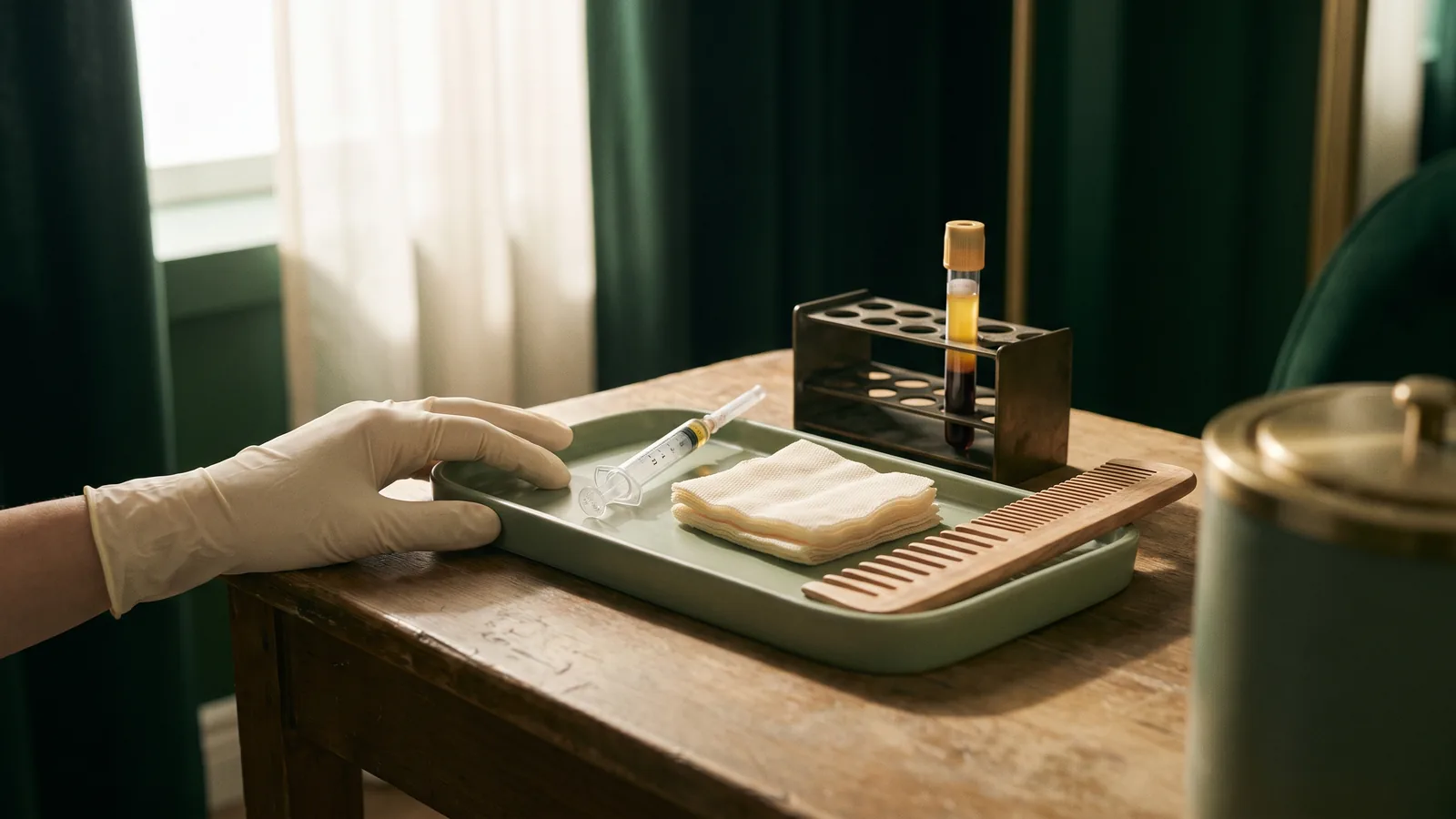
We draw a little of your blood and spin it so the platelets separate out. That leaves a syringe of pale plasma packed with platelets at several times their normal level. Platelets are tiny signaling factories. When activated they release growth factors (proteins that tell nearby cells to repair and grow) that do four useful things at the follicle.
They wake up the cells at the base of the follicle that decide whether it grows or rests. They push follicles from the resting phase into the growing phase. They thicken existing fine hairs. And they bring in new blood vessels, which the follicle needs to grow a strong strand. Because it is your own blood, there is no allergic reaction and nothing synthetic involved. This is the same biology behind our broader PRP therapy for skin and joints.
Why we offer it. PRP works on the follicle itself. It nudges resting follicles back into the growing phase and improves the blood supply a follicle needs to hold a thicker strand. A 2024 meta-analysis (a study that pools the results of many trials) in Anais Brasileiros de Dermatologia pooled 13 randomized clinical trials. It found PRP increased hair density by an average of about 27.6 hairs per square centimeter compared with placebo. A larger 2025 systematic review in Dermatology and Therapy covered 43 randomized trials and 1,877 participants. It likewise found PRP improved hair density and reduced hair loss, with generally favorable patient satisfaction. That is a solid evidence base for an in-office option made from your own blood.
Wondering whether your follicles are still savable?
Your $35 first visit includes a scalp exam and the labs that decide whether PRP will work for you, with the fee applied toward your plan.
Book your $35 first visit Call (734) 436-3357
Does PRP actually work?
The honest answer is that the evidence has grown a lot. A 2025 review pooling many randomized trials found PRP increased hair density versus placebo, and that maintenance sessions reduced relapse. A 2024 review comparing PRP with minoxidil found PRP at least as good, and often better for thickness. If you are weighing the two against each other, we go through the head-to-head trial data in PRP vs minoxidil for thinning hair.
Two honest caveats. First, not all PRP is equal. Platelet concentration, technique, depth and spacing all matter, so bargain PRP is not the same product. Second, PRP works best earlier in the loss. We do not use words like "miracle" or "guaranteed", because they are not honest. What we can say is that the current evidence supports PRP as a first-line in-office option for genetic hair loss in both men and women.
Who is a good candidate
Good candidates:
- are in the early to moderate stages and still have visible hair across the scalp
- have realistic expectations about a three- to six-month timeline
- are willing to do a series plus maintenance
People who do less well include those with smooth bald areas where no follicles remain, those with scarring hair loss, those on blood thinners that cannot be paused, and those who are pregnant. We screen for all of this at the $35 consultation. If PRP will not help you, we will say so and discuss other options.
What I see in clinic
A common pattern I see is a woman in her 40s with a widening part and "normal" labs whose iron stores are quietly too low for good hair growth. We correct the iron first, then run the PRP series. Most patients notice less shedding by month two or three and visible new growth by month five or six. Results vary, and I set that expectation honestly from the first visit.
What a session looks like, and the timeline
On treatment day you arrive with clean hair. We numb the scalp, draw your blood, and process it while the numbing sets in. Once ready, we inject the plasma in a grid across the thinning areas with a fine needle, placing it at the depth of the hair bulb. Total chair time is about 60 to 90 minutes.

Hair grows slowly, so results lag the biology. Shedding usually slows by month two or three. Fine new "baby hairs" appear by month three or four, and those thicken through month six, when we re-photograph and compare. After the initial three to four sessions, maintenance is usually one session every six to twelve months, because the genetic process is managed, not cured.
Frequently Asked Questions
How long do PRP hair results last?
For most people, gains from the initial three- to four-session series hold for twelve to eighteen months with maintenance. Without maintenance, the genetic loss continues and gains fade over twelve to eighteen months. We usually schedule one maintenance session every six to twelve months.
Is PRP painful?
We always numb first, using numbing cream plus small anesthetic blocks at the edge of the area. With that, most people rate the discomfort 1 to 3 out of 10. The temples and front hairline are more sensitive than the crown, and we adjust technique there.
Can women do PRP, or is it only for men?
PRP is well supported in both men and women. Women with diffuse thinning, a widening part, postpartum shedding or perimenopausal thinning are some of our most consistent responders. That is especially true when we address iron, thyroid and hormones.
How many sessions will I need?
The standard start is three to four sessions spaced four to six weeks apart. People with more advanced loss may need five to six. We re-photograph at six months and decide on maintenance from there.
When will I see results?
Slower shedding by month two or three, visible new growth by month three or four, and meaningful thickness change by month five or six. Plan on a six-month look back to judge the full series.
Will PRP regrow hair that is completely gone?
No. PRP works on shrunken follicles that still exist. If a follicle has been gone for years and the scalp is smooth, no in-office treatment will regrow hair there. That is why starting early matters, and why we refer for a transplant when that is the right answer.
Arbour Longevity, 2217 Packard St #15, Ann Arbor, MI 48104. Hours: Thursday through Monday, 10am to 7pm. Book your $35 first visit or call (734) 436-3357; the $35 is applied toward your treatment plan.
References
- Platelet-Rich Plasma in the Management of Alopecia: A Systematic Review and Meta-Analysis of Clinical Evidence. Dermatology and Therapy. 2025.
- Comparison of the efficacy of platelet-rich plasma with topical minoxidil in treating patients with androgenetic alopecia: a systematic review. Skin Health and Disease. 2024.
This article is educational and does not replace individualized medical advice.
Gandhi Bhattarai, FNP-BC, PMHNP-BC, Anti-Aging/Functional Medicine BC
Triple board-certified nurse practitioner and founder of Arbour Longevity in Ann Arbor. Every article is written from clinic practice and reviewed against current guidelines.
✓ Medically reviewed · Last updated August 21, 2026
How we reviewed this article
Arbour Longevity articles are written by the treating clinician, checked against primary sources (peer-reviewed journals, FDA labeling, Endocrine Society and other specialty guidelines) and re-reviewed when guidance changes. See our editorial policy. Spotted an error? Email info@arbourlongevity.com.
This article is educational and is not a substitute for individualized medical advice. Whether a treatment is appropriate for you is determined during consultation.
Your symptoms have a cause. Let’s find it.
Book a $35 first visit in Ann Arbor. It’s a 30–45 minute consultation with Gandhi Bhattarai, applied toward your plan. Serving Ann Arbor, Ypsilanti, Saline, Dexter, Chelsea, and Michigan by telehealth.





.webp)

