

NAD+ IV for Fatigue and Brain Fog
Key takeaways
- NAD+ IV may help lingering fatigue and brain fog, but only after treatable causes have been ruled out.
- Thyroid disease, low iron or B12, menopause and sleep apnea cause the same symptoms, and a drip will not fix them.
- NAD+ supports the process your cells use to make energy, which is why it is tried for these symptoms.
- Most people who respond describe steadier energy rather than a caffeine-like lift.
- Start with a proper workup and a conversation, not with a drip.

Looking for the full treatment guide? Start with NAD+ IV Therapy in Ann Arbor: energy, longevity, safety and pricing. It covers doses, session length, cost and contraindications (reasons a treatment should not be used). This article is narrower. It is about two symptoms, persistent fatigue and brain fog, and how NAD+ does and does not relate to them.
You wake up tired. Your coffee stops working by 10 AM. Your focus drifts by early afternoon. No amount of sleep seems to reset it.
That combination is the single most common reason people come to see me. It is also where the urge to jump straight to a drip is strongest. And it is where doing so is most likely to waste your money. So let us take it in order.
Before NAD+: What Has to Be Ruled Out First
Fatigue and brain fog are symptoms, not diagnoses. Several very treatable things produce exactly this picture. Working through them first is not a delaying tactic. It is the part that most often finds the answer.

- Thyroid function. Subclinical hypothyroidism (a mildly underactive thyroid) affects a meaningful share of adults. Middle-aged patients with it may have fatigue, altered mood and cognitive symptoms, meaning trouble with thinking, memory and focus (Biondi, Cappola and Cooper, JAMA, DOI: 10.1001/jama.2019.9052, PMID 31287527).
- Iron and B12 status. Ferritin (your stored iron) can be low enough to cause symptoms while hemoglobin (the oxygen-carrying protein in red blood cells) still looks normal. That is why a standard anemia screen (a check for low red blood cells) alone can miss it.
- The menopause transition. Disrupted sleep, mood changes and changes in thinking are recognized features. The link to menopause is often not obvious to the person going through it (Duralde, Sobel and Manson, BMJ, DOI: 10.1136/bmj-2022-072612, PMID 37553173).
- Sleep quality, not just sleep hours. Untreated sleep apnea (breathing that repeatedly stops and starts during sleep) is common. It is often missed in people who do not fit the stereotype.
- Blood sugar, medications, alcohol, mood and stress load. Each of these can produce the same two symptoms on its own.
If one of these is driving how you feel, an infusion will not fix it. I would rather tell you that at the consultation than after you have paid for a series.
Where NAD+ Actually Comes In

NAD+ is a coenzyme (a helper molecule that lets enzymes do their work) found in every cell of your body. It is central to ATP production, the process your mitochondria (the tiny power plants inside your cells) use to make usable energy. It also supports sirtuins, a family of proteins involved in DNA repair and in controlling inflammation (the body's alarm response). And it fuels PARP enzymes, the cell's DNA damage-response system. The available pool declines with age. We cover why in detail in why NAD+ declines with age.
The link to fatigue and fog is plausible at the level of cell biology. A cell with a smaller energy budget does less work. The two tissues that notice first tend to be muscle and brain. That is the reasoning. Reasoning is not the same as proof, and the human trial evidence here is thinner than most clinics admit. We lay that out plainly in does NAD+ IV therapy actually work.
Wondering whether you are a candidate?
Your $35 first visit in Ann Arbor is a 30–45 minute consultation to find what is actually driving how you feel, with the fee applied toward your plan.
Book your $35 first visit Call (734) 436-3357
What People Describe After an Infusion

Steadier energy rather than a spike
The most common description is not a lift like caffeine. It is the absence of the crash: the two o'clock wall arriving later, or not at all. Many people say their floor was raised rather than their ceiling. That pattern shows up most in three groups:
- People whose fatigue is not resolving with rest.
- People recovering from an illness.
- People who train hard and are not bouncing back the way they used to.
Clearer thinking
The change in thinking that people report is usually described as fog lifting. Sentences finish more easily. It takes less effort to hold a thread. The word they wanted comes back faster. For people whose work depends on sustained mental output, this is often the effect that matters most.
I want to be careful here. NAD+ has not been shown to treat or prevent cognitive disease, and I do not offer it for that. What is being described is a shift in day-to-day mental stamina. It is reported by patients, not measured as a cognitive outcome in a large trial.
Burnout and nervous system load
Prolonged stress is not only psychological. It changes sleep, appetite and metabolic function (how your body turns food into energy). It also changes how much energy demand your system is carrying. Patients recovering from a long high-stress period often use a short NAD+ series as one part of a broader recovery plan. So do people with post-viral fatigue (exhaustion that lingers after an infection). That plan also addresses sleep, hormones and workload. NAD+ works better as part of that plan than as a substitute for it.
Where it fits with metabolic and hormone care
NAD+ is involved in insulin sensitivity (how well your cells respond to insulin, the blood-sugar hormone). It also plays a part in how the body handles fat and glucose (sugar). It is often used alongside hormone optimization or a medical weight program. It is not a weight loss treatment, and I would not sell it as one. What patients do report is that when energy improves, the parts of a plan that take effort become easier to sustain.
What NAD+ Will Not Do
An honest list is more useful than a long benefits list.
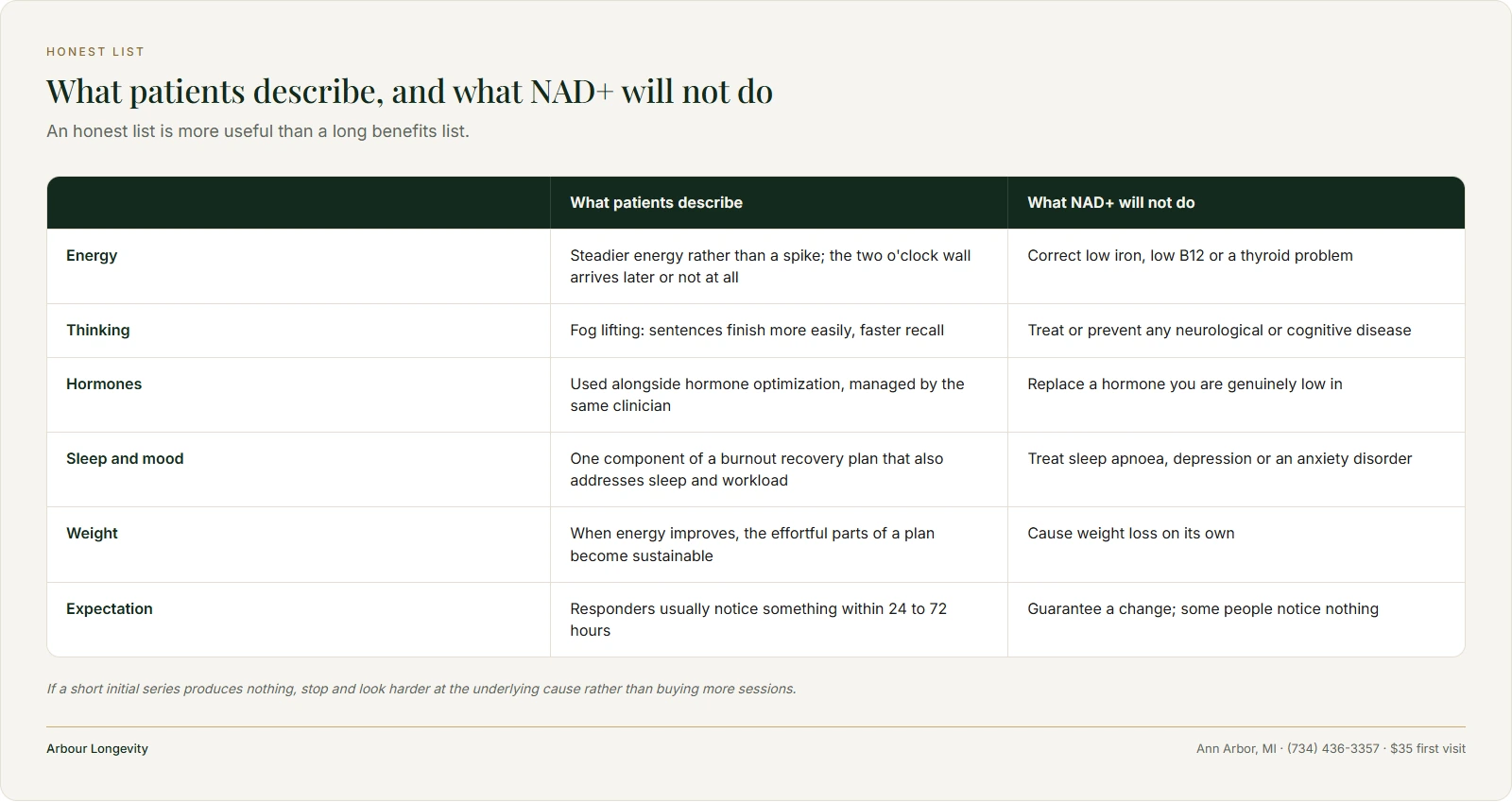
- It will not replace a hormone you are genuinely low in.
- It will not correct low iron, low B12 or a thyroid problem.
- It will not treat sleep apnea, depression or an anxiety disorder.
- It will not cause weight loss on its own.
- It is not a treatment for any neurological (brain and nerve) or cognitive disease.
- It is not a guarantee of feeling different, and some people notice nothing.
If a clinic tells you otherwise, that is a reason to be more careful, not less.
Practical Questions

How soon would I know if it is helping?
Most people who respond notice something within 24 to 72 hours of the first infusion. If a short initial series produces nothing at all, that is useful information. The right response is to stop and look harder at the underlying cause, not to keep buying sessions.
How often would I need it?
For fatigue or burnout recovery, the usual starting point is a short series of a few sessions over a few weeks. After that, sessions are spaced out or stopped based on how you respond. Dosing, session length and pricing are covered in our main NAD+ IV therapy guide.
Could I just take a pill instead?
Possibly, and the evidence for oral products is genuinely stronger than the IV evidence. Oral precursors (building blocks your body turns into NAD+) act as a slow daily baseline rather than a fast push. We compare them in NMN vs NR, which precursor actually reaches your cells.
Who should not have it?
A clinical assessment comes first for everyone. NAD+ IV is generally not appropriate, or needs specialist clearance, in these situations:
- You are pregnant or breastfeeding.
- You are in active cancer treatment.
- You have significant kidney, liver or heart disease.
- You have uncontrolled hypertension (high blood pressure).
- You have a known sensitivity to nicotinamide (a form of vitamin B3).
This is not a complete list. We decide together based on your history.
What are the side effects?
The common ones depend on how fast the drip runs. While the drip runs quickly, people may notice:
- Mild chest tightness.
- Stomach cramping.
- Nausea.
- Flushing.
- A brief headache.
These typically ease within minutes of slowing the infusion. That is why the rate is adjusted throughout the session rather than set once at the start.
Is NAD+ the same as vitamin B3?
They are related but not the same. Your body makes NAD+ from vitamin B3 (niacin) and related compounds. But taking a B3 supplement is an indirect and inefficient way to raise NAD+. A precursor or a direct infusion does it more efficiently.
The Sensible Starting Point
If persistent fatigue or brain fog is what brought you here, start with a conversation and a proper workup, not with a drip. We spend the first visit on your symptoms, your history, your previous labs and what you have already tried. Then we order the tests that make sense for your picture. If NAD+ turns out to be a reasonable part of the plan, we will say so. If something else explains it, we would rather find that.
Serving Ann Arbor, Dexter, Saline, Plymouth, Ypsilanti, Canton, Northville and Southeast Michigan.
Ready to start? Book your $35 first visit online, or call or text (734) 436-3357. The $35 consultation fee applies toward your care. Arbour Longevity, 2217 Packard St #15, Ann Arbor, MI 48104. We are open Thursday through Monday, 10:00 to 19:00, and closed Tuesday and Wednesday. Parking is free and directly outside, with no meters and no structure. Suite 15 is down a flight of stairs, so please call ahead if stairs are difficult for you.
References
- Biondi B, Cappola AR, Cooper DS. Subclinical hypothyroidism: a review. JAMA. 2019;322(2):153-160. PMID 31287527. DOI: 10.1001/jama.2019.9052
- Duralde ER, Sobel TH, Manson JE. Management of perimenopausal and menopausal symptoms. BMJ. 2023;382:e072612. PMID 37553173. DOI: 10.1136/bmj-2022-072612
- Covarrubias AJ, Perrone R, Grozio A, Verdin E. NAD+ metabolism and its roles in cellular processes during ageing. Nat Rev Mol Cell Biol. 2021;22(2):119-141. PMID 33353981. DOI: 10.1038/s41580-020-00313-x
- Lautrup S, Sinclair DA, Mattson MP, Fang EF. NAD+ in brain aging and neurodegenerative disorders. Cell Metab. 2019;30(4):630-655. PMID 31577933. DOI: 10.1016/j.cmet.2019.09.001
- Yaku K, Nakagawa T. NAD+ precursors in human health and disease: current status and future prospects. Antioxid Redox Signal. 2023;39(16-18):1133-1149. PMID 37335049. DOI: 10.1089/ars.2023.0354
Citations verified against PubMed. This content is educational and does not constitute medical advice or a promise of any particular result. Individual responses vary.

Gandhi Bhattarai, FNP-BC, PMHNP-BC, Anti-Aging/Functional Medicine BC
Triple board-certified nurse practitioner and founder of Arbour Longevity in Ann Arbor. Every article is written from clinic practice and reviewed against current guidelines.
✓ Medically reviewed · Last updated August 16, 2026
How we reviewed this article
Arbour Longevity articles are written by the treating clinician, checked against primary sources (peer-reviewed journals, FDA labeling, Endocrine Society and other specialty guidelines) and re-reviewed when guidance changes. See our editorial policy. Spotted an error? Email info@arbourlongevity.com.
This article is educational and is not a substitute for individualized medical advice. Whether a treatment is appropriate for you is determined during consultation.
Your symptoms have a cause. Let’s find it.
Book a $35 first visit in Ann Arbor. It’s a 30–45 minute consultation with Gandhi Bhattarai, applied toward your plan. Serving Ann Arbor, Ypsilanti, Saline, Dexter, Chelsea, and Michigan by telehealth.





.webp)

