

Does NAD+ IV Therapy Actually Work?
Key takeaways
- The strongest human evidence is for the oral precursors NMN and NR, not for IV NAD+.
- No randomised controlled trial of IV NAD+ for fatigue exists yet.
- Four questions sort most marketing claims: human, how large, how long, what was measured.
- Patient reports are worth describing honestly, but they are not trial evidence.
- The reasonable position: try it in the right person, with expectations set honestly.

Want the treatment details instead of the research? Our main guide is NAD+ IV Therapy in Ann Arbor: energy, longevity, safety and pricing. It covers doses, session length, screening and cost. This article is a straight look at the published evidence.
The short answer first. NAD+ (a molecule every cell needs to make energy and repair DNA) can be raised in two ways. You can take a precursor (a building block your body turns into NAD+) by mouth, or have NAD+ itself by IV drip. Oral precursors have real randomised trial data behind them. They raise blood NAD+ reliably and have been safe in the doses studied. A few trials show modest functional effects in specific groups of people. Intravenous NAD+ has far less. It rests on:
- A sound mechanism.
- One small published human pharmacokinetic study (one that tracks how a substance moves through the body).
- Decades of clinical use.
- A large volume of consistent patient report.
That is a reasonable basis for trying it. It is not a basis for promising anything.
The Background, in One Paragraph
NAD+ is a coenzyme (a helper molecule enzymes need to work). Your cells use it for three jobs:
- Making energy.
- Repairing DNA.
- Sirtuin signalling (sirtuins are proteins involved in cell repair and aging).
The available pool declines with age. We cover that story in full in why NAD+ declines with age. This article covers the part people rarely get told: what has actually been tested in humans.
What Has Been Tested in People
Oral precursors: the strongest data
The best human evidence in this field is for NMN and NR (two NAD+ precursors) taken by mouth.
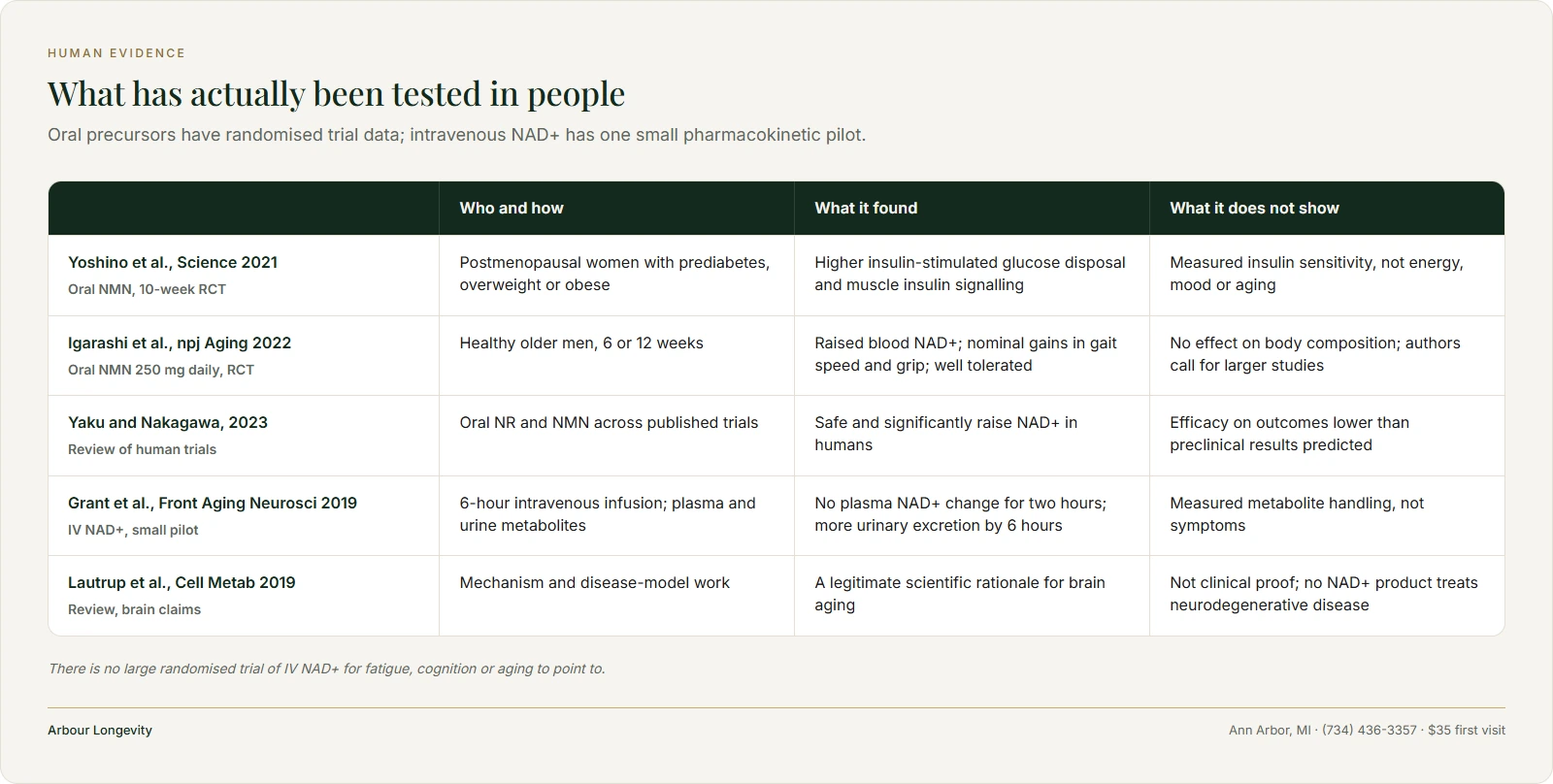
NMN improved muscle insulin sensitivity in one trial. Yoshino and colleagues ran a 10-week randomised, placebo-controlled, double-blind trial (people were assigned by chance to NMN or an inactive look-alike, and nobody knew who got which). They gave NMN to postmenopausal women with prediabetes who were overweight or obese. Insulin sensitivity (how well insulin moves sugar from the blood into cells) was measured with a hyperinsulinaemic-euglycaemic clamp, a detailed lab test. Insulin-stimulated glucose disposal rose with NMN, and so did skeletal muscle insulin signalling. Neither changed with placebo (Science, 2021; DOI: 10.1126/science.abe9985, PMID 33888596). That trial is a real randomised result in a specific population. It measured insulin sensitivity, not energy, mood or aging.
Igarashi and colleagues ran a placebo-controlled, randomised, double-blind, parallel-group trial. They gave 250 mg of NMN daily to healthy older men for 6 or 12 weeks. Supplementation was well tolerated and caused no significant harm. It significantly raised blood NAD+ and NAD+ metabolites (its breakdown products). There were nominally significant improvements in gait speed and left grip performance. The authors themselves said those need validating in larger studies. There was no significant effect on body composition (npj Aging, 2022; DOI: 10.1038/s41514-022-00084-z, PMID 35927255).
Oral NR and NMN are safe and significantly raise NAD+ in humans. But their effect on outcomes has been lower than the preclinical (lab and animal) results predicted. That is the summary Yaku and Nakagawa reached in their review of the human trials (Antioxidants & Redox Signaling, 2023; DOI: 10.1089/ars.2023.0354, PMID 37335049). It is also the one I would give a patient.
Intravenous NAD+: much thinner
This is the part that usually gets skipped.
The most relevant published human study of IV NAD+ is a small pilot study (a small early study) by Grant and colleagues. It tracked plasma and urine NAD+ and its metabolites during and after a 6-hour intravenous infusion. The findings were genuinely surprising. At that infusion rate, no change in plasma NAD+ or its metabolites could be detected for the first two hours. That suggests NAD+ was being rapidly and completely removed from plasma. By 6 hours, urinary excretion of NAD+ and methylnicotinamide (an NAD+ breakdown product) had increased (Frontiers in Aging Neuroscience, 2019; DOI: 10.3389/fnagi.2019.00257, PMID 31572171). It was small, and it measured metabolite handling, not symptoms.
I include it because it is the honest centre of this topic. It tells us infused NAD+ is taken up and processed quickly. It does not tell us that an infusion makes anyone feel better. And there is no large randomised trial of IV NAD+ for fatigue, cognition (thinking, memory and focus) or aging to point to.
The brain claims
Claims that NAD+ protects the aging brain rest largely on mechanism and disease-model work. Lautrup, Sinclair, Mattson and Fang summarise that work in their Cell Metabolism review (DOI: 10.1016/j.cmet.2019.09.001, PMID 31577933). That is a legitimate scientific rationale. It is not clinical proof. No NAD+ product has been shown to prevent or treat neurodegenerative disease (illness in which brain cells are lost over time).
Want to know what this would mean for you?
Your $35 first visit at Arbour Longevity in Ann Arbor reviews your history, labs and goals, and the fee is applied toward your treatment plan.
Book your $35 first visit Call (734) 436-3357
How to Read a NAD+ Claim
Four questions will get you through almost any marketing page.
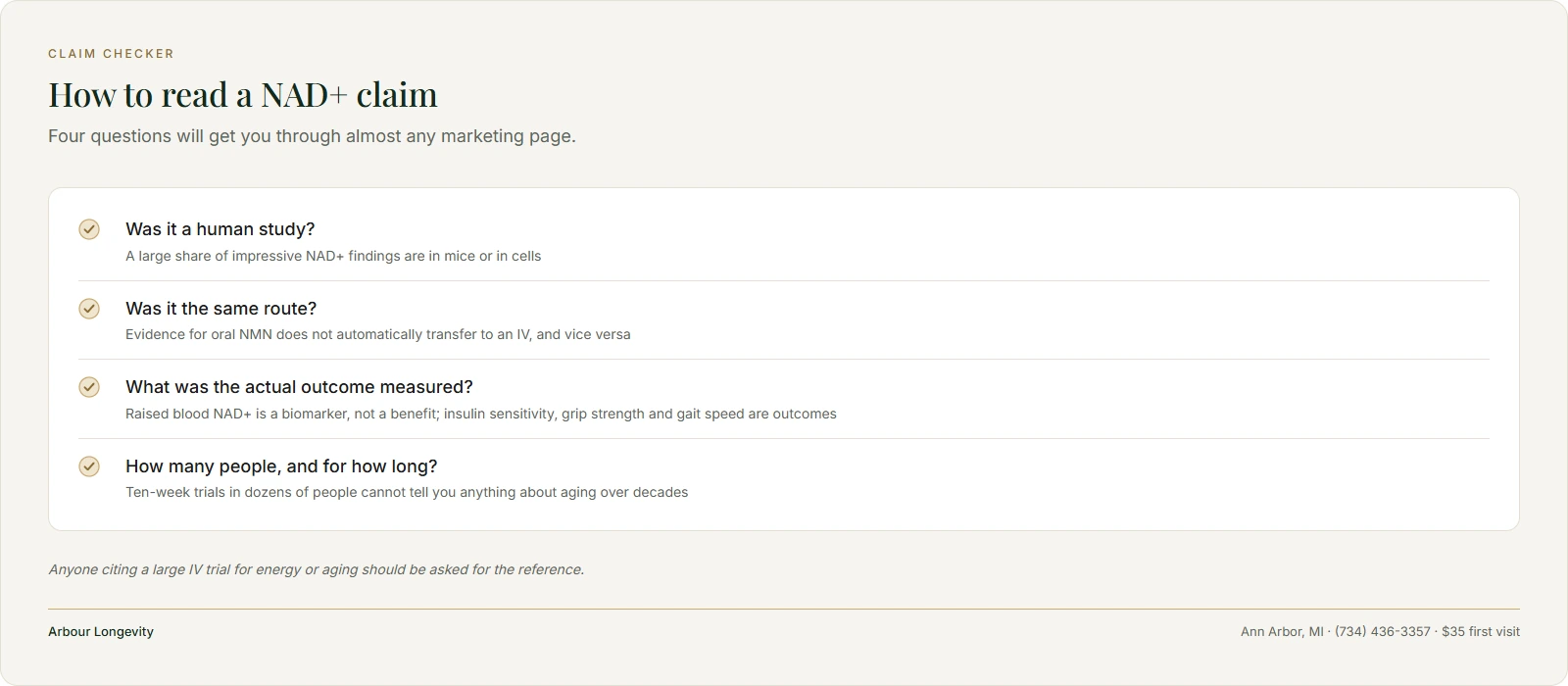
- Was it a human study? A large share of impressive NAD+ findings are in mice or in cells.
- Was it the same route? Evidence for oral NMN does not automatically transfer to an IV, and vice versa.
- What was the actual outcome measured? "Raised blood NAD+" is a biomarker (a lab measurement), not a benefit. Insulin sensitivity, grip strength and gait speed are outcomes.
- How many people, and for how long? Ten-week trials in dozens of people cannot tell you anything about aging over decades.
What Patients Consistently Report
Patient report is not trial evidence, and I will not dress it up as such. It is still worth describing accurately. It is part of why this treatment persists.
The most common pattern people describe is a lift in mental clarity and steadier energy within one to three days. That pattern includes less of a mid-afternoon crash. Over the following weeks some report better sleep. After a short series, some report easier recovery from training. It is not a stimulant, so there is no coffee-like buzz. For more on what patients report, see our guide to NAD+ IV therapy benefits.
What it does not do is equally consistent. It does not:
- Replace missing hormones.
- Correct iron or thyroid problems.
- Cause weight loss on its own.
If any of those is the real driver of how you feel, an infusion will disappoint you. That is precisely why we work the diagnosis first.
What I Do With This in Clinic
I treat the evidence as permission to try in the right person, not as a promise. That means the basics get checked and corrected first:
- Thyroid.
- Iron.
- B12.
- Blood sugar.
- Hormones.
- Sleep quality.
- Medications.
- Mood.
When those are handled and someone still wants energy support, a short NAD+ series is a reasonable thing to trial. It comes with an honest conversation about the state of the evidence, and a clear plan to stop if it does nothing.
That is also the standard I would want applied to me as a patient.
Frequently Asked Questions
Is there a randomised controlled trial of IV NAD+ for fatigue?
Not one I can point you to. The published human IV work is small and pharmacokinetic. Anyone citing a large IV trial for energy or aging should be asked for the reference.
Is the oral evidence good enough to just take NMN or NR instead?
The oral evidence is genuinely better, which surprises people. Whether that makes it the right choice for you depends on your goals and timeline. We compare the two precursors directly in NMN vs NR, which precursor actually reaches your cells.
Does raising blood NAD+ mean my cells got more?
Not necessarily, and this is one of the field's open problems. Blood levels are what is easy to measure. Tissue levels are what matter, and the link between the two is still being worked out.
Has IV NAD+ been shown to be safe?
The published human work and long clinical use have not raised safety signals at the doses used. The common effects, such as chest tightness or abdominal cramping, depend on the infusion rate. They ease when the infusion is slowed. Safety still depends on proper screening. That is why we take a full history and review labs first.
Why do so many articles sound more certain than this one?
Because certainty sells better than accuracy. The state of the science is interesting and incomplete, and you deserve to hear it that way.
What would change my mind?
An adequately powered randomised trial of IV NAD+ (one large enough to detect a real effect). It would need a patient-relevant primary outcome, fatigue or cognition, over a meaningful follow-up. If that arrives and is negative, I will say so here.
The Next Step
Want to talk through whether this is worth trying in your situation? The first step is to book your $35 first visit, where we review your history, labs and goals. You can read what to expect in what happens at the $35 consultation. You can also see the kinds of patients we work with in the five profiles I see every week. For practical treatment detail, see our main NAD+ IV therapy guide. Prefer to talk first? Call (734) 436-3357.
Arbour Longevity - 2217 Packard St #15, Ann Arbor, MI 48104 - (734) 436-3357 - Open Thursday through Monday, 10:00 to 19:00, closed Tuesday and Wednesday. Parking is free and directly outside, with no meters and no structure. Suite 15 is down a flight of stairs, so please call ahead if stairs are difficult for you. Ready to start? Book your $35 first visit.
References
- Grant R, Berg J, Mestayer R, et al. A pilot study investigating changes in the human plasma and urine NAD+ metabolome during a 6 hour intravenous infusion of NAD+. Front Aging Neurosci. 2019;11:257. PMID 31572171. DOI: 10.3389/fnagi.2019.00257
- Yoshino M, Yoshino J, Kayser BD, et al. Nicotinamide mononucleotide increases muscle insulin sensitivity in prediabetic women. Science. 2021;372(6547):1224-1229. PMID 33888596. DOI: 10.1126/science.abe9985
- Igarashi M, Nakagawa-Nagahama Y, Miura M, et al. Chronic nicotinamide mononucleotide supplementation elevates blood NAD+ levels and alters muscle function in healthy older men. npj Aging. 2022;8(1):5. PMID 35927255. DOI: 10.1038/s41514-022-00084-z
- Yaku K, Nakagawa T. NAD+ precursors in human health and disease: current status and future prospects. Antioxid Redox Signal. 2023;39(16-18):1133-1149. PMID 37335049. DOI: 10.1089/ars.2023.0354
- Lautrup S, Sinclair DA, Mattson MP, Fang EF. NAD+ in brain aging and neurodegenerative disorders. Cell Metab. 2019;30(4):630-655. PMID 31577933. DOI: 10.1016/j.cmet.2019.09.001
- Covarrubias AJ, Perrone R, Grozio A, Verdin E. NAD+ metabolism and its roles in cellular processes during ageing. Nat Rev Mol Cell Biol. 2021;22(2):119-141. PMID 33353981. DOI: 10.1038/s41580-020-00313-x
Citations verified against PubMed. This article is educational and does not replace individualized medical advice.

Gandhi Bhattarai, FNP-BC, PMHNP-BC, Anti-Aging/Functional Medicine BC
Triple board-certified nurse practitioner and founder of Arbour Longevity in Ann Arbor. Every article is written from clinic practice and reviewed against current guidelines.
✓ Medically reviewed · Last updated August 16, 2026
How we reviewed this article
Arbour Longevity articles are written by the treating clinician, checked against primary sources (peer-reviewed journals, FDA labeling, Endocrine Society and other specialty guidelines) and re-reviewed when guidance changes. See our editorial policy. Spotted an error? Email info@arbourlongevity.com.
This article is educational and is not a substitute for individualized medical advice. Whether a treatment is appropriate for you is determined during consultation.
Your symptoms have a cause. Let’s find it.
Book a $35 first visit in Ann Arbor. It’s a 30–45 minute consultation with Gandhi Bhattarai, applied toward your plan. Serving Ann Arbor, Ypsilanti, Saline, Dexter, Chelsea, and Michigan by telehealth.





.webp)

