

O-Shot for Stress Urinary Incontinence | Ann Arbor
Key takeaways
- The O-Shot is one of the few non-surgical options with randomized-trial support for stress urinary incontinence, the leaking that happens with a cough, laugh or run.
- It works by rebuilding the tissue that supports your urethra, not by tightening a muscle.
- Trials used two or three injections spaced four to six weeks apart, and PRP plus pelvic floor training beat training alone.
- For severe leakage or prolapse, surgery is still the stronger option, and we will say so.
This page is about one problem: bladder leaks. The O-Shot is one of the few non-surgical options with randomized-trial support for stress urinary incontinence (leaking when you cough, sneeze, laugh, lift, or run). It works by rebuilding the tissue that supports your urethra, not by tightening a muscle you already exercise. Still deciding whether the O-Shot is right for you at all? Start with our complete guide to the O-Shot in Ann Arbor, MI. It covers the procedure, results timeline, sessions and pricing. This article picks up where bladder leakage is the main concern.
Stress Leakage Is a Tissue Problem, Not a Willpower Problem
Stress urinary incontinence (SUI) is leakage triggered by pressure: a cough, a sneeze, a laugh, a jump, a heavy lift, the third mile of a run. There is no urgency and no warning. Pressure goes up inside the abdomen, and the support around the urethra does not hold.
That is a different mechanism from urge incontinence, where the bladder muscle contracts on its own and you get a sudden, hard-to-ignore signal. Urge leakage responds to bladder retraining, timed voiding, and medication. Stress leakage responds to whatever restores urethral support. Many women have some of both. That is one reason a proper assessment matters before anyone injects anything.
The support structure in question is the front vaginal wall and the tissue around the urethra. That means the collagen (the protein that keeps tissue firm), small blood vessels, and connective tissue between the vagina and the urethra. Childbirth, chronic straining, weight change, hormone decline, and time all thin it. Once that tissue thins, muscle effort can only make up so much. This is why women who have done Kegels faithfully for six months, cut their coffee, and timed their water intake still leak. They are exercising a muscle when the problem is the scaffolding.
What Does the O-Shot Actually Do to Urethral Support?
PRP (platelet-rich plasma, a concentrate of your own blood platelets) is prepared from a small blood draw spun in a centrifuge in-office during your appointment. Platelets carry the growth factors your body already uses to rebuild injured tissue: signals for new collagen, new small blood vessels, and cell repair.
For incontinence, placement is everything. The plasma goes into the front vaginal wall and the area around the urethra, the tissue that physically supports it, rather than only the clitoral region targeted for sensation. Over the following weeks the treated tissue thickens, its blood supply improves, and the urethra gets better backing when abdominal pressure spikes.
This is regeneration on a biological schedule. Nothing is implanted, nothing is tightened, and nothing happens the same afternoon. The tissue has to rebuild.
What Do the Trials Show?
The incontinence evidence for PRP is stronger than most people assume. It comes from randomized trials (studies where people are assigned by chance to treatment or a sham), not just clinic testimonials.
A double-blind, sham-controlled randomized trial. Fifty women with confirmed stress incontinence were randomized to two PRP injections around the urethra, four to six weeks apart, or to identical sham injections of saline. Subjective cure was much higher in the PRP group (32% versus 4%). Urine loss measured on a one-hour pad test was lower in the PRP group at six months. No adverse events were seen (Grigoriadis et al., Urogynecology, 2024; doi:10.1097/SPV.0000000000001378).
A 2026 systematic review and meta-analysis (a study that pools the results of many trials). Eight studies covering 257 women were pooled. PRP produced real reductions in UDI-6 and ICIQ-SF symptom scores at one to three months. It also raised abdominal leak point pressure, the pressure your urethra can withstand before leaking, by a mean of 51.07 (95% CI 36.21 to 65.93). Quality-of-life scores improved across studies. Reported side effects were mild and short-lived, with no serious complications (Utama et al., Frontiers in Medicine, 2026; doi:10.3389/fmed.2026.1728478).
PRP added to pelvic floor training beat training alone. Sixty women with untreated SUI were randomized to two PRP injections a month apart plus pelvic floor muscle training, or to training alone. At five months the one-hour pad weight had dropped more in the combined group, by roughly 8 grams, and symptom scores favoured the combined group at both two and five months. No adverse events followed injection (Saraluck et al., Neurourology and Urodynamics, 2024; doi:10.1002/nau.25365).
That last trial is the useful one in practice. It says the O-Shot and pelvic floor physical therapy are not rivals. The injection rebuilds the passive support; the therapy trains the active support. Together they beat the therapy alone.
Tired of planning your day around bathrooms?
A 30-45 minute first visit that separates stress leaks from urge leaks and measures your baseline, with the $35 applied toward your plan.
Book your $35 first visit Call (734) 436-3357
The Honest Boundary: What PRP Does Not Replace
A systematic review that covered both female sexual dysfunction and SUI found steady improvement in ICIQ-SF and UDI-6 scores after PRP. It also found a head-to-head randomized trial in which a midurethral sling beat PRP injections on both measures. The authors rated the overall evidence base as low, because of small studies and mixed protocols (Dankova et al., Biomedicines, 2023; doi:10.3390/biomedicines11112919).
The fair reading: for mild-to-moderate stress leakage, PRP is a reasonable, low-risk, no-downtime option with real randomized support behind it. For severe leakage, significant prolapse, or leakage that has already failed a well-done surgical repair, surgery remains the more powerful tool, and you should be told so plainly. PRP can still have a role there, preparing tissue before a repair or supporting it afterward. It is not a substitute for an operation you actually need.
What Does a Course Look Like When Incontinence Is the Target?
Incontinence protocols in the research differ from sexual-function protocols. The review above described the studied SUI approach as roughly 5 to 6 mL of PRP around the urethra, once a month for three months. For sexual function it was 2 mL into the front vaginal wall monthly (Dankova et al., 2023). Your plan at Arbour is tailored rather than copied from a paper, but the shape is similar. More volume, placed around the urethra, given as a short series rather than a single shot.
A typical incontinence course here:
- Assessment visit. We separate stress leakage from urge leakage, review childbirth and surgical history, screen for prolapse, and check hormone status. We set a baseline with validated tools: UDI-6 and ICIQ-SF for symptoms, and IIQ-7 for how much the leakage is costing you day to day.
- Treatment sessions. Numbing cream first, then a small blood draw and in-office spin while it takes effect, then placement. The injection portion takes minutes. You go back to normal activity the same day.
- Spacing. Sessions are often four to six weeks apart, matching the intervals used in the randomized trials.
- Pelvic floor work in parallel. Because the combined approach beat training alone, we want you doing both. If you have never had a proper pelvic floor assessment, we will arrange one.
- Re-measurement. We repeat the same questionnaires at follow-up rather than asking whether you feel better. Scores move or they do not, and that decides whether another session is worth your money.
When Should You Notice a Change?
Because this is tissue rebuilding, the first month is quiet. Most women who respond describe fewer episodes before they describe no episodes: the run stops being a problem before the hard sneeze does. Pooled symptom-score gains in the meta-analysis were measured at one to three months, and the sham-controlled trial found the pad-test difference still present at six months.
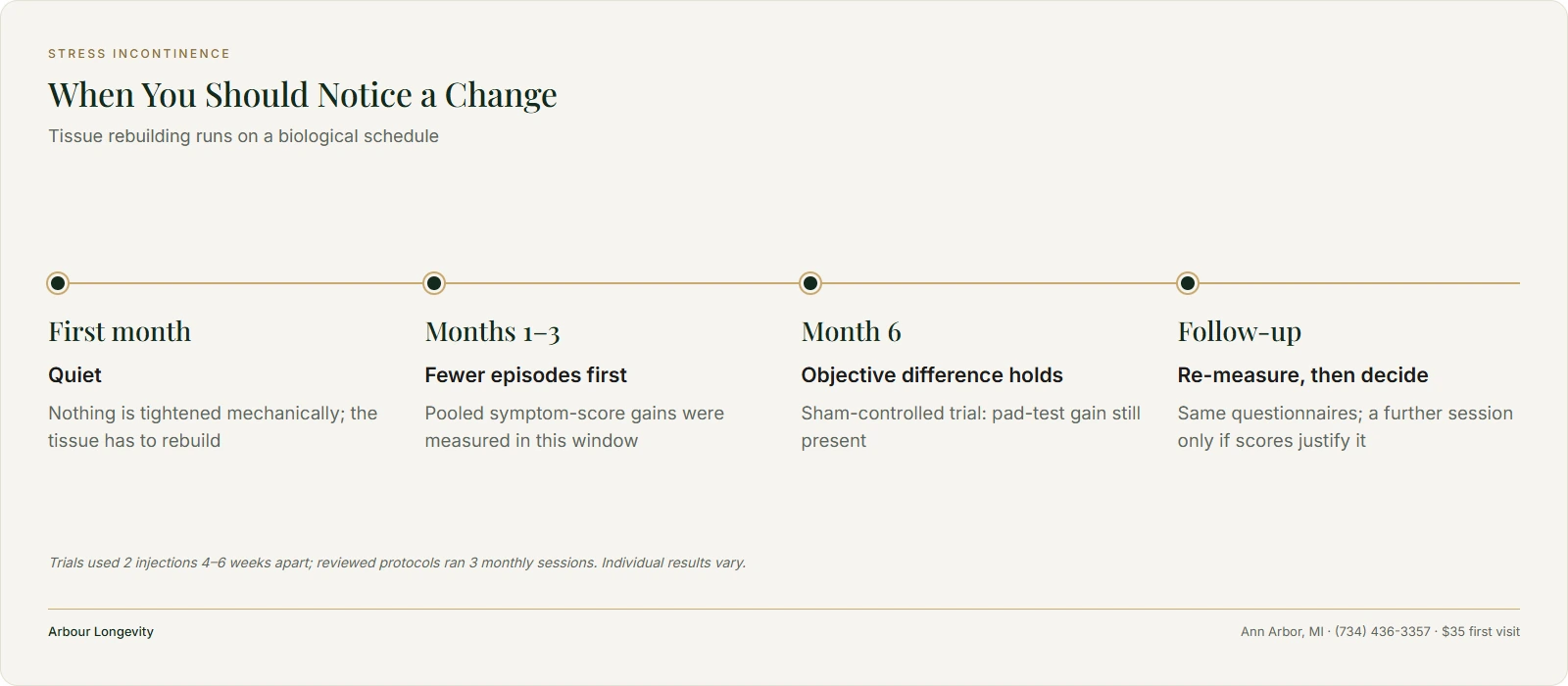
Practical markers women tell us about: not scouting for the bathroom before a workout, and not packing a spare pair. Going back to trampolines with the kids. Stopping the daily liner. Results vary, and we will tell you if your pattern is one that has responded less well in the research.
Preparing for Your Appointment
Platelet function matters, so we ask you to avoid NSAIDs such as ibuprofen and naproxen for about 48 hours beforehand. Discuss any blood thinner with us in advance rather than stopping it on your own. Come well hydrated; it makes the blood draw easier. Plan for the appointment itself rather than a whole day off. There is no recovery period to schedule around.
Often Asked Questions About the O-Shot for Bladder Leaks
How do I know if my leakage is the type the O-Shot helps?
If leakage happens only with pressure (coughing, sneezing, laughing, lifting, running, jumping) and there is no sudden urge first, that is stress incontinence. That is the type with randomized support behind PRP. If you get a strong urge and cannot make it to the bathroom, that is urge incontinence and needs a different plan. Mixed patterns are common, and part of the assessment is working out the split.
Will one session fix it?
Sometimes. But the randomized trials that showed benefit used two injections spaced four to six weeks apart, and the reviewed incontinence protocols ran three monthly sessions. Plan for a short series and be pleased if you need less.
Do I still need pelvic floor physical therapy?
In most cases yes, and that is a feature rather than a failure. The randomized trial that added PRP to pelvic floor training found the pair clearly better than training alone at five months. The two treatments address different halves of the same how it works.
Is it painful?
Numbing cream is applied and given time to work before anything is injected. Most women describe pressure rather than pain. Mild tenderness or light spotting for a day or two afterward is normal and settles on its own.
Are there risks?
The plasma is made from your own blood, so allergic reaction and rejection are not concerns. Across the randomized trials cited above, no adverse events were seen, and the pooled meta-analysis reported only mild, short-lived effects with no serious complications. The realistic short-term effects are tenderness, mild swelling, and occasional light spotting.
What if I have already had a sling?
That needs an individual assessment. Prior surgery is not an automatic exclusion, but it changes the anatomy and the expectations. We would want your operative history before recommending anything.
Does it help with prolapse?
Prolapse is a separate structural problem. PRP is not a prolapse repair. If an exam shows significant prolapse, we will say so and help you get the right workup rather than sell you an injection that cannot do that job.
Where to Go From Here
If bladder leakage is the specific thing that brought you here, the next step is an assessment that actually tells stress from urge and measures where you are starting. Related reading: our complete O-Shot guide for Ann Arbor and our breakdown of who is and is not a good O-Shot candidate. If your leakage started after a birth or after menopause, see how the O-Shot fits each of those life stages.
Your first visit is $35, applied toward treatment if you proceed: book your $35 first visit or call or text (734) 436-3357. Arbour Longevity is at 2217 Packard St, Suite 15, Ann Arbor, MI 48104, serving Ypsilanti, Saline, Dexter, Chelsea and the wider Washtenaw County area. We are open Thursday through Monday, 10:00 to 19:00, and closed Tuesday and Wednesday. Parking is free and directly outside, with no meters and no parking structure. Suite 15 is down a flight of stairs, so please call (734) 436-3357 ahead if stairs are difficult for you and we will make arrangements.
References
- Grigoriadis T, Kalantzis C, Zacharakis D, et al. Platelet-Rich Plasma for the Treatment of Stress Urinary Incontinence - A Randomized Trial. Urogynecology (Phila). 2024;30(1):42-49. PMID 37493287. doi:10.1097/SPV.0000000000001378
- Utama BI, Birru ABA, Cuandra KN, et al. Therapeutic efficacy and safety of injectable platelet-rich plasma in women with stress urinary incontinence: a systematic review and meta-analysis. Frontiers in Medicine. 2026;13:1728478. PMID 41930120. doi:10.3389/fmed.2026.1728478
- Saraluck A, Chinthakanan O, Kijmanawat A, et al. Autologous platelet rich plasma (A-PRP) combined with pelvic floor muscle training for the treatment of female stress urinary incontinence (SUI): A randomized control clinical trial. Neurourology and Urodynamics. 2024;43(2):342-353. PMID 38108468. doi:10.1002/nau.25365
- Dankova I, Pyrgidis N, Tishukov M, et al. Efficacy and Safety of Platelet-Rich Plasma Injections for the Treatment of Female Sexual Dysfunction and Stress Urinary Incontinence: A Systematic Review. Biomedicines. 2023;11(11):2919. PMID 38001920. doi:10.3390/biomedicines11112919
- Office on Women's Health, U.S. Department of Health and Human Services. Urinary incontinence. womenshealth.gov
- National Institute of Diabetes and Digestive and Kidney Diseases. Bladder Control Problems in Women. niddk.nih.gov
This content is educational and does not constitute medical advice. The O-Shot requires clinical evaluation and is not appropriate for everyone. Individual results vary.

Gandhi Bhattarai, FNP-BC, PMHNP-BC, Anti-Aging/Functional Medicine BC
Triple board-certified nurse practitioner and founder of Arbour Longevity in Ann Arbor. Every article is written from clinic practice and reviewed against current guidelines.
✓ Medically reviewed · Last updated June 8, 2026
How we reviewed this article
Arbour Longevity articles are written by the treating clinician, checked against primary sources (peer-reviewed journals, FDA labeling, Endocrine Society and other specialty guidelines) and re-reviewed when guidance changes. See our editorial policy. Spotted an error? Email info@arbourlongevity.com.
This article is educational and is not a substitute for individualized medical advice. Whether a treatment is appropriate for you is determined during consultation.
Your symptoms have a cause. Let’s find it.
Book a $35 first visit in Ann Arbor. It’s a 30–45 minute consultation with Gandhi Bhattarai, applied toward your plan. Serving Ann Arbor, Ypsilanti, Saline, Dexter, Chelsea, and Michigan by telehealth.





.webp)

