
PDO Thread Lift vs. Surgical Facelift: Cost, Recovery, and Results Compared
Key takeaways
- A PDO thread lift costs a fraction of a surgical facelift, needs only local anesthetic, and has 3 to 7 days of downtime.
- Surgery gives the biggest, longest-lasting change (5 to 10+ years) and is the right choice for heavy sagging and excess skin.
- Threads suit mild to moderate laxity, usually in your 30s to early 50s, with results lasting about 1 to 3 years.
- Published series report high satisfaction with PDO cog threads and a complication rate near 4.8 percent.
- Arbour Longevity layers threads with Sculptra and Plexr so lift, volume and tightening are treated together.
If you have started noticing jowls, sagging cheeks or a softer jawline, you have probably wondered whether a facelift is the only real answer. There is a middle ground. PDO thread lifts deliver visible lifting and skin tightening without general anesthesia, large incisions or weeks of downtime.
So how do PDO threads stack up against a surgical facelift? This guide compares cost, recovery, how long results last and who each option suits, using research from PubMed. If you are in the Ann Arbor area, Arbour Longevity's non-surgical facelift program combines threads with other treatments. Many patients find that gives them the best of both worlds.
What Is a PDO Thread Lift?
A PDO (polydioxanone) thread lift places fine, dissolving medical threads beneath the skin to lift sagging tissue. Barbed "cog" threads lift right away, and all threads trigger new collagen over the following months. The threads dissolve, but the collagen they build keeps improving your skin after they are gone. For the full explanation of thread types, treatment areas, cost and candidacy, read our main guide, PDO thread lift in Ann Arbor. For the healing weeks afterward, see PDO thread lift recovery and aftercare.
What Is a Surgical Facelift?
A surgical facelift (the medical term is rhytidoplasty) is major surgery done under general anesthesia or deep sedation. The surgeon cuts along the hairline and around the ears. They lift the deeper facial tissue (the SMAS layer, a sheet of muscle and connective tissue under the skin), remove excess skin, and close with stitches. It usually takes 3 to 5 hours and needs a long recovery.
Surgery remains the gold standard for advanced laxity, heavy jowling or deep structural change that non-surgical methods cannot fix alone.
Side-by-Side Comparison: PDO Thread Lift vs. Surgical Facelift
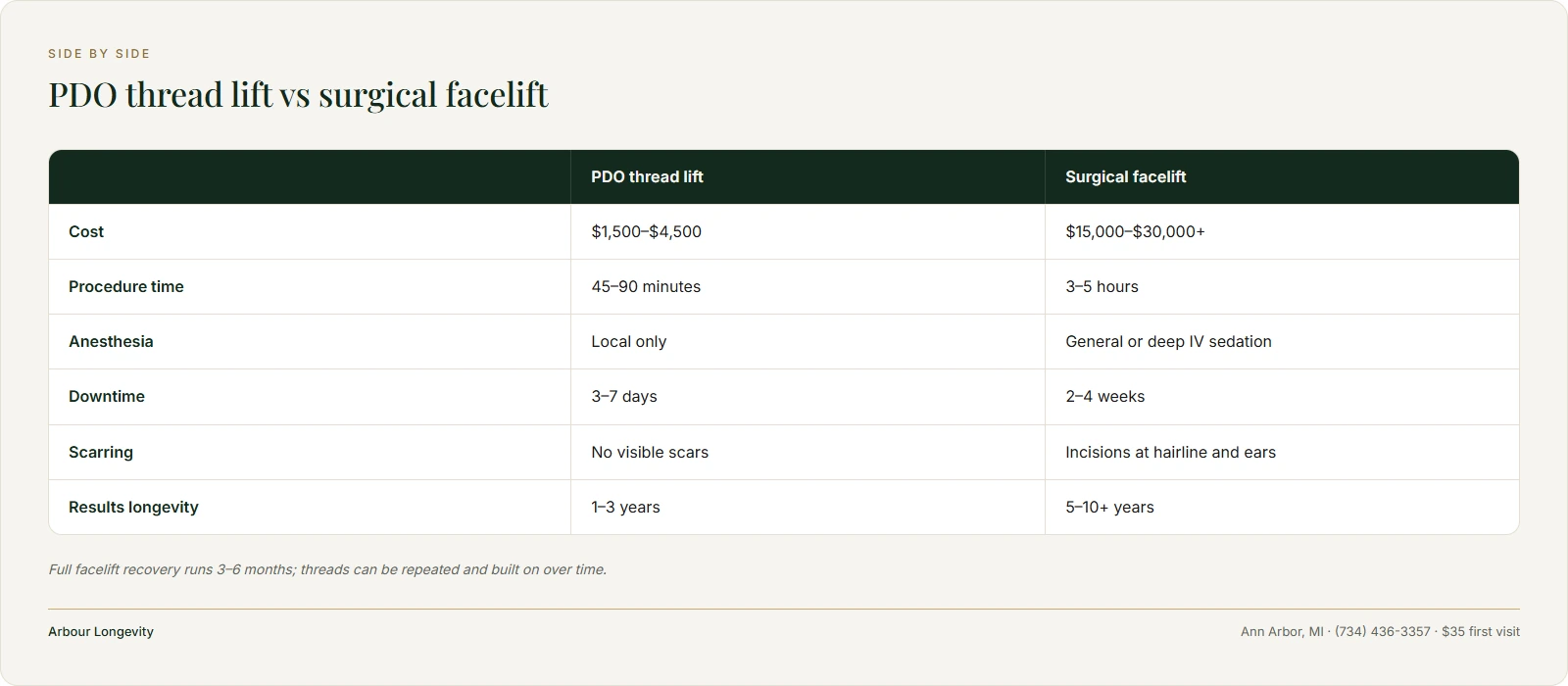
| Factor | PDO Thread Lift | Surgical Facelift |
|---|---|---|
| Cost | Priced per zone; full face from $2,800 at Arbour Longevity | $15,000 – $30,000+ |
| Procedure Time | 45 – 90 minutes | 3 – 5 hours |
| Anesthesia | Local anesthesia only | General anesthesia or deep IV sedation |
| Downtime | 3 – 7 days | 2 – 4 weeks (full recovery: 3 – 6 months) |
| Scarring | No visible scars (needle entry points only) | Incision scars along hairline and ears |
| Results Onset | Immediate lift with continued improvement over 2 – 3 months | Visible after swelling subsides (6 – 12 weeks) |
| Results Longevity | 1 – 3 years (longer with combination treatments) | 5 – 10+ years |
| Collagen Stimulation | Yes - significant new collagen production | Minimal (primarily structural repositioning) |
| Risk Level | Low (minor bruising, swelling) | Higher (hematoma, nerve injury, infection, anesthesia risks) |
| Repeat Treatments | Can be repeated safely | Revision surgery possible but more complex |
| Ideal Age Range | 30s – 50s (mild to moderate laxity) | 50s – 70s (moderate to severe laxity) |
What the Research Says: Clinical Evidence for PDO Thread Lifts
The most common question patients ask is whether PDO thread lifts truly work. Several peer-reviewed studies on PubMed support both how well they work and how safe they are.
One study treated 38 patients with barbed PDO cog threads. On the Global Aesthetic Improvement Scale (a standard rating of visible change), 78.9% were rated "very much improved" and 18.4% "much improved". Patient satisfaction was equally strong: 76.3% rated their outcome "excellent" and 21.0% "very good". No patient reported a "fair" or "poor" result (Unal et al., 2019, DOI: 10.1080/09546634.2019.1640347).
Another study followed patients for a full 24 months after PDO thread lifting. It found clear, long-lasting effects, including measurable skin lifting of 3 to 10 millimeters. The complication rate was only 4.8%. Results were "highly augmented" when thread lifting was combined with Botox, fillers and PRP (Ali, 2017, DOI: 10.1080/14764172.2017.1368562).
A study of 30 patients confirmed clear, measurable improvement at one month, with 100% patient satisfaction. It highlighted the collagen-building effect of PDO threads and their ability to "strengthen the contour of the face, reduce roundness, and lift sagging skin" (Khan et al., 2021, DOI: 10.1111/jocd.14092).
Combining PDO mid-face lifting with other treatments beat a single treatment. Patients had higher satisfaction, better wrinkle reduction and no reported complications (Park et al., Aesthetic Plastic Surgery, 2024, DOI: 10.1007/s00266-024-03975-6).
The Collagen-Stimulating Advantage of PDO Threads
A key difference between PDO threads and a surgical facelift is what happens beneath the surface. A facelift moves tissue and removes excess skin, but it does little to build new collagen.
PDO threads trigger a controlled healing response. As the threads dissolve over several months, your body builds new collagen and elastin around them. Your skin becomes firmer, thicker and more resilient, in ways a facelift alone does not achieve.
This is one reason many providers now see PDO threads as more than a "mini facelift". They are a genuine skin renewal treatment in their own right.
Wondering which camp you are in?
A $35 first visit gives you a 30–45 minute laxity assessment and an honest answer on threads versus surgery, with the fee applied toward your plan.
Book your $35 first visit Call (734) 436-3357
Ideal Candidates: Who Should Choose Which?
PDO Thread Lift May Be Right for You If:
- You are in your 30s to early 50s with mild to moderate skin laxity
- You want noticeable improvement without major surgery
- You cannot afford 2 to 4 weeks of downtime
- You want a procedure done under local anesthesia in an office setting
- You are looking for collagen stimulation and skin quality improvement, not just repositioning
- You want a treatment that can be repeated and built upon over time
Surgical Facelift May Be Right for You If:
- You are in your late 50s or older with significant sagging, deep jowls and excess skin
- You want the most dramatic, longest-lasting single-procedure result
- You are medically cleared for general anesthesia
- You can take 3 to 6 weeks away from work and social activities
- You understand the higher risk profile and potential for scarring
The Arbour Longevity Approach: Why Combination Therapy Outperforms Either Option Alone
At Arbour Longevity in Ann Arbor, Gandhi Bhattarai, FNP-BC, PMHNP-BC, Anti-Aging/Functional Medicine BC, uses a combined approach. It works around the limits of any single treatment. Rather than relying on threads alone, the plan layers three treatments:
- PDO Thread Lifting gives the immediate lift and triggers long-term collagen growth. Barbed cog threads lift the jawline, cheeks and neck, while smooth threads improve skin texture and firmness.
- Sculptra (Poly-L-Lactic Acid) is a biostimulator (an injectable that prompts your skin to build its own collagen over months). It slowly replaces lost facial volume over 2 to 3 months. Combined with threads, Sculptra fills the volume loss that threads alone cannot fix. Because it builds volume slowly, it behaves quite differently from hyaluronic acid fillers; we compare the two in Sculptra vs. fillers for facial volume.
- Plexr Plasma Pen is an FDA-cleared plasma device that tightens and resurfaces skin using sublimation (turning a tiny point of tissue straight from solid to gas, without cutting). Plexr works especially well for upper and lower eyelid tightening, lines around the mouth and loose neck skin. Arbour Longevity is the only clinic offering Plexr in Ann Arbor.
This three-part plan (lift, add volume and tighten) mimics many outcomes of a surgical facelift at a fraction of the cost, risk and recovery time. The 24-month study by Ali (2017) found that combining thread lifting with other treatments gives "highly augmented results" compared to threads alone.
This approach also allows gradual, tailored treatment. Many Arbour patients begin with PDO threads and Sculptra, then add Plexr for targeted skin tightening. They build results over several visits rather than one high-stakes surgery. Botox and dermal fillers can refine the result by smoothing expression lines and enhancing the lips or under-eyes. Those add-ons are priced by units and product rather than by session; our Botox cost guide for Ann Arbor breaks down what to budget.
Cost Comparison: Is a PDO Thread Lift Worth It?
Budget is a fair factor in any aesthetic decision. Here is how the numbers usually break down:
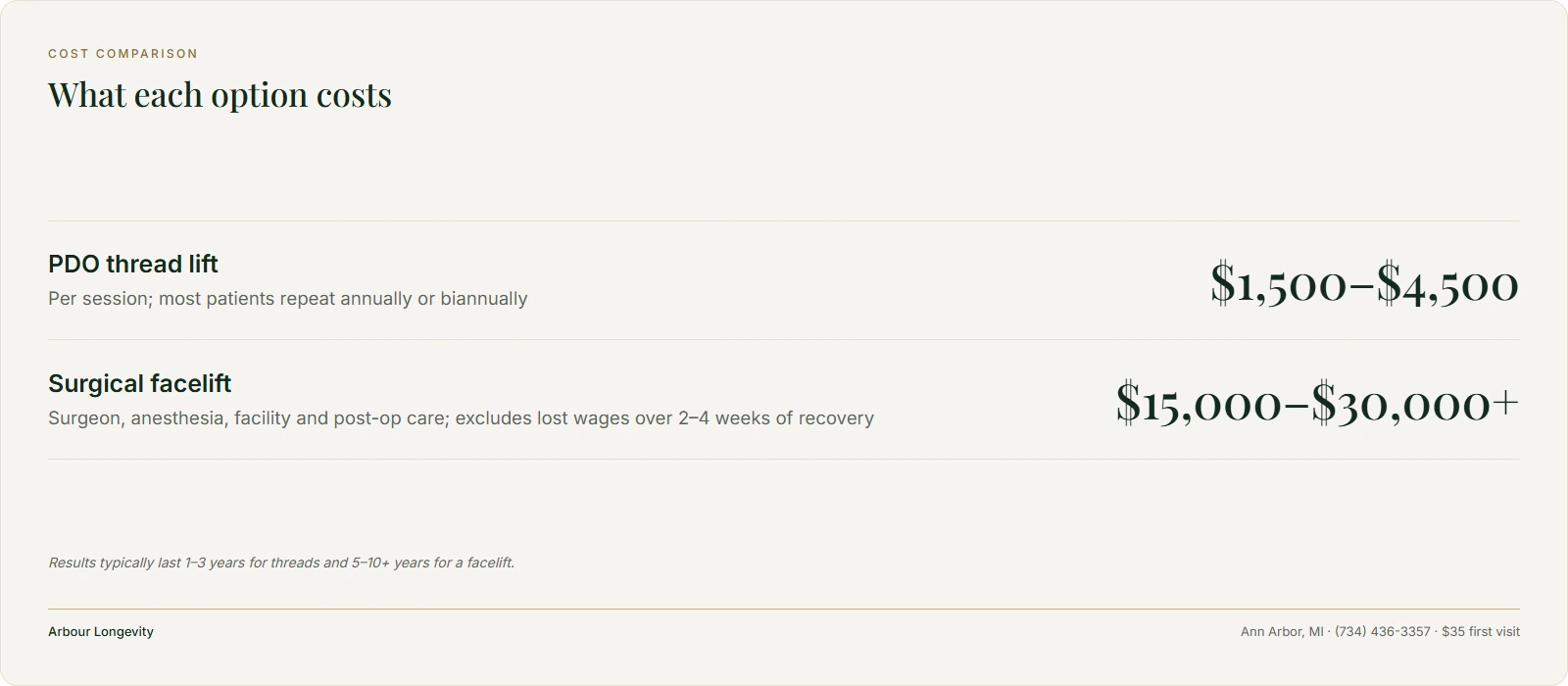
- PDO Thread Lift: at Arbour Longevity, priced per zone from $350, with a full face from $2,800. The figure depends on the number and type of threads and the areas treated. Most patients book one session every one to two years to hold results. Our PDO thread lift guide lists pricing by thread type.
- Surgical Facelift: $15,000 to $30,000 or more, including surgeon fees, anesthesia, facility costs and aftercare. This does not include lost wages during 2 to 4 weeks of recovery.
Factor in the shorter downtime, lower risk and the option to build results over time. Many patients find PDO thread lifting, especially as part of a combined plan, delivers strong value.
Frequently Asked Questions
How painful is a PDO thread lift compared to a facelift?
A PDO thread lift is done under local anesthesia. Most patients describe mild pressure or tugging. Pain during and after is minimal, and most people manage soreness with over-the-counter pain relievers for 1 to 2 days. A surgical facelift involves general anesthesia and far more pain, swelling and bruising, which usually needs prescription pain medication for 1 to 2 weeks.
Can I get a PDO thread lift if I have already had a surgical facelift?
Yes. PDO threads can be a good follow-on to a past facelift, especially as some laxity returns over the years. Threads can help hold and extend the results of your surgery without another major operation. This is one reason combined approaches are becoming the standard.
How long do PDO thread lift results last?
Results usually last 1 to 3 years, depending on the type and number of threads, your skin quality and your overall health. The collagen effect keeps improving skin for several months after the threads dissolve. Maintenance treatments can extend results further. Surgical facelift results generally last 5 to 10 years, though the face keeps aging after either one.
Are there any serious risks with PDO thread lifts?
PDO thread lifting has a strong safety record. The published complication rate is about 4.8%. The most common side effects are minor bruising, swelling and short-lived dimpling at the entry points. Serious problems are rare in experienced hands. Surgical facelifts carry more risk. These include hematoma (a pool of blood under the skin) in 1 to 3% of cases, nerve injury, infection, poor scarring, and the risks of general anesthesia.
What is Plexr, and why does it matter for non-surgical facelifts?
Plexr is an FDA-cleared plasma pen device that uses sublimation to tighten and resurface skin without cutting, stitching or lasers. It works well for eyelid tightening (non-surgical blepharoplasty), neck tightening and lines around the mouth. Combined with PDO threads and Sculptra, Plexr adds the skin-surface tightening that rounds out a full non-surgical facelift. Arbour Longevity is currently the only clinic offering Plexr in Ann Arbor.
The Bottom Line
Both options have their place. A surgical facelift remains the most powerful single treatment for advanced laxity and long-lasting results. But many people want real improvement without the cost, risk and recovery of surgery. For them, a well-placed PDO thread lift can deliver a great deal. As part of a layered plan, it can rival surgery for the right candidate at a fraction of the cost. Results vary from person to person.
At Arbour Longevity in Ann Arbor, we specialize in exactly this kind of planned, layered approach. We combine PDO threads, Sculptra and Plexr, which is available only at our clinic in the Ann Arbor area. Together they lift, restore volume and tighten skin without general anesthesia, visible scarring or weeks of downtime.
Ready to find out which approach is right for you? Book your $35 first visit at Arbour Longevity or call (734) 436-3357. You will talk through your goals with Gandhi Bhattarai, FNP-BC, PMHNP-BC, and learn how a combined plan can help you look refreshed and like yourself.

Gandhi Bhattarai, FNP-BC, PMHNP-BC, Anti-Aging/Functional Medicine BC
Triple board-certified nurse practitioner and founder of Arbour Longevity in Ann Arbor. Every article is written from clinic practice and reviewed against current guidelines.
✓ Medically reviewed · Last updated August 19, 2026
How we reviewed this article
Arbour Longevity articles are written by the treating clinician, checked against primary sources (peer-reviewed journals, FDA labeling, Endocrine Society and other specialty guidelines) and re-reviewed when guidance changes. See our editorial policy. Spotted an error? Email info@arbourlongevity.com.
This article is educational and is not a substitute for individualized medical advice. Whether a treatment is appropriate for you is determined during consultation.
Your symptoms have a cause. Let’s find it.
Book a $35 first visit in Ann Arbor. It’s a 30–45 minute consultation with Gandhi Bhattarai, applied toward your plan. Serving Ann Arbor, Ypsilanti, Saline, Dexter, Chelsea, and Michigan by telehealth.




.webp)

