PDO Thread Lift in Ann Arbor: Non-Surgical Facelift
Key takeaways
- A PDO thread lift uses fine, dissolving threads to lift loose skin and trigger new collagen, with no cutting or general anesthesia.
- It suits early to moderate sagging of the jowls, jawline, cheeks, brow, neck and nose; heavy excess skin still needs surgery.
- Threads dissolve in 4 to 6 months, but results usually last 9 to 24 months depending on thread type.
- At Arbour Longevity pricing starts from $350 per zone and full face from $2,800; your first visit is $35.
- Downtime is days, not weeks: mild swelling and tenderness, no hard exercise for 48 hours.
You catch your reflection at a red light on Packard Street, and there it is: the soft sag along your jawline that was not there a few years ago. Your skincare still works. Your makeup still goes on fine. But the structure of your face has started to drift downward, and no cream will pull it back up.
That is the moment most people start weighing a facelift, and then stall. Surgery, anesthesia and weeks of recovery feel like too much for a problem that is not that big yet.
A PDO thread lift lives in that gap. It lifts and tightens loose skin without a scalpel, without general anesthesia, and without disappearing from your life for a month. At Arbour Longevity in Ann Arbor it is one of the most requested skin-longevity treatments. It is delivered by a triple board-certified clinician. It is often paired with PRP (platelet-rich plasma, a concentrate of your own blood platelets), or with a topical growth-factor serum, to support the regenerative response.
Here is a straight, no-hype explanation of how it works, every area it can treat, what it costs, and how to know if you are a candidate.
Related reading. Still weighing threads against surgery? PDO thread lift vs surgical facelift covers cost, recovery and how long results last. Already decided? PDO thread lift recovery and aftercare walks through the two weeks afterward, day by day.
What Is a PDO Thread Lift, and How Does It Work?

A PDO thread lift is a non-surgical procedure. Fine, absorbable threads reposition sagging skin and trigger your body's own collagen production. A clinician places the threads beneath the skin through a fine needle, lifts the tissue into a more youthful position, and the threads hold it there.
No incisions. Nothing cut, stitched or cauterized. Most thread sessions at Arbour Longevity run 30 to 90 minutes depending on the areas treated. The whole visit usually wraps in under two hours.
The treatment works in two ways at once. There is an immediate mechanical lift you can see as the threads go in, and a slower collagen-building effect that keeps improving your skin for months afterward.
What Are PDO Threads Made Of?
The threads are not an exotic new material. They are made from polydioxanone (PDO), the same medical-grade absorbable material used in surgical stitches. It has a decades-long safety record in the human body.
Polydioxanone: The Same Material Used in Surgical Sutures
If you have ever had a procedure closed with dissolving internal stitches, there is a good chance PDO was involved. Surgeons already trust the material. So thread lifts rest on a well-understood foundation, not something brand-new being tested on faces.
Are PDO Threads Absorbable?
Yes, and this matters. The threads dissolve over roughly 4 to 6 months, and your body breaks them down with nothing permanent left behind. Because the material is biocompatible, your body does not fight it as a foreign object. Instead it treats it as a controlled healing signal. It sends fibroblasts (the cells that make collagen) to the area and builds new connective tissue. So even as the threads dissolve, the structural benefit keeps going.
How Do PDO Threads Lift and Tighten Sagging Skin?
This is worth understanding before you book anything. It explains both why the results look natural and why they are not permanent.
The Instant Mechanical Lift vs. the Long-Term Collagen Effect
Two separate things are happening.
The mechanical lift is immediate. Barb (cog) threads have tiny directional hooks along their length that grip the underside of the tissue. That lets the clinician reposition sagging skin and hold it in a lifted position. The effect is visible as the threads go in: lifting jowls, moving mid-face volume upward, defining the jawline, lifting the brow.
The biological effect is slower, and it is the real magic. Placing the threads triggers a small, controlled inflammatory response. The body moves to repair it, and that repair is where the lasting improvement comes from.
How PDO Threads Stimulate Collagen Production
When your skin senses the threads, fibroblasts activate around them and begin laying down new collagen. As the PDO dissolves, it leaves behind a fresh collagen framework that holds the improvement long after the thread itself is gone.
Collagen is what keeps skin firm. It declines steadily with age, which is exactly why skin loosens. By rebuilding that support along the path of each thread, a PDO thread lift does more than hold your skin up for a while. It helps rebuild the scaffolding underneath. That is why results often look better at two to three months than they did on day one.
What Thread Types Does Arbour Longevity Use?
Not all threads do the same job. Your clinician chooses from three types, and usually combines more than one in a single plan:
- Mono threads (smooth): Single, smooth filaments placed in a mesh pattern. They produce no lift; their job is pure collagen stimulation for crepey, thin or lax skin. Used across the face, neck, décolleté, under-eye, lip border and scalp. Best results usually come from a series of three sessions. From $350–$600 per zone.
- Screw / twist threads: One or two threads twisted in a corkscrew pattern, giving better grip and a mild volumizing effect. Ideal for mild hollowing, nasolabial folds and cheeks. From $450–$750 per zone.
- Barb / cog threads: The lifting workhorse. Their hooks reposition and anchor sagging tissue for an immediate, visible lift. These are the most technically demanding threads, where clinician skill most directly shapes the result. From $600–$1,200 per zone.
In practice most plans combine them: barb threads to lift, mono or screw threads to improve the surrounding skin. That is why a consultation matters far more than a one-size menu.
Not sure if threads are right for your face?
Your $35 first visit is a 30–45 minute assessment of your skin, your laxity and your options, with the fee applied toward your plan.
Book your $35 first visit Call (734) 436-3357
Which Areas Can a PDO Thread Lift Treat in Ann Arbor?
One of the biggest advantages of thread lifting is its range. Arbour Longevity runs one of the fullest thread programs in Southeast Michigan, organized into five treatment categories. People walk in with very different concerns and still find a tailored answer.
Here is where PDO threads can be used, and what each area addresses:
- Face: jowls, lower face, jawline, cheeks, mid-face, brow, under-eye, lip border
- Neck: early laxity and "tech neck" looseness
- Nose: the PDO nose thread, a non-surgical refinement of the nasal tip
- Gluteal and body: a non-surgical lift for the buttocks, plus skin laxity on arms, abdomen and thighs
- Scalp: trichogenesis threads (threads placed to stimulate hair follicles and density)
Let's break down the most popular requests.
PDO Threads for Jowls, Jawline, and Neck
Jowls are usually the first thing that sends someone searching for a non-surgical facelift. As deeper facial structures lose support, skin migrates down and blurs the once-clean line of the lower face.
Barb threads are especially effective here. They anchor higher and lift the sagging tissue to restore definition without removing any skin. The same approach sharpens the jawline into a cleaner "V". It also addresses early neck laxity before it progresses to the point of needing surgery. Non-surgical neck tightening is one of the fastest-growing requests the clinic sees.
Cheek, Brow, and Mid-Face Lifting
When the mid-face deflates, the whole face can look tired. Lifting that volume upward refreshes the area and often softens the folds below it as a bonus. A subtle brow lift with threads opens up the eyes and lightens the upper third of the face. It is a small change people notice without being able to name.
Softening Nasolabial Folds and the PDO Nose Thread
The nasolabial folds (nose-to-mouth lines) are often treated as filler territory. But much of that creasing comes from descended cheek tissue, not just lost volume. Lifting the mid-face, or placing screw threads that add subtle volume, can reduce these folds closer to the source.
Arbour Longevity also offers the PDO nose thread, sometimes called a non-surgical rhinoplasty. Fine threads lift and refine the nasal tip and improve contour. It does not change bone or cartilage, and results typically last 12 to 18 months. Because it demands precise knowledge of the blood vessels in the nose, it is performed only by the clinician.
PDO Threads vs. Other Treatments: How Do I Choose?
This is the question almost everyone asks. The honest answer depends on how much lift you need and how much downtime you can accept.
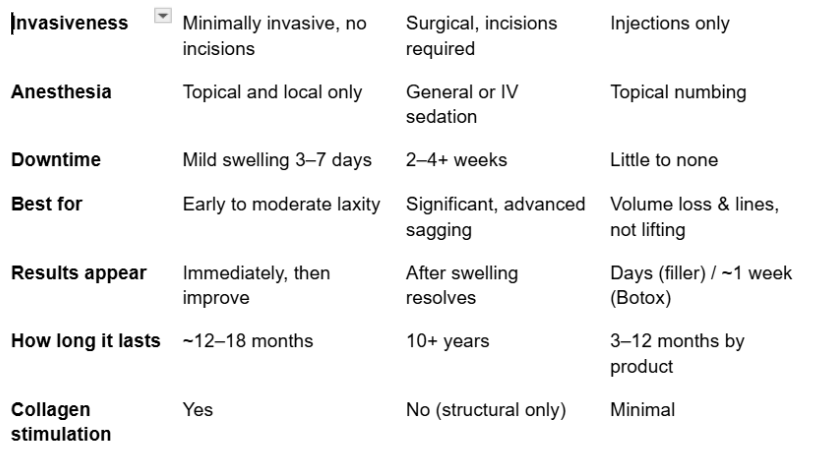
PDO Thread Lift vs. a Surgical Facelift
A surgical facelift is still the right call for significant sagging or excess skin, and a good clinician will tell you so. Threads are the right tool when you notice early-to-moderate changes and want to delay or avoid surgery. They are not the tool for a full structural overhaul. Many Arbour Longevity patients say threads gave them the lift they had assumed required surgery. Results vary from person to person.
PDO Threads vs. Fillers and Botox
A common mix-up. Botox relaxes muscles to soften expression lines. Fillers replace lost volume. Neither one lifts sagging skin. Threads are the lifting tool. They are often combined with Botox, fillers, PRP or a topical growth-factor serum rather than competing with them, so each does the job it is built for. Arbour Longevity offers all of these under one roof, which makes building a balanced plan simple.
What to Expect: Results, Recovery, Safety, and Cost

Once people understand how thread lifts work, the conversation shifts to the practical questions that decide whether you book. Let's answer them directly.
How Much Does a PDO Thread Lift Cost in Ann Arbor?
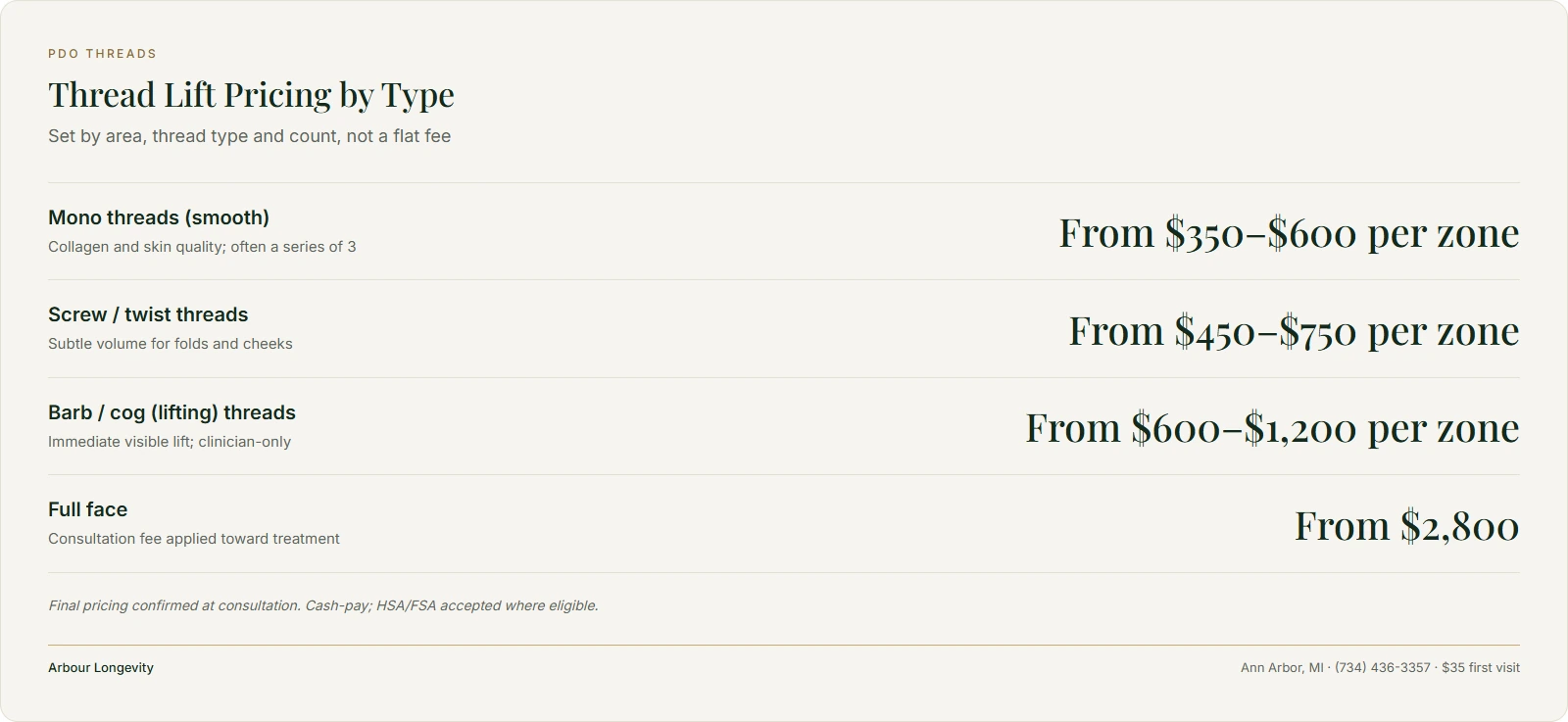
At Arbour Longevity, PDO thread pricing starts from $350 per zone. It is set by area, thread type and thread count rather than a flat fee. As a rough guide:
- Mono threads: from $350–$600 per zone
- Screw / twist threads: from $450–$750 per zone
- Barb / cog (lifting) threads: from $600–$1,200 per zone
- Gluteal and body: from $900 per area
- Scalp trichogenesis: from $400 per session
- Full face: from $2,800
Final pricing is confirmed at your consultation once the clinician has assessed your anatomy and mapped a plan. Treatments are cash-pay, and many patients use HSA/FSA funds where eligible.
What Affects Your Price
A few factors move the number up or down:
- how many threads you need
- how many zones you treat
- which thread types are used
- whether you add PRP or a topical growth-factor serum
Think of it the way you would think about any skilled work on something you cannot easily redo. The cheapest quote is rarely the real bargain. Your result is only as good as the clinician placing the threads.
Is a PDO Thread Lift Safe, and Does It Hurt?
PDO threads rest on a strong safety foundation, largely because they are made from the same absorbable material used in surgical stitches. The most common after-effects are minor and short-lived: some swelling, tenderness or mild bruising for a few days.
As with any procedure that breaks the skin, rare risks exist. That is exactly why who performs it matters. Barb-thread placement, the most technically demanding part, is a clinician-only procedure here.
On pain: the area is numbed with topical and local anesthetic first. During treatment you will feel pressure and movement more than sharp pain. Mild soreness afterward usually settles within a few days.
What Is Recovery Like, and How Much Downtime Should I Plan For?
This is where threads shine compared to surgery. Recovery is measured in days, not weeks. Most people are back to normal quickly, with a few sensible rules to protect the result while it settles.
PDO Thread Lift Recovery Timeline
Here is a realistic picture:
- Days 1–7: Mild swelling and tenderness. Avoid strenuous exercise for 48 hours. Sleep on your back and avoid heavy chewing early on.
- Weeks 1–2: Follow your clinician's guidance on sleeping position and activity while the threads settle. Skip facials, saunas and aggressive face-washing.
- Months 2–3: The collagen-building phase ramps up. This is when results often look their best as new collagen firms the treated area.
The pattern surprises people. You look good early because the lift is immediate, then you keep improving over the following weeks.
How Long Do PDO Thread Lift Results Last?
The threads dissolve within about 4 to 6 months, but the collagen they stimulate lasts much longer. At Arbour Longevity, expected duration by thread type is:
- Barb / cog (lift): 9 to 18 months
- Screw / twist: 12 to 18 months
- Mono: 12 to 24 months
How long your results last depends on your age, skin quality and how advanced your laxity was to begin with. Mono and screw threads typically need a series of three sessions for the best collagen build-up. Most patients maintain results with annual or twice-yearly touch-ups, so collagen keeps building rather than starting from scratch.
Am I a Good Candidate for a PDO Thread Lift?
Thread lifts work beautifully for the right person and disappoint the wrong one. Honest candidacy matters, and the clinic assesses it directly.
You are likely a strong candidate if you:
- Have early to moderate skin laxity (threads work best before tissue loses significant structural support)
- Want lift and tightening but are not ready for, or interested in, surgery
- Have reasonable skin thickness and good underlying tissue quality
- Hold realistic expectations: modest to moderate improvement, not a surgical-scale transformation
- Can follow post-treatment guidelines on activity and sleeping position for two weeks
Threads may not be the right fit, or may need careful evaluation first, if you have:
- significant excess skin (where surgery serves you better)
- an active autoimmune condition
- pregnancy or breastfeeding
- diabetes
- blood-thinning medication
- an active infection at the treatment site
A proper consultation is exactly where this gets sorted honestly.
Why Choose Arbour Longevity for Your Thread Lift in Ann Arbor?

When someone is placing threads beneath the skin of your face, who does it is the single most important decision you will make. At Arbour Longevity, that principle is the whole philosophy: your results are as good as your clinician.
Treatment Led by a Triple Board-Certified Clinician
Your thread lift is performed by Gandhi Bhattarai, FNP-BC, PMHNP-BC, triple board certified in Family Medicine, Psychiatric Mental Health, and Anti-Aging/Functional Medicine. That depth matters. Every treatment is assessed in a full clinical context, so your skin is not treated in isolation from your overall health.
It also means an honest answer if threads are not your best option. The clinic would rather guide you to the right treatment, whether that is surgery, plasma soft surgery, fillers or something else from its menu, than oversell the wrong one.
Threads Paired With PRP and a Topical Growth-Factor Serum
Here is what sets Arbour Longevity apart from a standard thread provider. Where clinically appropriate, thread placement can be paired with PRP, which is injected, and with a growth-factor serum applied topically to the skin surface only. The PRP supplies concentrated growth factors from your own blood.
What Patients Notice
Patients often describe the same surprise: a lift they assumed required surgery. Some describe a cleaner jawline after barb threads paired with mono threads for skin quality. Others describe a PDO nose thread result as natural and discreet. Individual results vary. For how threads compare to other options, see the clinic's Botox and fillers pages, and its plasma soft surgery programs for more advanced lifting.
Book Your PDO Thread Consultation in Ann Arbor, Michigan
The fastest way to find out whether a thread lift is right for you is to come in and talk it through. Your $35 first visit is a private 30–45 minute assessment. It covers what is bothering you, what is biologically going on, and the shortest path to the outcome you want. The fee is applied toward your treatment.
You will find Arbour Longevity inside the Eastover Professional Center at 2217 Packard St #15, Ann Arbor, MI 48104, open Thursday through Monday, 10am–7pm, with free on-site parking. Serving Ann Arbor, Dexter, Ypsilanti, Saline, Plymouth, Canton, Northville and Southeast Michigan.
Frequently Asked Questions About PDO Threads at Arbour Longevity
What is a PDO thread lift?
A non-surgical procedure that places absorbable medical-grade polydioxanone threads beneath the skin. Barb threads provide immediate mechanical lifting; all thread types stimulate long-term collagen. The threads dissolve over 4 to 6 months, leaving a collagen framework that holds the result. Three types are available (mono, screw/twist and barb/cog) across the face, neck, nose, brow, gluteal area, body and scalp.
How long do PDO threads last?
The threads dissolve in 4 to 6 months, but results last longer: roughly 9–18 months for barb/cog, 12–18 for screw/twist, and 12–24 for mono. Mono and screw threads usually need a series of three sessions. Most patients maintain with annual or twice-yearly touch-ups.
Does a PDO thread lift hurt?
Discomfort is minimal. The area is numbed with topical and local anesthetic, so you will mostly feel pressure and movement. Mild soreness for a few days afterward is normal.
How much does a PDO thread lift cost in Ann Arbor?
Pricing starts from $350 per zone and is set by area, thread type and thread count: mono from $350, screw from $450, barb/lift from $600, full face from $2,800. Your exact plan is confirmed at consultation. Cash-pay, with HSA/FSA accepted where eligible.
How much downtime should I expect?
Mild swelling and tenderness for 3 to 7 days. Avoid strenuous exercise for 48 hours, and follow your clinician's guidance on activity and sleeping position for the first two weeks. The lift is visible immediately; collagen improvement develops over two to three months.
What is a PDO nose thread?
Also called a non-surgical rhinoplasty, it uses fine PDO threads to lift and refine the nasal tip and improve contour without altering bone or cartilage. Results typically last 12 to 18 months. Given the precision required, it is performed only by the clinician.
Am I a candidate?
Threads work best for early to moderate laxity in patients with realistic expectations. They may not suit significant excess skin (where surgery is better) or certain conditions such as active autoimmune disease, pregnancy or diabetes. All of this is assessed honestly at your consultation.
Ready to see your jawline again? Book your $35 first visit at Arbour Longevity or call (734) 436-3357, and take the first real step toward a refreshed, natural-looking lift without surgery.

Gandhi Bhattarai, FNP-BC, PMHNP-BC, Anti-Aging/Functional Medicine BC
Triple board-certified nurse practitioner and founder of Arbour Longevity in Ann Arbor. Every article is written from clinic practice and reviewed against current guidelines.
✓ Medically reviewed · Last updated August 21, 2026
How we reviewed this article
Arbour Longevity articles are written by the treating clinician, checked against primary sources (peer-reviewed journals, FDA labeling, Endocrine Society and other specialty guidelines) and re-reviewed when guidance changes. See our editorial policy. Spotted an error? Email info@arbourlongevity.com.
This article is educational and is not a substitute for individualized medical advice. Whether a treatment is appropriate for you is determined during consultation.
Your symptoms have a cause. Let’s find it.
Book a $35 first visit in Ann Arbor. It’s a 30–45 minute consultation with Gandhi Bhattarai, applied toward your plan. Serving Ann Arbor, Ypsilanti, Saline, Dexter, Chelsea, and Michigan by telehealth.




.webp)

