

PDO Thread Lift Recovery and Aftercare | Day-by-Day Timeline, Ann Arbor
Key takeaways
- PDO thread lift recovery is mild but real: swelling for three to five days, tightness for up to two weeks.
- The first 72 hours decide how smooth recovery is; sleep on your back and do not disturb the threads.
- No vigorous exercise for about a week, and no facials or energy treatments for at least four weeks.
- The result keeps improving for months as new collagen forms; many people prefer the six-month photo to the six-week one.
- Call the clinic for spreading redness, rising pain after day three, fever, or asymmetry that has not settled by three weeks.

The short version. Recovery is mild but it is not nothing. Expect swelling and possible bruising for three to five days. A tight or pulling feeling along the lift lines lasts one to two weeks, and the contour settles by roughly week three. The part people are rarely told in advance: the face you see at week three is not the finished result. The collagen response keeps building for months after that.
Not at this stage yet? If you are still deciding whether a thread lift is right for you, start with PDO thread lift in Ann Arbor. It covers how it works, treatment areas, cost and candidacy. If you are weighing threads against surgery, read PDO thread lift vs surgical facelift.
Recovery at a Glance

| When | What is normal | What to do |
|---|---|---|
| Treatment day | Tightness along the lift lines, tiny entry-point marks, swelling beginning | Sleep on your back with your head raised; light cold compress with no pressure |
| Days 1 to 3 | Swelling at its peak, bruising may appear, pulling sensation strongest | No exercise, no alcohol, softer foods, no face-down sleeping |
| Days 4 to 7 | Swelling easing, bruising fading, most people back at work | Still no vigorous exercise; keep big facial movements moderate |
| Weeks 2 to 3 | Contour settling, tightness resolving, lift becoming clear | Normal exercise usually resumes; no facials, massage or microcurrent on the area |
| Months 1 to 6 | Firmness increasing as new collagen forms | Daily sun protection; review at your follow-up |
| Months 6 to 18 | Peak firmness, then gradual, natural softening | Discuss timing for maintenance if you want it |
The Day of Your Treatment
You are awake throughout. We take photographs and mark the planned lift lines while you sit upright. Then we numb the area with topical cream and a small amount of local anesthetic. Each thread enters through a tiny entry point via a fine cannula (a blunt tube) or needle, is positioned along the marked line, and is gently tensioned to lift. A focused jawline treatment takes roughly 30 to 45 minutes; a fuller treatment 60 to 90 minutes.
You will feel pressure and a pulling sensation rather than sharp pain. Walking out, the most common surprise is not soreness but tightness: the feeling of the lift itself. Some people also notice small dimples or puckering at the entry points on day one. That is expected and settles as the tissue relaxes.
Drive yourself home if you wish; no sedation is used. Plan a quiet evening rather than a dinner reservation.
The First 72 Hours
This window decides how smooth the rest of recovery is. Almost all of it comes down to not disturbing threads that have not yet anchored.
Swelling generally peaks between 24 and 72 hours, then declines steadily. Bruising is not universal. When it appears it usually shows around the entry points and along the thread path, and follows the ordinary bruise timeline of a week to ten days. Tightness is strongest now, and it is a good sign rather than a bad one.
Sleep on your back with your head raised on an extra pillow. Do not sleep on your side or face down. Skip alcohol for two to three days, since it worsens both swelling and bruising. Eat softer foods and avoid wide yawning, loud singing and hard chewing. Large jaw movements pull directly against fresh barbed threads. Keep cold compresses light and brief; the aim is cool, not compression.
Days Four to Seven
Most people are comfortable in public and back at work within a few days. Swelling is visibly reducing, bruising is turning yellow-green if it appeared, and the tight sensation is downgrading from constant to occasional.
Vigorous exercise still waits. Anything that raises blood pressure and heart rate sharply, or that involves lying face down or inverted, is off the list for about a week. That includes heavy lifting, hot yoga, saunas and steam rooms. Gentle walking is encouraged from day one.
Makeup over the entry points is usually fine once they have sealed, typically after 48 hours, provided you pat it on rather than rub or drag. Avoid cleansing brushes and anything abrasive.
Weeks Two and Three: When the Contour Settles
This is the point at which the lift becomes properly readable. Residual swelling has resolved, any early asymmetry from uneven swelling has usually evened out, and what you see is close to the mechanical result the threads produced.
The published case series bear this out. In a series of 38 patients treated with bidirectional barbed PDO cog threads, 78.9 percent were rated very much improved and 18.4 percent much improved on the Global Aesthetic Improvement Scale. Every patient was satisfied with the outcome (Unal et al., J Dermatolog Treat 2021, PMID 31267809, DOI). In a separate review of 35 patients, 94.3 percent were satisfied and complications were few. The complications that did occur resolved on their own without surgery. The authors did note asymmetry as something that was seen (Lee et al., J Cosmet Laser Ther 2018, PMID 29271683, DOI).
Small side-to-side differences during the settling period are common and usually resolve. Differences that persist past about three weeks are worth reviewing in person rather than waiting out.
Facials, facial massage, microcurrent, radiofrequency and any energy-based skin treatment over the treated area wait until we clear them, generally at least four weeks. So does dental work involving prolonged wide mouth opening, where it can reasonably be deferred.
Recovering and unsure whether something is normal?
If you are still deciding on threads, your $35 first visit includes a skin-thickness check and a written recovery plan, with the fee applied toward treatment.
Book your $35 first visit Call (734) 436-3357
Months One to Six: When the Result Actually Arrives
The mechanical lift is only half the treatment. Polydioxanone is a material long used for absorbable surgical suture. Its presence in the tissue stimulates new collagen along the thread path, called neocollagenesis in the literature. This collagen effect, alongside tissue contraction, is described as one of the two mechanisms by which the treatment works (Park et al., Aesthetic Plast Surg 2024, PMID 38519570, DOI). Reviews of the technique stress that patient selection is the key determinant of outcome. The trade-off is fewer complications and minimal downtime relative to surgery (Kochhar et al., Clin Plast Surg 2023, PMID 37169412, DOI).
In practice, the threads themselves dissolve over roughly four to six months, by which point the new collagen is carrying the result. Many patients tell us the six-month photograph looks better than the six-week one. That is the opposite of how filler behaves. It is the single most useful thing to understand about the recovery arc: patience is part of the treatment.
In our experience results generally hold for around twelve to eighteen months. Some people still see benefit at two years, particularly where maintenance treatment is used along the way. Aging continues regardless, so the honest measure is against where you would have been without the treatment, not against a permanent stop.
Aftercare Rules, and the Reason Behind Each One
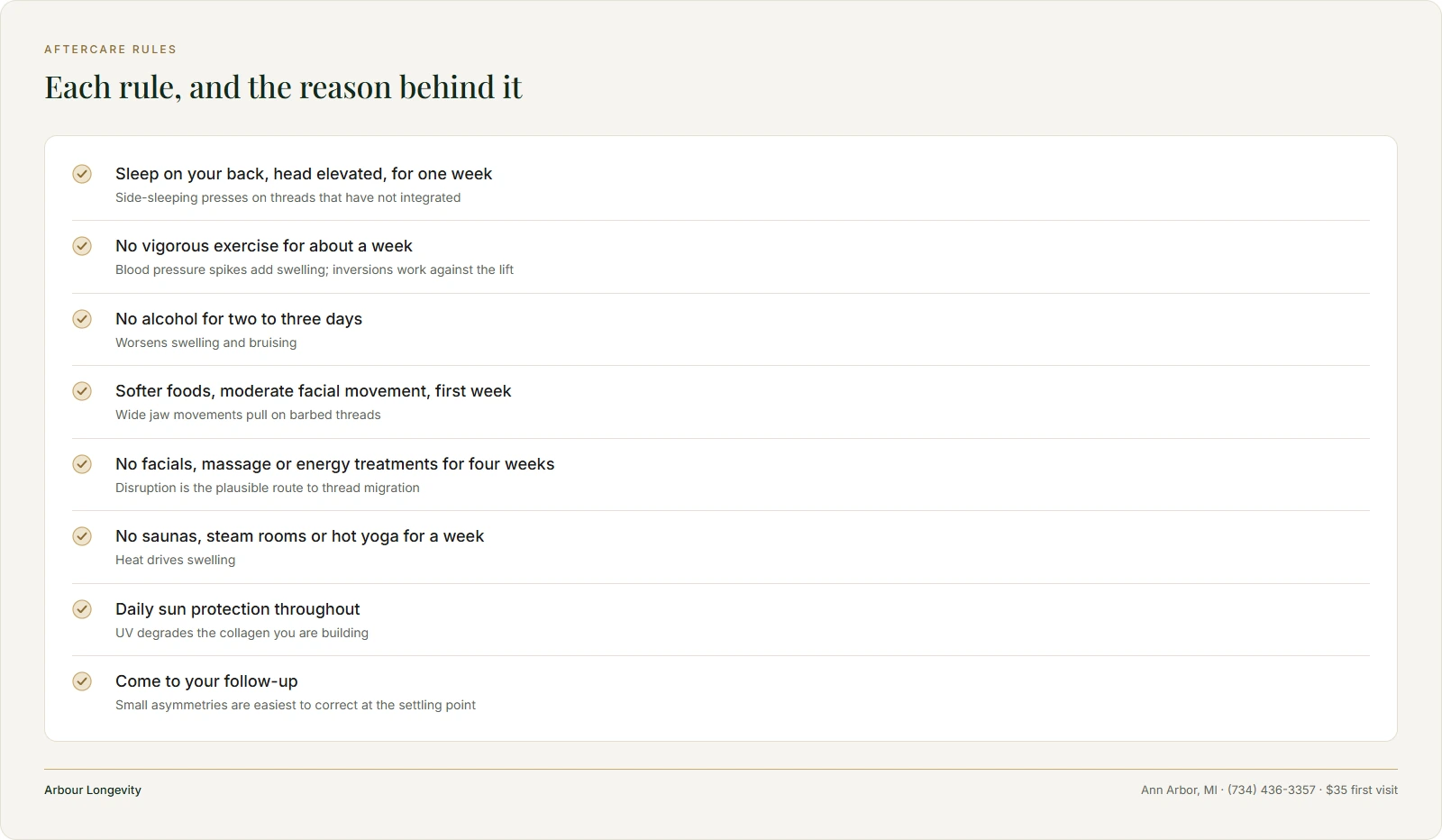
- Sleep on your back, head elevated, for one week. Side-sleeping applies sustained directional pressure to threads that have not yet integrated.
- No vigorous exercise for about a week. Sharp rises in blood pressure increase swelling and bruising; inverted positions work against the lift vector.
- No alcohol for two to three days. It reliably worsens both swelling and bruising.
- Softer foods and moderate facial movement for the first week. Wide jaw movements pull directly on barbed threads.
- No facials, massage or energy-based treatments for at least four weeks. Mechanical and thermal disruption is the plausible route to thread migration.
- No saunas, steam rooms or hot yoga for a week. Heat drives swelling.
- Daily sun protection throughout. Ultraviolet exposure degrades exactly the collagen you have just paid to build.
- Come to your follow-up. Reviewing at the settling point is how small asymmetries get corrected while correction is straightforward.
What Is Normal, and What Is Worth a Phone Call
Normal, and expected to settle:
- swelling for three to five days
- bruising for up to ten days
- tightness or pulling for one to two weeks
- mild puckering at entry points in the first days
- small side-to-side differences during the settling period
- a faint pulling sensation on wide smiling in the first two weeks
Call us on (734) 436-3357 for any of these:
- spreading redness
- increasing pain after day three
- warmth or discharge at an entry point
- fever
- a thread tip that can be felt at the surface or seen
- dimpling that is worsening rather than settling
- asymmetry that has not resolved by around three weeks
None of these are common, and all of them are far easier to address early. Serious complications are rare when the procedure is performed properly. The published series describe complications that were few and largely self-resolving, but that statistic is no reason to sit at home wondering.
What I See in Clinic
The pattern I see most often in recovery is not a complication. It is someone at day five, still slightly swollen, quietly convinced the treatment has not worked. Almost without exception, the same person at week three is pleased, and at month four is more pleased still. Swelling in the first week flattens the very contour the threads created. That is precisely why judging your result before the two weeks are up tends to cause needless worry.
The second pattern is people who feel fine on day three and go back to the gym early. That is the group most likely to see prolonged swelling and a softer result than they should have had. The restrictions are short. They are worth keeping.
Frequently Asked Questions
How many days off work do I need?
Most people take two to three days, and many are presentable enough to return sooner. If you have a significant event, plan the treatment at least three weeks ahead so the contour has fully settled.
When can I exercise again?
Gentle walking from day one. Vigorous exercise, heavy lifting, hot yoga, saunas and steam rooms wait about a week. Anything face-down or inverted waits until we clear it at follow-up.
How should I sleep?
On your back, with your head raised on an extra pillow, for the first week. This is the single aftercare instruction that most affects how the first two weeks go.
When can I have a facial or a massage again?
At least four weeks, and confirm with us first. That includes facial massage, microcurrent, radiofrequency, microneedling and lymphatic drainage over the treated area.
Can I fly after a thread lift?
Flying itself is not a problem. Cabin conditions can make swelling look slightly worse for a day or two, so if you have a choice, give yourself three to five days first.
When will I see the final result?
The contour is readable at about three weeks. The firmness continues to improve for months as new collagen forms, and most people consider the result at three to six months better than the result at three weeks.
Will the tightness go away?
Yes. A tight or pulling feeling along the lift lines is normal and typically eases over the first one to two weeks as the tissue relaxes around the threads.
Will the threads be visible or able to be felt afterwards?
When threads are placed correctly in skin of adequate thickness, they should be neither visible nor palpable once swelling settles. Very thin skin carries a higher chance of feeling them, which is why we assess skin thickness before treating rather than afterwards.
How is pricing set?
Pricing depends on how many threads your plan needs rather than a flat package. The $35 consultation includes the assessment, a treatment plan and a written estimate, so you know the cost before deciding.
Aftercare Support in Ann Arbor
If you are recovering from a thread lift and something does not feel right, call us rather than waiting for your scheduled review. Gandhi Bhattarai, FNP-BC, PMHNP-BC, Anti-Aging/Functional Medicine BC is a triple board certified nurse practitioner and performs these treatments herself.
We are at 2217 Packard St #15, Ann Arbor, MI 48104, open Thursday through Monday, 10am to 7pm, closed Tuesday and Wednesday. Parking is free and directly outside, with no meters and no parking structure. Suite 15 is down a flight of stairs; if stairs are difficult for you, please call (734) 436-3357 before your visit so we can make arrangements.
Book your $35 first visit or call (734) 436-3357. The first visit is $35, applied toward your treatment plan.
References
- Unal M, İslamoğlu GK, Ürün Unal G, Köylü N. Experiences of barbed polydioxanone (PDO) cog thread for facial rejuvenation and our technique to prevent thread migration. J Dermatolog Treat. 2021;32(2):227-230. PMID 31267809. doi:10.1080/09546634.2019.1640347
- Lee H, Yoon K, Lee M. Outcome of facial rejuvenation with polydioxanone thread for Asians. J Cosmet Laser Ther. 2018;20(3):189-192. PMID 29271683. doi:10.1080/14764172.2017.1400167
- Kochhar A, Kumar P, Karimi K. Minimally invasive techniques for facial rejuvenation utilizing polydioxanone threads. Clin Plast Surg. 2023;50(3):465-477. PMID 37169412. doi:10.1016/j.cps.2022.12.011
- Cobo R. Use of polydioxanone threads as an alternative in nonsurgical procedures in facial rejuvenation. Facial Plast Surg. 2020;36(4):447-452. PMID 32866981. doi:10.1055/s-0040-1714266
- Park JH, Jeong JW, Park JU. Advanced facial rejuvenation: synergistic effects of lower blepharoplasty and ultrasound guided mid-face lift using polydioxanone (PDO) threads. Aesthetic Plast Surg. 2024;48(9):1706-1714. PMID 38519570. doi:10.1007/s00266-024-03975-6
Clinical information on this page is drawn from articles retrieved from PubMed and is provided for education. It is not medical advice, not a diagnosis, and not a promise of any individual result.

Gandhi Bhattarai, FNP-BC, PMHNP-BC, Anti-Aging/Functional Medicine BC
Triple board-certified nurse practitioner and founder of Arbour Longevity in Ann Arbor. Every article is written from clinic practice and reviewed against current guidelines.
✓ Medically reviewed · Last updated August 21, 2026
How we reviewed this article
Arbour Longevity articles are written by the treating clinician, checked against primary sources (peer-reviewed journals, FDA labeling, Endocrine Society and other specialty guidelines) and re-reviewed when guidance changes. See our editorial policy. Spotted an error? Email info@arbourlongevity.com.
This article is educational and is not a substitute for individualized medical advice. Whether a treatment is appropriate for you is determined during consultation.
Your symptoms have a cause. Let’s find it.
Book a $35 first visit in Ann Arbor. It’s a 30–45 minute consultation with Gandhi Bhattarai, applied toward your plan. Serving Ann Arbor, Ypsilanti, Saline, Dexter, Chelsea, and Michigan by telehealth.





.webp)

