Plasma Pen vs Laser | Skin Tightening and Resurfacing Comparison, Ann Arbor
Key takeaways
- A plasma device never touches the skin. It creates tiny points of controlled injury just above it.
- Plasma has a genuine advantage on the upper eyelid, where laser is harder to use safely.
- Lasers are the better answer for resurfacing a whole face, neck or chest.
- Skin tone matters, because melanin absorbs light energy and changes how a laser behaves.
- Both create a wound and both need downtime. Neither is a facial.
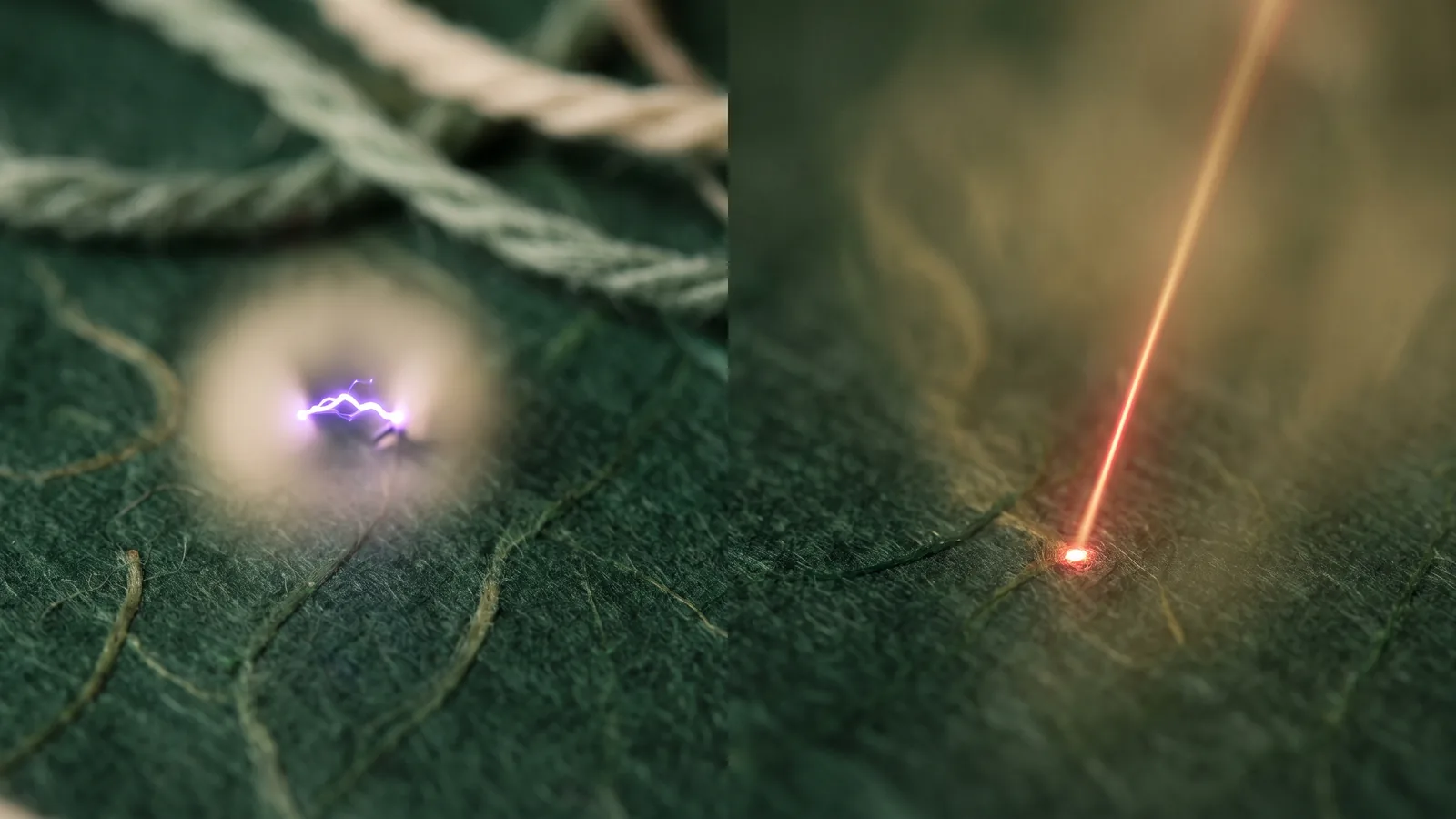
The comparison in one sentence: a plasma pen ionises the thin gap of air just above the skin so that controlled micro-points of tissue sublimate at the surface, while an ablative or fractional laser fires light at a wavelength that water inside the tissue absorbs and converts to heat.
The short version. Plasma draws tissue tight during the appointment, then recruits your own healing response over the following weeks, with a documented advantage on the upper eyelid and around the eye, where skin is thin and the anatomy makes other devices harder to use. Lasers are the broader tool: wavelengths aimed at water for resurfacing, or at pigment and vessels for specific targets, across much larger areas.
Plasma Pen vs Laser: The Mechanism Difference
A plasma device never touches the skin. A fine probe is held a fraction of a millimetre above the surface, and the electrical potential across that gap ionises the air within it. The micro-arc deposits its energy where it lands, and tissue there passes straight from solid to vapour. That is sublimation, and it is why the literature calls the technique plasma exeresis or voltaic arc dermabrasion.
Two things follow. The contraction is visible during the appointment, because removing tissue at the surface draws surrounding skin inward. And the energy stays at the surface rather than being driven downward: on thermal infrared imaging during plasma treatment of facial lesions, average skin temperature during irradiation was 290.3 ± 21.7 °C and immediately after was 90.6 ± 21.8 °C (Scarano et al., 2020, DOI).
A laser works on a different principle. Anderson and Parrish set it out in Science in 1983: brief pulses of selectively absorbed optical radiation cause selective damage to targeted structures, and precise aiming is unnecessary because the target's own optical and thermal properties provide the selectivity (Anderson and Parrish, 1983, DOI). Selective photothermolysis underpins every aesthetic laser: the clinician chooses a wavelength, and the wavelength chooses the target.
For resurfacing lasers the target is water, which is everywhere in living tissue, so the laser removes a controlled thickness rather than picking out a colour: it removes the superficial epidermis and dermis containing actinic damage, promoting re-epithelialisation of healthy skin. Fractional devices do the same in a grid of narrow columns, leaving untreated skin between to speed recovery; fully ablative resurfacing was more effective for actinic keratosis, at the cost of longer healing (Tai et al., 2021, DOI).
Both converge on the same biology. Laser resurfacing produces a controlled skin injury resulting in a wound healing response, and that response allows the collagen remodelling that improves texture and tone (Angra et al., 2021, PubMed). Plasma reaches the same destination by another road: in a pilot study using reflectance confocal microscopy, ten patients had three plasma exeresis sessions on the upper eyelid, clinical improvement of 2.6 ratings was observed, and collagen was afterwards classified as long straight fibres (Rossi et al., 2018, DOI).
Why Plasma Has a Genuine Advantage on the Eyelid
This is where the two are not interchangeable, and why we offer plasma soft surgery at all. Upper eyelid skin is the thinnest on the body, sits directly over the globe, and the laxity people want addressed is usually small and precisely located — which suits a device that removes tissue point by point, without contact and without a beam continuing past its target.
A clinical trial of 40 women with upper eyelid dermatochalasis gave each three plasma exeresis sessions a month apart, assessed three months later by two blinded dermatologists and two blinded ophthalmologists. Eyelid laxity on the facial laxity rating scale fell significantly (p < .001), with 36 of 40 patients (90 percent) showing change, and marginal crease distance increased (p = .001), without serious adverse events (Hassan et al., 2020, DOI). A larger trial of 56 women on the same schedule measured skin biomechanics with a Reviscometer and reported significant improvement in dermatochalasis and palpebral laxity versus baseline (p < 0.001), with no significant or permanent side effects (Abdollahimajd et al., 2021, DOI).
Plasma is also efficient for discrete lesions around the eye. A retrospective series of 71 eyes in 66 patients removed every lesion in a single treatment, mean procedure time 4.0 minutes, with mild irritation afterwards in 3 cases (4.2 percent) (Ucar and Unluzeybek, 2024, DOI). A review of non-surgical blepharoplasty places plasma exeresis among the techniques suited to skin showing excess and lost elasticity together (Miotti et al., 2023, DOI).
Two honest limits. Severity: a study of 21 eyes, graded by blinded dermatologists, found severity directly affected improvement (P = 0.039) and concluded non-invasive ablative microplasma may offer safe and effective therapy for upper eyelid dermatochalasis, and can even be performed in patients at surgical risk, while more advanced grades do better with surgery (Nemet et al., 2024, DOI). Expectations: an observational study of 16 patients found satisfaction highest at day 7 (P = .038), with oedema and itching most reported at 7 and 30 days (Ferreira et al., 2020, DOI).
Whichever device is used, periocular work demands corneal protection and trained hands — a published case of thermal keratopathy after treatment with a different plasma device class makes the point plainly (Meyer et al., 2024, DOI).
Where Lasers Are the Better Answer
Area. Resurfacing a full face, neck or chest is a laser job. Plasma places individual points; a fractional laser lays down thousands of microscopic columns per pass across a large field in minutes. Erbium, carbon dioxide, and ablative, non-ablative and hybrid fractional lasers are all described as effective and popular tools, with advances making treatment more efficacious with less downtime (Pozner and DiBernardo, 2016, DOI).
Specific targets. Because a laser is chosen by wavelength, it can be aimed at chromophores other than water. Short-pulse Nd:YAG is described as a transformative tool for Fitzpatrick types 4 to 6, targeting melanin, haemoglobin and water, with improvements in hyperpigmentation, acne, fine lines and scar texture (Chao et al., 2023, DOI). Plasma has no equivalent mechanism.
Depth, and pairing with surgery. A meta-analysis of laser resurfacing at the time of facelift surgery pooled 17 studies and 1,361 patients and found pooled satisfaction of 98.1 percent, with rare complications: hypertrophic scarring 0.51 percent, non-transient dyspigmentation 0.35 percent (Wen et al., 2026, DOI). Lasers have periorbital data too: among 59 patients having lower blepharoplasty with adjunctive fractionated CO2 resurfacing, post-inflammatory hyperpigmentation occurred in 3 of 59 (5.1 percent) and lower eyelid retraction in 1, with no infections and satisfaction in all patients (Watson et al., 2022, DOI).
Not sure which one fits you?
Your first visit at Arbour Longevity in Ann Arbor is $35 and includes an assessment of whether this treatment suits your skin. It is applied toward your treatment plan.
Book your $35 first visit Call (734) 436-3357
Fitzpatrick I to VI: What the Chromophore Question Means
Skin type matters here for a mechanical reason: melanin is a chromophore, so any device depositing energy melanin can absorb carries pigment risk in richly pigmented skin. The laser literature is direct about it. Use of energy-based devices in higher Fitzpatrick skin types is a recognised concern because of increased risk of hyperpigmentation and scarring, and non-ablative fractional lasers, which target water rather than melanin, are described as particularly safer for darker skin types (Chao et al., 2023, DOI). A review of resurfacing in ethnic skin agrees traditional resurfacing including laser therapy can carry prolonged recovery and higher risk of dyspigmentation and scarring (Cohen and Elbuluk, 2016, DOI). Managing it is routine: evaluation includes Glogau scale and Fitzpatrick type precisely to minimise these risks (Hamilton and Kao, 2020, DOI).
Plasma does not select a chromophore at all. It sublimates whatever tissue sits under the arc, which is why the periorbital trials above enrolled unselected cohorts without serious adverse events. It is not pigment-neutral, though: in the thermal-imaging facial series, three patients had transient post-inflammatory pigmentation peaking at one month and fading spontaneously over two to three months (Scarano et al., 2020, DOI). Transient is the operative word, and it is a different profile from a chromophore-driven risk. Fitzpatrick type is assessed at every consultation here.
Downtime, Described Honestly
Both work by creating a wound; neither is a facial.
After plasma, each treated point forms a small dark carbon crust that stays put and then sheds. The clearest figure comes from 135 patients treated for static crow's feet: complete epidermal healing of all subjects was evident at 7 days, with good aesthetic outcome and no clinical complications (Scarano et al., 2021, DOI). Around the eyelid, swelling is the first-week story (Ferreira et al., 2020, DOI). Plan for about a week, and not three days before an event.
After ablative laser resurfacing, downtime scales with how much tissue was removed. Fractional devices exist to shorten it (Pozner and DiBernardo, 2016, DOI); fully ablative treatment buys more correction for a longer recovery, and redness can persist after the skin has closed (Angra et al., 2021, PubMed).
Sessions, Timelines and How Long It Lasts
The plasma protocols in the periorbital literature are strikingly consistent: three sessions at one-month intervals (Hassan et al., 2020, DOI; Abdollahimajd et al., 2021, DOI), while discrete lesions cleared in a single session (Ucar and Unluzeybek, 2024, DOI). Two timelines then run in parallel. The tightening you see on the day is mechanical contraction; the collagen change is slower, and it is what confocal imaging picked up weeks after the final session (Rossi et al., 2018, DOI). Judge the result a month after your last session, not on day eight.
On longevity we will give you the shape of the evidence rather than a number we cannot support. Most published plasma follow-up runs to six or twelve months; the crow's feet series assessed patients at one year (Scarano et al., 2021, DOI), and an animal safety study of conjunctival tissue found no persistent histopathological changes and no atypia or dysplasia at six months (Nejat et al., 2021, DOI). What we did not find, and will not invent, is a multi-year durability study for periorbital plasma, or any head-to-head randomised trial pitting plasma exeresis against ablative or fractional laser for eyelid laxity. Neither stops ageing; both buy time.
What We Know, and How Much of It There Is
The plasma-device literature is smaller than the laser literature — a fact about the field, not a verdict on the treatment.
A randomised controlled trial compared plasma exeresis against cryotherapy for seborrhoeic keratosis, one side of each patient treated with each: at week 6, 16 of 28 remaining lesions treated by plasma exeresis were clear (57.1 percent) versus 6 of 29 by cryotherapy (20.7 percent), significant at p = 0.005, with no difference in side effects (Noorbakhsh et al., Skin Res Technol, 2023, DOI). A published correction later added ethics approval and disclosed one co-author’s affiliation with the device manufacturer (DOI) — the kind of detail that changes how much weight a reader gives a result.
A descriptive study of one clinic recorded 710 patients treated with plasma exeresis, over 33 percent on the upper eyelids and 18 percent on the lower, with more than 52.9 percent of contactable patients extremely satisfied (Tsioumas et al., 2021, PubMed). In an adjacent device class, porcine histology showed ablation and dermal coagulation followed by neovascularisation and fibroblast proliferation (Hsu, 2025, DOI).
Plexr Plus, the plasma device used at Arbour Longevity, is FDA-cleared.
Cost, Framed Usefully
The useful comparison is not price per session but the cost of a full course against what it is expected to achieve. Plasma around the eyes is typically three sessions a month apart, priced by area. Laser resurfacing is priced by area and depth, and a light fractional treatment and a fully ablative one are different purchases. Ask for the total course price. We keep detailed plasma pricing in one place so it stays current: see Plexr plasma pen treatment cost.
How the Choice Is Made at Arbour Longevity
The decision turns on four things. Where the concern sits: upper eyelid and periorbital laxity, crow's feet and small benign eyelid lesions point toward plasma; broad photodamage, or a vascular or pigmented target, points toward a laser. How much laxity there is: beyond a certain severity grade a surgical referral is the more honest recommendation (Nemet et al., 2024, DOI). Your skin type and pigment history. What week you can give it, because crusting and swelling occupy the first.
Plasma is one option among several here, and often sequenced rather than chosen alone. Our Plexr Plus protocols page sets out how sessions are structured; CAT resurfacing and microneedling address different compartments of the same problem; our skin longevity approach treats any single treatment as part of a longer plan. For the treatment described end to end, read Plexr soft surgery in Ann Arbor and Plexr Plus plasma resurfacing.
Frequently Asked Questions
Is a plasma pen just a type of laser?
No. A laser emits light at a wavelength a specific target absorbs — selective photothermolysis (Anderson and Parrish, 1983, DOI). A plasma device emits no beam; it ionises the air above the skin so a micro-point of tissue sublimates where the arc lands (Scarano et al., 2020, DOI).
Which one is better for my upper eyelids?
For mild to moderate upper eyelid laxity, plasma has blinded-assessor evidence: significant reduction in laxity in 90 percent of 40 patients after three sessions (Hassan et al., 2020, DOI). For more advanced dermatochalasis, surgery has been reported to do better (Nemet et al., 2024, DOI). Which category you fall into is an in-person assessment.
I have deeper skin. Is one of these safer for me?
Mechanism matters. Devices that deposit energy into melanin carry a recognised risk of hyperpigmentation and scarring in higher Fitzpatrick types, which is why lasers targeting water rather than melanin are described as particularly safer for darker skin (Chao et al., 2023, DOI). Plasma does not select melanin at all, though it is not risk-free: transient post-inflammatory pigmentation was reported in three patients in one facial series (Scarano et al., 2020, DOI). Bring your pigmentation history to the consultation.
How much time will I need off?
For plasma, plan on about a week: complete epidermal healing was evident at 7 days in 135 patients treated for crow's feet (Scarano et al., 2021, DOI). For laser it depends on the depth chosen (Pozner and DiBernardo, 2016, DOI).
How many sessions, and when do I see the result?
The periorbital plasma trials used three sessions at one-month intervals (Hassan et al., 2020, DOI); single benign eyelid lesions cleared in one session (Ucar and Unluzeybek, 2024, DOI). Contraction is immediate; the collagen side develops over the following weeks.
Is Plexr Plus FDA-cleared?
Yes. Plexr Plus, the plasma device used at Arbour Longevity, is FDA-cleared.
Plasma and Laser Consultations in Ann Arbor
We assess skin in person before recommending anything, because the choice between a surface-sublimating device and a wavelength-selective one depends on where your concern sits and how your skin behaves. Gandhi Bhattarai, FNP-BC, PMHNP-BC, Anti-Aging/Functional Medicine BC is a triple board certified nurse practitioner.
We are at 2217 Packard St #15, in the Eastover Professional Center, Ann Arbor, MI 48104, open Thursday through Monday, 10am to 7pm, closed Tuesday and Wednesday. Parking is free and directly outside — no meters, no structure. Suite 15 is down a flight of stairs; if stairs are difficult for you, please call (734) 436-3357 before visiting so we can help. Call (734) 436-3357 or book your first visit. First visit $35, applied toward your plan. Cash pay, HSA and FSA accepted.
Clinical information on this page is drawn from articles retrieved from PubMed and is provided for education. It is not medical advice, not a diagnosis, and not a promise of any individual result.
Gandhi Bhattarai, FNP-BC, PMHNP-BC, Anti-Aging/Functional Medicine BC
Triple board-certified nurse practitioner and founder of Arbour Longevity in Ann Arbor. Every article is written from clinic practice and reviewed against current guidelines.
✓ Medically reviewed · Last updated August 17, 2026
How we reviewed this article
Arbour Longevity articles are written by the treating clinician, checked against primary sources (peer-reviewed journals, FDA labeling, Endocrine Society and other specialty guidelines) and re-reviewed when guidance changes. See our editorial policy. Spotted an error? Email info@arbourlongevity.com.
This article is educational and is not a substitute for individualized medical advice. Whether a treatment is appropriate for you is determined during consultation.
Your symptoms have a cause. Let’s find it.
Book a $35 first visit in Ann Arbor. It’s a 30–45 minute consultation with Gandhi Bhattarai, applied toward your plan. Serving Ann Arbor, Ypsilanti, Saline, Dexter, Chelsea, and Michigan by telehealth.





.webp)

