
PRP vs Minoxidil for Hair Loss: What the Trials Show
Key takeaways
- In pooled randomized trials, PRP and minoxidil produce similar hair density; neither clearly beats the other on that measure.
- Patient satisfaction and shedding tests favored PRP in the 2025 meta-analysis, but study-to-study variation is large.
- Minoxidil is cheap, daily and forever; PRP is a course of in-office visits with maintenance every six to twelve months.
- Many patients use both, because they work through different mechanisms on different schedules.
- Do not stop minoxidil to "test" PRP; keep it going, add the series, and judge with photos at six months.

You have a bottle of minoxidil in the bathroom cabinet and a browser tab open on PRP. You want someone to just tell you which one is worth your money. Here is the honest read of the head-to-head evidence, and the practical differences the trials do not measure.
New to PRP? For the full explanation of what platelet-rich plasma is, how a session runs and the month-by-month timeline, start with PRP Hair Restoration: How It Works and What to Expect. This article is narrower on purpose: PRP measured against minoxidil, the treatment most people have already tried.
The short version: in the pooled randomized data these two are closer than the marketing on either side suggests. Hair density outcomes come out broadly similar. Where they differ is in what patients report, since satisfaction and shedding tests have favored PRP, and in what the treatments ask of you. Minoxidil is cheap, daily and forever. PRP is a course of in-office visits with periodic maintenance.
How each one works
Minoxidil is a topical applied to the scalp and the long-standing standard therapy for androgenetic alopecia (the genetic pattern thinning behind most adult hair loss). It works on the follicle's growth cycle and its blood supply. It works only while you keep using it.
PRP (platelet-rich plasma) takes a small draw of your own blood, concentrates the platelets, and delivers that plasma into the scalp at the depth of the hair bulb. The platelets release growth factors that push resting follicles back into the growing phase, thicken fine hairs and improve the local blood supply. It comes in courses rather than daily doses: a starting series, then maintenance.
They are not competing for the same job so much as attacking the same problem from two directions. That is why the interesting question is not only which is better, but whether you should be choosing at all.
What the head-to-head evidence shows
The pooled analysis. A 2025 systematic review and meta-analysis (a study that pools the results of many trials) in Aesthetic Plastic Surgery screened 789 articles. It pooled nine randomized controlled trials with 451 participants comparing PRP against topical minoxidil. Its findings, plainly:
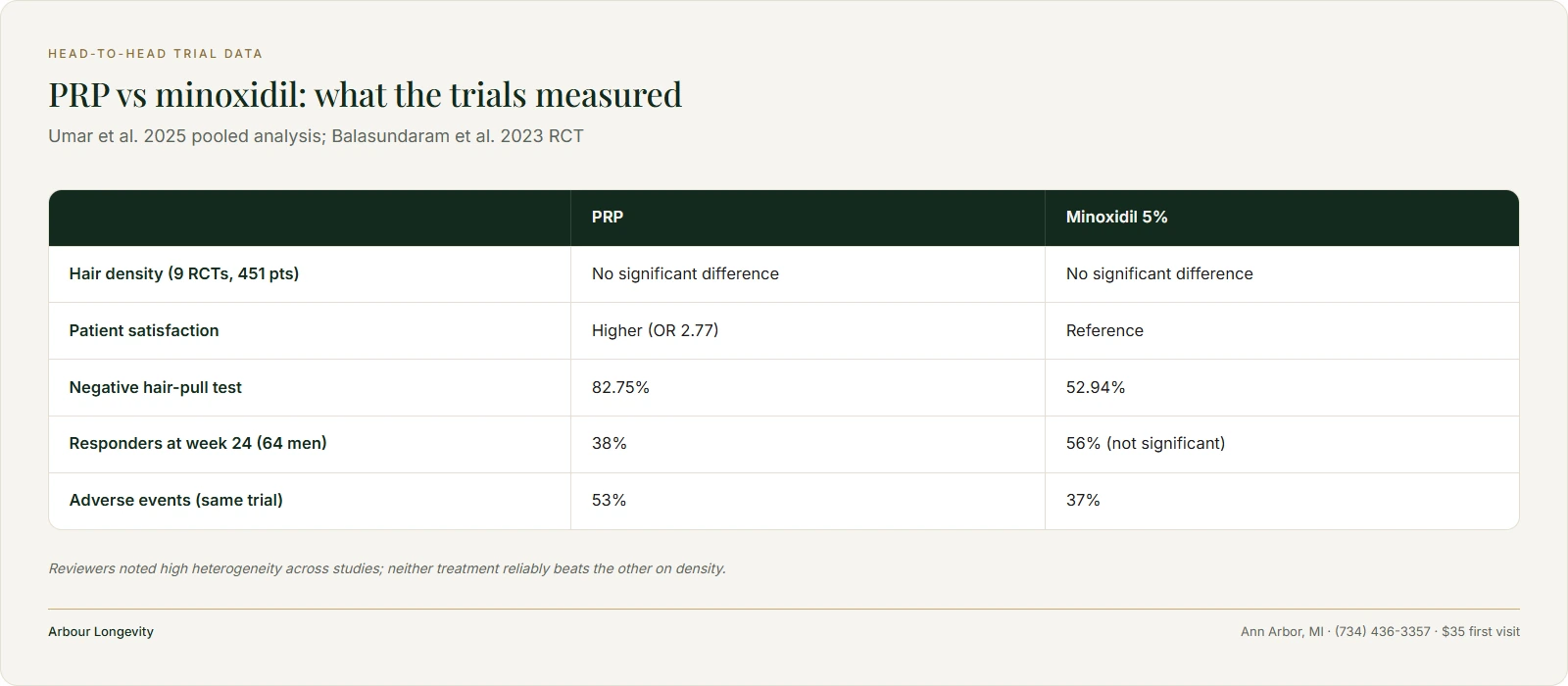
- no significant difference between the two in hair density;
- patient satisfaction much higher with PRP than with 5% minoxidil (odds ratio 2.77, 95% CI 1.53 to 5.04);
- negative hair pull tests, a practical measure of active shedding, in 82.75% of PRP patients versus 52.94% on minoxidil;
- similar results between the two for moderate-to-high regrowth and terminal hair count.
The authors noted high variation across the studies. They concluded that PRP shows promise and patients report liking it more, but it has no clear edge on the core clinical measures (Umar et al., 2025).
A representative individual trial. A randomized open-label trial followed 64 men with moderate (Grade III to IV) pattern loss. At week 24, 56% responded to minoxidil versus 38% to PRP, a difference that did not reach statistical significance. Both groups gained hair count and density at week 12, again with no significant difference between them. Side effects were more common in the PRP arm (53% versus 37%), and satisfaction in this trial favored minoxidil (Balasundaram et al., Journal of Dermatological Treatment, 2023).
Both are worth reading together. They point at the same answer from opposite directions: neither treatment reliably beats the other on density, and results vary a lot from study to study.
What the evidence does not say
It does not say PRP replaces a treatment that is working for you. It does not say minoxidil is obsolete. And it does not settle the question of protocol. PRP preparations differ in platelet concentration, injection depth, spacing and number of sessions. Those differences are a major reason the trials disagree. A bargain PRP session and a carefully prepared one are not the same product being tested.
Six months in on minoxidil and not sure what to do next?
Your $35 first visit includes a scalp exam, the labs that cap any hair treatment, and a plan for one or both, with the fee applied toward treatment.
Book your $35 first visit Call (734) 436-3357
The differences the trials do not measure
- Effort. Minoxidil is twice daily, every day, for good. PRP is a series of three to four visits, then maintenance every six to twelve months. Adherence is where minoxidil most often fails in real life.
- Cost shape. Minoxidil is cheap per month but never ends. PRP is a larger upfront investment with a lower ongoing cost. Over several years the totals converge more than people expect.
- Side effect profile. Minoxidil commonly causes scalp dryness, itching or irritation, and an initial shedding phase that alarms people who were not warned. PRP causes scalp soreness and tenderness for a day or two after each session. The trial data above found side effects somewhat more common with PRP.
- Cosmetic friction. A daily topical has to live in your hair. Some people never make peace with that, especially women with longer or styled hair.
- Suitability. PRP is not suitable during pregnancy, for people with scarring hair loss, or where blood thinners cannot be paused. Minoxidil has its own cautions worth discussing before you start, especially if you are pregnant, nursing or planning a pregnancy.
Who each one suits
Minoxidil tends to suit people who:
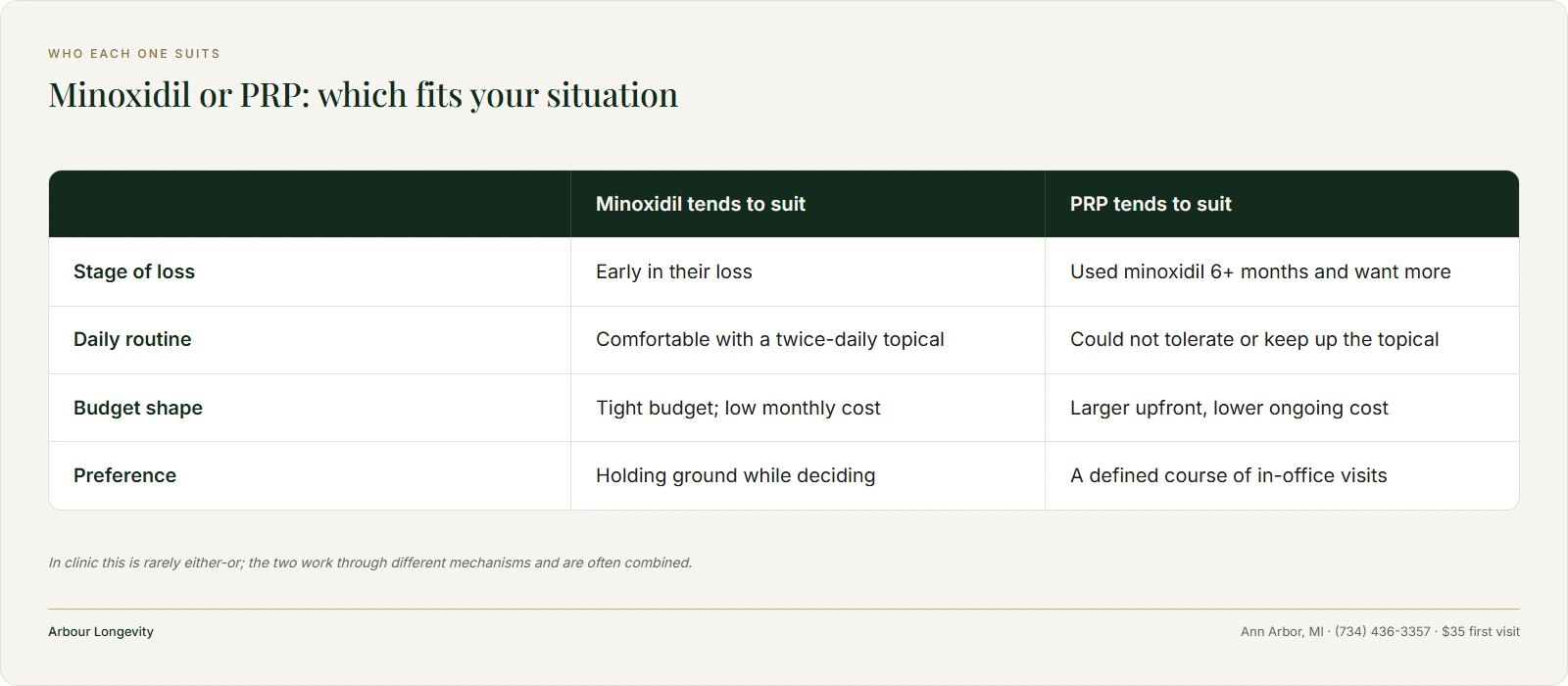
- are early in their loss
- are comfortable with a daily routine
- are working within a tight budget
- want to hold ground while they decide on anything more involved
PRP tends to suit people who:
- have used minoxidil steadily for six months or more and want more
- could not tolerate the topical or would not keep it up
- have diffuse thinning and dislike a daily scalp product, which is common in women
- prefer a defined course of in-office treatment to a daily habit with no end date
Why we often use both
In clinic this is rarely an either-or decision. The two work in different ways and on different schedules. Pairing a daily topical with an in-office series is a sound way to attack pattern loss from both sides. We also address the things that quietly cap any hair treatment's ceiling: iron stores, thyroid function, protein intake and hormonal shifts around perimenopause. A follicle that is under-supplied will not respond well to anything. Where appropriate we may also apply a topical growth-factor serum with microneedling.
If you are already on minoxidil
Do not stop it to "test" PRP. Stopping typically means losing the ground minoxidil was holding, which makes any new treatment look worse than it is. Keep the topical going, add the PRP series, photograph at baseline in consistent lighting, and reassess at six months. If you then want to simplify your routine, have that conversation with a real photo comparison in front of you rather than a guess.
Frequently Asked Questions
Is PRP better than minoxidil?
Not clearly, on the measures the trials use. The pooled randomized data found no significant difference in hair density, while patient satisfaction and hair pull test results favored PRP. Which is better for you depends more on your stage of loss, how you feel about a daily topical, and your budget than on the trial averages.
Can I use PRP and minoxidil together?
Yes, and many of our patients do. They work in different ways and on different schedules, so pairing them is common for pattern hair loss.
Do I have to use minoxidil forever?
Its effect lasts as long as you use it. Genetic pattern loss is a process to manage rather than cure, which is equally true of PRP. Both need continuation or maintenance to hold their gains.
Does PRP cause the shedding phase that minoxidil does?
The early shedding people associate with starting minoxidil is not a typical feature of PRP. Expect scalp tenderness for a day or two after a session instead.
Which is better for women?
Both are used in women. Women with diffuse thinning are among our most consistent PRP responders, especially when iron, thyroid and hormone causes are corrected at the same time. Women who dislike a daily scalp topical often prefer the PRP route. If you are pregnant, nursing or planning a pregnancy, tell us before we plan anything.
How long before I know whether it is working?
Six months, for either treatment. Hair biology is slow. Both are usually judged with baseline and six-month photographs rather than by how things feel in month two.
What if neither is enough?
Then the answer is usually not a third product but a reassessment. That means labs, the pattern and stage of loss, and an honest talk about whether a transplant referral is the right next step. We would rather tell you that than sell you another series. If a transplant is on your mind already, our comparison of PRP and hair transplant sets out what each one does and what the trials report.
Arbour Longevity, 2217 Packard St #15, Ann Arbor, MI 48104. Thursday through Monday, 10am to 7pm; closed Tuesday and Wednesday. Book your $35 first visit or call (734) 436-3357; the $35 is applied toward your plan.
References
- Umar M, Anwar A, Shamim L, et al. Comparative Efficacy and Safety of Platelet Rich Plasma (PRP) versus Topical Minoxidil for Androgenetic Alopecia: A Systematic Review and Meta-analysis. Aesthetic Plast Surg. 2025;50(3):1340-1353. doi:10.1007/s00266-025-05394-7
- Balasundaram M, Kumari R, Ramassamy S. Efficacy of autologous platelet-rich plasma therapy versus topical Minoxidil in men with moderate androgenetic alopecia: a randomized open-label trial. J Dermatolog Treat. 2023;34(1):2182618. doi:10.1080/09546634.2023.2182618
- Platelet-Rich Plasma in the Management of Alopecia: A Systematic Review and Meta-Analysis of Clinical Evidence. Dermatology and Therapy. 2025. doi:10.1007/s13555-025-01542-8
This article is educational and does not replace individualized medical advice. References retrieved via PubMed.

Gandhi Bhattarai, FNP-BC, PMHNP-BC, Anti-Aging/Functional Medicine BC
Triple board-certified nurse practitioner and founder of Arbour Longevity in Ann Arbor. Every article is written from clinic practice and reviewed against current guidelines.
✓ Medically reviewed · Last updated August 21, 2026
How we reviewed this article
Arbour Longevity articles are written by the treating clinician, checked against primary sources (peer-reviewed journals, FDA labeling, Endocrine Society and other specialty guidelines) and re-reviewed when guidance changes. See our editorial policy. Spotted an error? Email info@arbourlongevity.com.
This article is educational and is not a substitute for individualized medical advice. Whether a treatment is appropriate for you is determined during consultation.
Your symptoms have a cause. Let’s find it.
Book a $35 first visit in Ann Arbor. It’s a 30–45 minute consultation with Gandhi Bhattarai, applied toward your plan. Serving Ann Arbor, Ypsilanti, Saline, Dexter, Chelsea, and Michigan by telehealth.






.webp)

