

Free vs Total Testosterone: How to Read Your Lab Panel
Key takeaways
- Total testosterone counts everything in the sample; free testosterone counts only the small unbound share that can act.
- SHBG is the binding protein that decides the split, so two men with the same total can have very different free levels.
- The Endocrine Society recommends measuring free testosterone when total sits near the low end or a condition alters SHBG.
- Timing is part of the test: fasting, morning, and repeated on a second morning before anything is concluded.
- A panel is a pattern, not a number; estradiol, LH, FSH, hematocrit, PSA and thyroid all change what the result means.
Looking for the full picture on treatment? Start with our main guide: Testosterone Replacement Therapy for Men in Ann Arbor. This page covers one narrower question: how to read the labs.
Total testosterone: what does it actually measure?
Total testosterone is the sum of every molecule of testosterone in your blood at the moment of the draw. It counts them whether or not they are free to do anything. Most are not. In a typical man, the great majority is bound: tightly to sex hormone-binding globulin (SHBG), a protein that grabs hormones so tissues cannot use them, and loosely to albumin. Only a small share is genuinely unbound.
Total is the right first test. It is standardized, widely available and inexpensive. The Endocrine Society guideline recommends a fasting morning total testosterone, using an accurate and reliable assay, as the first diagnostic test. The diagnosis is confirmed by repeating that morning fasting measurement (Bhasin et al., J Clin Endocrinol Metab 2018, DOI: 10.1210/jc.2018-00229).
What total cannot do is tell you how much of that hormone is available to your muscle, brain and bone. That is the next number.
Free testosterone: the fraction that works
Free testosterone is the unbound portion: the part that can leave the bloodstream, cross into tissue and bind a receptor. It is a small slice of the total, and it is the slice that tracks most closely with how you feel.
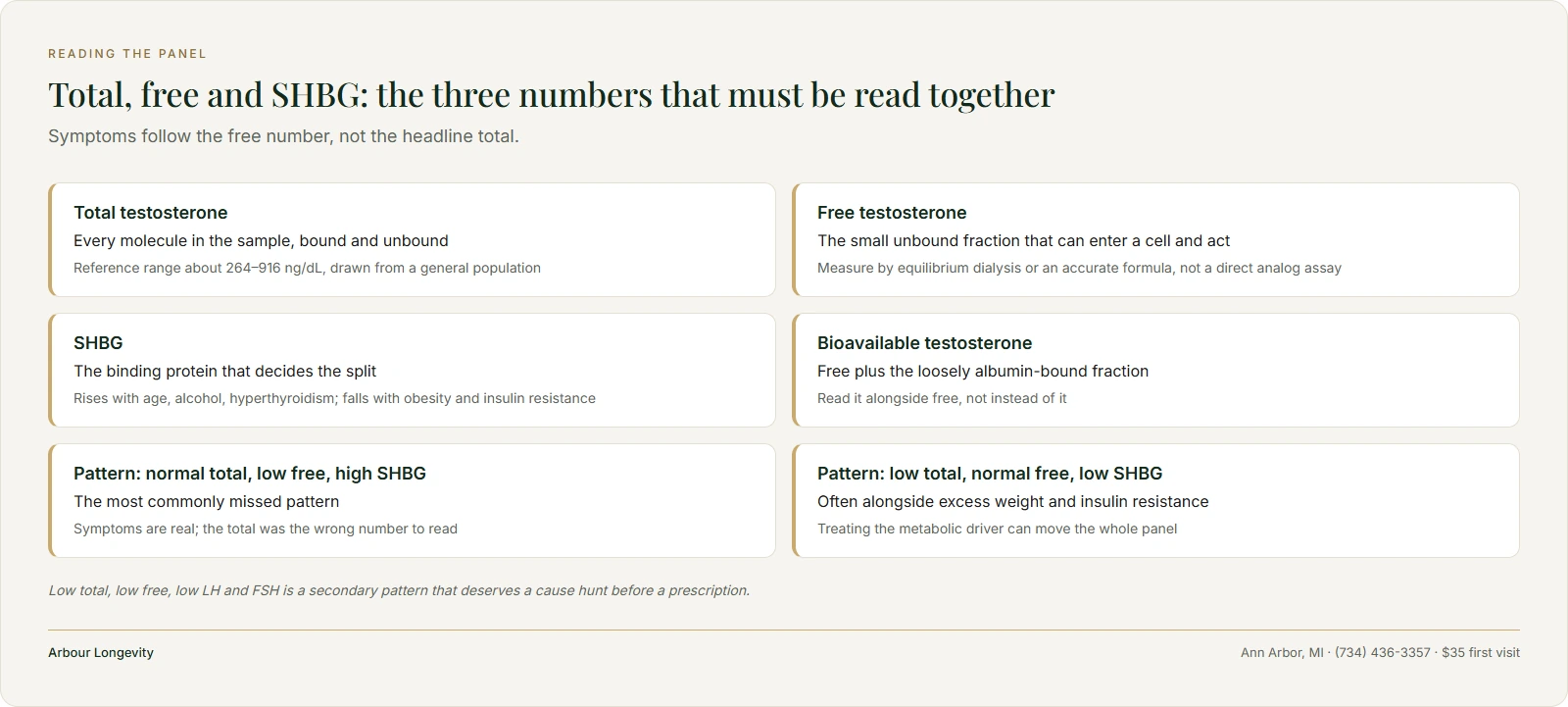
This is where a great many evaluations stop too early. A man can have a total testosterone that a lab flags as unremarkable while his free testosterone sits at the bottom of its range, because his SHBG is high. Symptoms follow the free number, not the headline.
How free testosterone should be measured
Not all free testosterone results are equal. The Endocrine Society guideline is specific. It names two situations: a total near the lower limit of normal, or a condition that alters SHBG. In those cases free testosterone should be measured by equilibrium dialysis or estimated with an accurate formula (DOI: 10.1210/jc.2018-00229). Direct analog immunoassays for free testosterone are widely offered and much less reliable. If you are comparing results between labs, check which method was used before you draw conclusions from the difference.
SHBG: the protein that decides the split
SHBG binds testosterone tightly. The more SHBG you have, the more of your total is locked away and the less is free. It is not a fixed trait. It moves.
SHBG tends to rise with: age, alcohol intake, an overactive thyroid, liver disease, certain medications, and low calorie intake or significant weight loss.
SHBG tends to fall with: obesity and insulin resistance, an underactive thyroid, and higher circulating insulin.
This is why SHBG belongs on the panel rather than being added later. High SHBG produces the classic pattern: an acceptable total, a low free testosterone and clear symptoms. Low SHBG produces the opposite trap. The total looks low-ish while free testosterone is adequate, which can lead to treating a number rather than a person.
Bioavailable testosterone
Some panels also report bioavailable testosterone. That is the free fraction plus the loosely albumin-bound fraction, on the reasoning that albumin releases testosterone readily enough for tissue to use. It usually tells a similar story to free testosterone. If your report has it, read it alongside free rather than instead of it.
Why is the reference range so wide?
Many laboratories report a normal range for total testosterone of roughly 264 to 916 ng/dL. That range comes from a general population of men. It includes plenty who are sedentary, sleep-deprived, carrying excess weight or symptomatic. A result of 300 ng/dL is inside that range and still leaves many men feeling exactly as they describe.
Two things follow. First, "in range" and "optimal for you" are different claims, and only one of them was ever tested by the lab. Second, the range is a starting point for interpretation, not a verdict. That is why the guideline requires symptoms and signs of deficiency plus clearly and consistently low levels before low testosterone is diagnosed at all (DOI: 10.1210/jc.2018-00229).
Want your own numbers, not averages?
Bring your results or let us order the right panel from the start, with the $35 first-visit fee applied toward your plan.
Book your $35 first visit Call (734) 436-3357
Timing: the part that invalidates more panels than anything else
Testosterone follows a daily rhythm and peaks in the morning. A draw taken in the afternoon can make a man with perfectly adequate testosterone look deficient. It is one of the most common reasons a panel has to be repeated.

- Draw before roughly 10 a.m., when levels are at their daily peak.
- Fast beforehand. Food, and glucose in particular, can lower measured testosterone.
- Repeat on a second morning. Day-to-day variation is real, and a single value is a snapshot rather than a trend.
- Hold off during acute illness. Being unwell suppresses testosterone for a while and produces a result that does not represent your baseline.
Reading the rest of the panel, marker by marker
A testosterone result only means something in company. Here is what each of the other lines is doing on the page.
Estradiol (E2)
Testosterone converts to estradiol through the enzyme aromatase, largely in fat tissue. Men need estradiol. It supports bone density, mood, thinking and heart health, so the goal is a sensible ratio rather than the lowest possible number. Symptoms appear at both ends. Ask for a sensitive assay. Standard estradiol assays are calibrated for female ranges and read poorly at male concentrations.
LH and FSH
These pituitary hormones are the brain's signals to the testes, and they tell you where the problem sits. Low testosterone with high LH and FSH points to the testes (primary). Low testosterone with low or oddly normal LH and FSH points upstream to the pituitary or hypothalamus (secondary). Secondary is more common. It is more often tied to weight, sleep, medication or stress, and sometimes correctable at the source.
Hematocrit and CBC
Hematocrit is the share of your blood made of red cells. Your baseline is taken before any treatment starts, so later changes can be interpreted. Testosterone stimulates red cell production, and a high hematocrit at baseline is a reason to pause and investigate before starting.
PSA
PSA is a blood test that screens prostate health, particularly from age 40. The guideline advises against starting testosterone with a PSA above 4 ng/mL, or above 3 ng/mL in men at increased risk, without further urological evaluation first (DOI: 10.1210/jc.2018-00229).
Full thyroid panel
TSH alone is not a thyroid panel. Free T3, Free T4 and reverse T3 round it out. Thyroid problems reproduce most of the low testosterone symptom list. They also shift SHBG, which changes how your testosterone results should be read.
Metabolic markers
Fasting insulin, HbA1c (your three-month average blood sugar) and lipids. Insulin resistance lowers SHBG and is tightly linked with lower testosterone. It is frequently the thread that explains a confusing panel.
Cortisol, DHEA-S, vitamin D and ferritin
The stress axis and the common deficiencies that produce overlapping fatigue. They rarely change the testosterone diagnosis on their own. But they often explain the symptoms that testosterone alone would not have fixed.
Three patterns worth recognising
- Normal total, low free, high SHBG. The most commonly missed pattern. Symptoms are real; the total was simply the wrong number to read.
- Low total, normal free, low SHBG. Often seen alongside excess weight and insulin resistance. Treating the metabolic driver can move the whole panel.
- Low total, low free, low LH and FSH. A secondary pattern that deserves a cause hunt. Sleep apnea, weight, certain medications and chronic stress all belong on the list before a prescription does.
What to do with your results
If you have a panel in hand, check three things before anything else. Was it drawn in the morning and fasting? Does it include free testosterone and SHBG? Was it repeated? If any of those is missing, the honest answer is that you do not yet have enough to decide from.
From there:
- If your symptoms are what brought you here, read low testosterone symptoms in men.
- If you are weighing whether treatment fits you at all, read who is and isn't a candidate for TRT.
- If you want the numbers on price and follow-up, read what TRT costs and what monitoring is included.
- If you already know treatment is right and are choosing a format, read pellets vs injections vs gels.
Lab interpretation sits inside Arbour Longevity's wider hormone optimization program and its approach to hormone replacement therapy in Ann Arbor.
Frequently Asked Questions
My total testosterone is normal but I have every symptom. What now?
Ask for free testosterone and SHBG on a fasting morning draw, repeated on a second morning. A high SHBG is the most common explanation for a normal total sitting alongside a genuinely low usable level.
Which number matters more, free or total?
Neither alone. Total is the reliable screening measure; free is the one that tracks symptoms. SHBG is what reconciles them. Reading all three together is the whole point.
Why does my free testosterone differ between two labs?
Usually the assay. Equilibrium dialysis and accurate calculated methods do not produce the same values as direct analog immunoassays. Compare like with like, and prefer the more reliable method.
Does my result change if I train or fast before the draw?
Yes. Come fasting, sleep normally the night before, and avoid a hard training session right beforehand. Repeatable conditions are what make a repeat draw meaningful.
How often should I retest once I am on treatment?
A baseline panel before starting, a recheck at 6 to 12 weeks, then every 3 to 6 months once stable. The detail is in TRT cost and monitoring.
I was told I'm too young for treatment. Is age a cutoff?
No. Age is not a criterion. What matters is documented, repeated low levels with matching symptoms and a cause that has been looked for. A man in his thirties with a confirmed deficiency is a more appropriate candidate than a symptom-free man in his sixties.
Get your panel read properly
Arbour Longevity, 2217 Packard St #15, Ann Arbor, MI 48104. Open Thursday through Monday, 10am to 7pm, closed Tuesday and Wednesday. Parking is free and directly outside, with no meters and no structure. Suite 15 is down a flight of stairs; please call ahead if stairs are difficult and we will make arrangements.
If you already have results and want them interpreted in full, bring them in. We read free, total, SHBG, estradiol, thyroid and metabolic markers together. If you do not have results, we will order the right panel from the start. Book your $35 first visit or call (734) 436-3357.
References
- Bhasin S, Brito JP, Cunningham GR, et al. Testosterone Therapy in Men With Hypogonadism: An Endocrine Society Clinical Practice Guideline. J Clin Endocrinol Metab. 2018;103(5):1715-1744. PMID 29562364. DOI: 10.1210/jc.2018-00229
- Lincoff AM, Bhasin S, Flevaris P, et al. Cardiovascular Safety of Testosterone-Replacement Therapy (TRAVERSE). N Engl J Med. 2023;389(2):107-117. PMID 37326322. DOI: 10.1056/NEJMoa2215025
- Madsen MC, van Dijk D, Wiepjes CM, et al. Erythrocytosis in a Large Cohort of Trans Men Using Testosterone. J Clin Endocrinol Metab. 2021;106(6):1710-1717. PMID 33599731. DOI: 10.1210/clinem/dgab089
This article is educational and does not replace individualized medical advice.

Gandhi Bhattarai, FNP-BC, PMHNP-BC, Anti-Aging/Functional Medicine BC
Triple board-certified nurse practitioner and founder of Arbour Longevity in Ann Arbor. Every article is written from clinic practice and reviewed against current guidelines.
✓ Medically reviewed · Last updated June 8, 2026
How we reviewed this article
Arbour Longevity articles are written by the treating clinician, checked against primary sources (peer-reviewed journals, FDA labeling, Endocrine Society and other specialty guidelines) and re-reviewed when guidance changes. See our editorial policy. Spotted an error? Email info@arbourlongevity.com.
This article is educational and is not a substitute for individualized medical advice. Whether a treatment is appropriate for you is determined during consultation.
Your symptoms have a cause. Let’s find it.
Book a $35 first visit in Ann Arbor. It’s a 30–45 minute consultation with Gandhi Bhattarai, applied toward your plan. Serving Ann Arbor, Ypsilanti, Saline, Dexter, Chelsea, and Michigan by telehealth.






.webp)

