

Who Is and Isn't a Candidate for TRT: Low Testosterone or Something Else?
Key takeaways
- A TRT candidate has both symptoms that fit and testosterone that is clearly low on two fasting morning draws.
- Thyroid problems, insulin resistance, sleep apnea, stress and excess weight mimic low T and are often the real cause.
- Prostate or breast cancer, high PSA, high hematocrit and untreated sleep apnea are reasons to wait or not start.
- Heart disease alone does not rule you out; the TRAVERSE trial found no extra major heart events.
- Raise fertility plans before your first dose, because testosterone therapy suppresses sperm production.
Wondering whether your symptoms fit at all? Start with our main guide: Low Testosterone Symptoms in Men. This page covers the narrower question of candidacy: who testosterone therapy suits, and who it does not.
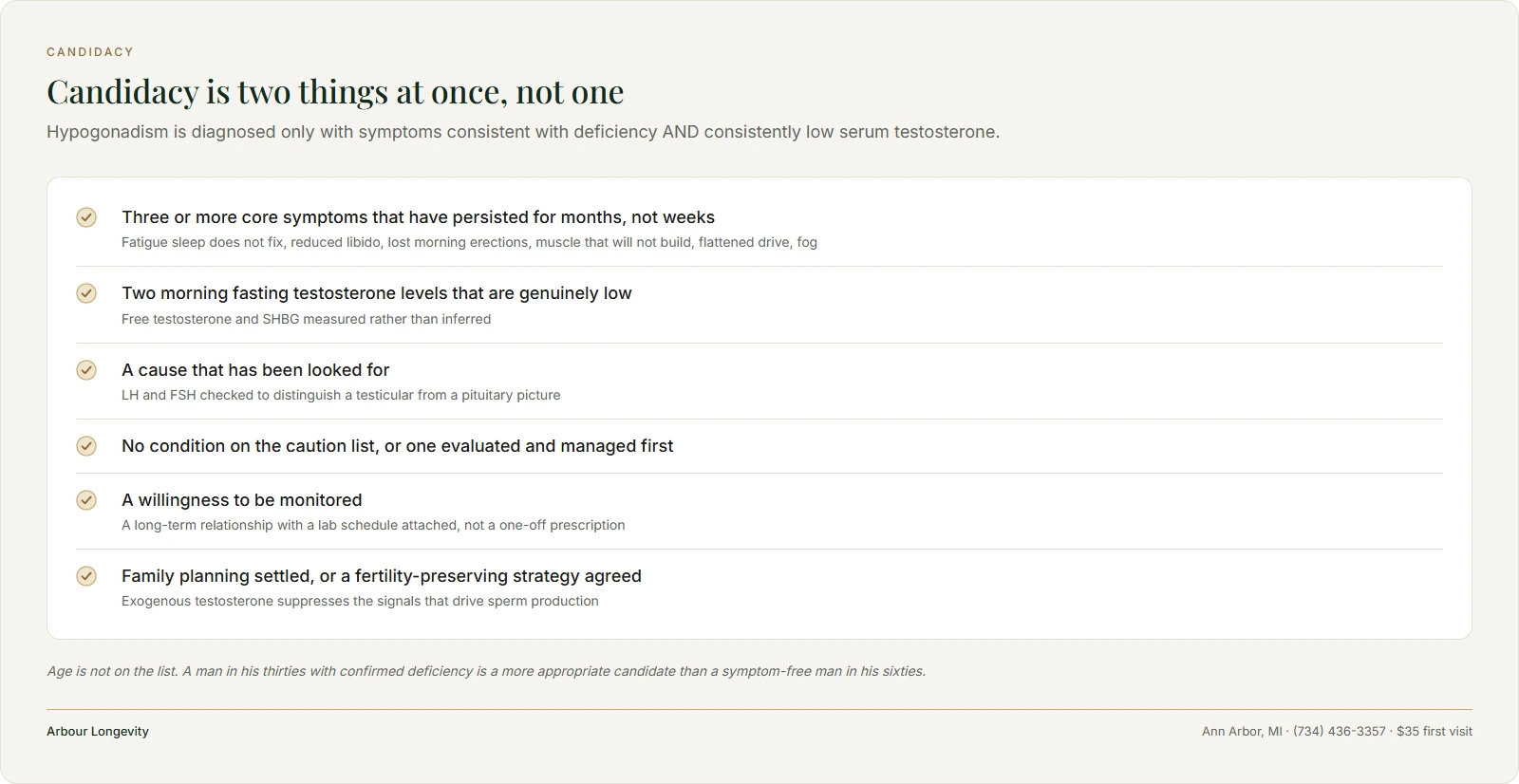
Candidacy is two things at once, not one
The Endocrine Society guideline is unambiguous on this point (Bhasin et al., J Clin Endocrinol Metab 2018, DOI: 10.1210/jc.2018-00229). Hypogonadism (the medical term for low testosterone) should be diagnosed only in men who meet two tests. They must have symptoms and signs of testosterone deficiency, AND clearly and consistently low blood testosterone.
Both halves matter. Symptoms without confirmed low levels mean the cause is still unknown. Low levels without symptoms mean there is nothing yet to treat. Either way, the honest next step is more information, not a prescription.
"Consistently low" is also doing real work. It means a fasting morning draw, repeated on a second morning, because a single afternoon result is not a diagnosis. The mechanics are covered in free vs total testosterone and how to read your lab panel.
Who tends to be a strong candidate?
Testosterone therapy fits best when the following line up:
- Three or more core symptoms that have lasted months rather than weeks. Think fatigue that sleep does not fix, lower sex drive, lost morning erections, muscle that will not build, fat that will not shift, flat drive, and brain fog.
- Two morning fasting testosterone levels that are genuinely low, with free testosterone (the usable, unbound share) and SHBG (the protein that binds it) measured rather than inferred.
- A cause that has been looked for. LH and FSH, the brain's signals to the testes, checked to tell a testicular problem from a pituitary one, and the common look-alikes below ruled out or addressed.
- No condition on the caution list, or one that has been evaluated and managed first.
- A willingness to be monitored. Treatment is a long-term relationship with a lab schedule attached, not a one-off prescription.
- Family planning settled, or a fertility-preserving strategy agreed before the first dose.
Age is not on that list, and it should not be. A man in his thirties with confirmed deficiency and matching symptoms is a more appropriate candidate than a symptom-free man in his sixties.
Not sure if this is you?
A 30 to 45 minute consultation and a full panel will tell you whether testosterone, or something else, explains your symptoms; the $35 is applied toward your plan.
Book your $35 first visit Call (734) 436-3357
Symptoms that usually point somewhere else
This is the part most testosterone programs skip, and it matters. The wrong diagnosis means a long-term prescription that never fixes the real problem.
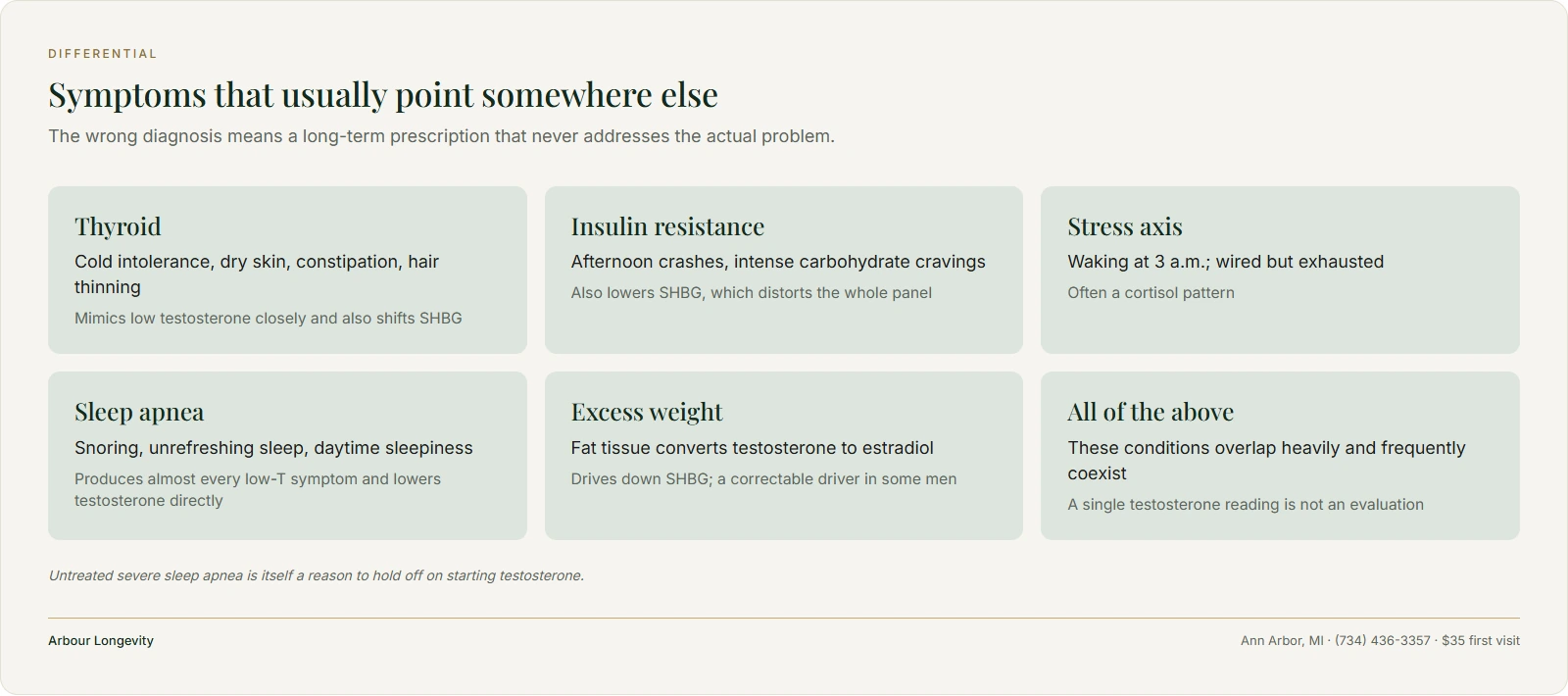
Cold intolerance, dry skin, constipation, hair thinning. These point toward the thyroid rather than testosterone. Thyroid problems mimic low testosterone closely and are often missed when only TSH is checked. They also shift SHBG, which changes how your testosterone results should be read in the first place.
Afternoon crashes and intense carbohydrate cravings. More suggestive of insulin resistance (cells that stop responding to insulin, so blood sugar and belly fat rise). Insulin resistance also lowers SHBG, which distorts the whole panel.
Waking at 3am consistently, or feeling wired but exhausted. Often a cortisol and stress-axis pattern.
Snoring, unrefreshing sleep, daytime sleepiness. Sleep apnea produces almost every symptom on the low testosterone list, and it lowers testosterone directly. Treating the testosterone without treating the apnea addresses the symptom and ignores the cause. Untreated severe sleep apnea is itself a reason to hold off on starting.
Significant excess weight. Fat tissue converts testosterone to estradiol and drives down SHBG. In some men this is a genuinely correctable driver, and addressing it moves the whole panel.
The honest position is that these conditions overlap heavily and often coexist. That is precisely why a single testosterone reading is not a workup.
When should testosterone therapy wait?
Sometimes testosterone is not the right next step. Sometimes something else needs to be checked and managed first. The Endocrine Society guideline advises against starting testosterone in men who plan to have children soon, or who have any of the following (DOI: 10.1210/jc.2018-00229):
- Breast or prostate cancer
- A palpable prostate nodule or hardening
- PSA (a prostate blood test) above 4 ng/mL, or above 3 ng/mL in men at increased risk of prostate cancer, without further urological evaluation first
- A high hematocrit (share of blood made of red cells) at baseline
- Untreated severe obstructive sleep apnea
- Severe lower urinary tract symptoms
- Uncontrolled heart failure
- Heart attack or stroke within the last six months
- Thrombophilia (a tendency to form blood clots)
Several of these are timing issues rather than permanent exclusions. Sleep apnea that gets treated, a hematocrit that comes down, a prostate question that gets answered: each can change the picture. A good evaluation says which of those applies to you.
What the heart evidence actually supports
Men with heart disease often assume they are automatically excluded. The evidence is more encouraging than that. The TRAVERSE trial enrolled 5,246 men aged 45 to 80 with low testosterone and either existing or high-risk heart disease. Daily testosterone gel was no worse than placebo for the combined outcome of heart death, nonfatal heart attack and nonfatal stroke (hazard ratio 0.96; 95% CI 0.78 to 1.17). Mean follow-up was 33.0 months. The trial did record more atrial fibrillation, acute kidney injury and pulmonary embolism in the testosterone group (Lincoff et al., N Engl J Med 2023, DOI: 10.1056/NEJMoa2215025).
Read plainly: existing heart disease is not by itself a bar to candidacy. It is a reason for a careful personal assessment. The monitoring plan should include kidney function and a watch for clotting and rhythm symptoms.
Fertility: raise it before you start, not after
This is the single most common conversation men tell us nobody had with them. Outside testosterone suppresses the pituitary signals that drive sperm production, and that effect is meaningful.
If children may be in your future, even uncertainly, even years out, say so at the first visit. There are approaches that raise testosterone while preserving sperm production, and add-ons that can be used alongside treatment. All of them are far easier to plan for at the start than to retrofit later.
What confirms candidacy in practice?
A meaningful evaluation covers, at minimum:
- Total and free testosterone, on two fasting morning draws
- SHBG, because it determines how much of your total is usable
- Estradiol, ideally by a sensitive assay
- LH and FSH, to locate the problem
- Full thyroid panel: TSH, Free T3, Free T4, reverse T3
- Metabolic markers: fasting insulin, HbA1c, lipids
- Cortisol and DHEA-S
- Hematocrit and PSA, as the baselines required before any treatment
- Vitamin D and ferritin, which produce overlapping fatigue
- A sleep history, and a sleep study where the picture warrants one
What each of those numbers means is covered in free vs total testosterone and how to read your lab panel.
If you are a candidate, what comes next
- Choosing a format: pellets vs injections vs gels
- What it costs and what is tracked: TRT cost and monitoring
- The full treatment picture: testosterone replacement therapy for men in Ann Arbor
Getting evaluated in Ann Arbor
Arbour Longevity checks for low testosterone in Ann Arbor with full lab testing rather than a symptom questionnaire. We will tell you plainly if testosterone is not the answer your results point to. Protocols are designed and monitored by Gandhi Bhattarai, FNP-BC, PMHNP-BC, Anti-Aging/Functional Medicine BC, a triple board certified nurse practitioner. Treatment is delivered by injection, cream or pellet, depending on what fits your life.
Read more about hormone optimization, our approach to hormone replacement therapy in Ann Arbor, or what our lab panels cover.
Arbour Longevity is at 2217 Packard St #15 in Ann Arbor. We serve Ypsilanti, Saline, Dexter, Chelsea and Washtenaw County, with telehealth follow-up across Michigan. We are open Thursday through Monday, 10am to 7pm, closed Tuesday and Wednesday. Parking is free and directly outside, with no meters and no parking structure. Suite 15 is down a flight of stairs, so please call ahead if stairs are difficult for you.
Your first visit is $35, applied toward your treatment plan, and HSA and FSA cards are accepted. Call (734) 436-3357 or book your $35 first visit.
References
- Bhasin S, Brito JP, Cunningham GR, et al. Testosterone Therapy in Men With Hypogonadism: An Endocrine Society Clinical Practice Guideline. J Clin Endocrinol Metab. 2018;103(5):1715-1744. PMID 29562364. DOI: 10.1210/jc.2018-00229
- Lincoff AM, Bhasin S, Flevaris P, et al. Cardiovascular Safety of Testosterone-Replacement Therapy (TRAVERSE). N Engl J Med. 2023;389(2):107-117. PMID 37326322. DOI: 10.1056/NEJMoa2215025
This article is educational and does not replace individualized medical advice.

Gandhi Bhattarai, FNP-BC, PMHNP-BC, Anti-Aging/Functional Medicine BC
Triple board-certified nurse practitioner and founder of Arbour Longevity in Ann Arbor. Every article is written from clinic practice and reviewed against current guidelines.
✓ Medically reviewed · Last updated August 19, 2026
How we reviewed this article
Arbour Longevity articles are written by the treating clinician, checked against primary sources (peer-reviewed journals, FDA labeling, Endocrine Society and other specialty guidelines) and re-reviewed when guidance changes. See our editorial policy. Spotted an error? Email info@arbourlongevity.com.
This article is educational and is not a substitute for individualized medical advice. Whether a treatment is appropriate for you is determined during consultation.
Your symptoms have a cause. Let’s find it.
Book a $35 first visit in Ann Arbor. It’s a 30–45 minute consultation with Gandhi Bhattarai, applied toward your plan. Serving Ann Arbor, Ypsilanti, Saline, Dexter, Chelsea, and Michigan by telehealth.






.webp)

