
Testosterone Replacement Therapy for Men in Ann Arbor: Benefits, Risks, and What to Expect
Key takeaways
- TRT restores low testosterone to a healthy range and can improve energy, sex drive, mood, muscle and bone.
- You need both low morning blood levels and matching symptoms before treatment makes sense.
- The TRAVERSE trial found no extra risk of major heart events in 5,246 men on testosterone.
- Injections, pellets and gels all work; the right one depends on your life and your labs.
- Good TRT is monitored: labs at 6 to 12 weeks, then every 3 to 6 months.
This is our main guide to testosterone replacement therapy in Ann Arbor. For a specific question, go straight to it:
- Low testosterone symptoms
- Who is and isn't a candidate
- Free vs total testosterone and reading your labs
- Pellets vs injections vs gels
- Cost and monitoring
What Is Low Testosterone, and How Common Is It?
Testosterone is the main male sex hormone. It drives sex drive, muscle, energy and mood. The medical term for low testosterone (low T) is hypogonadism. It affects an estimated 20 to 40% of men over age 45, and it becomes more common with each decade.
The American Urological Association defines low T as a total testosterone below 300 ng/dL. The level must be low on at least two separate morning blood draws, and you must also have signs or symptoms.
Testosterone falls by roughly 1 to 2% per year after age 30, so the changes creep in slowly. Many men write them off as normal aging. They are not.
What Are the Symptoms of Low T?
Low testosterone can touch almost every part of daily life. Common symptoms include:
- Persistent fatigue and low energy, even after enough sleep
- Lower sex drive and erectile dysfunction
- Loss of lean muscle and more body fat, mostly around the middle
- Brain fog, poor focus and memory lapses
- Low mood, irritability or emotional flatness
- Weaker bones, which raises fracture risk
- Poor sleep and less motivation
These symptoms overlap with depression, thyroid problems and metabolic syndrome. That is why lab work is essential to a precise diagnosis. Our detailed guide to low testosterone symptoms in men covers the physical, sexual and emotional picture in full.
Who Is a Good Candidate for TRT, and Who Isn't?
The ideal candidate has both documented low testosterone and symptoms that fit. Symptoms without low labs need a deeper look. So do low labs without symptoms. Neither should lead to an automatic prescription. Our full breakdown of who is and isn't a candidate for TRT walks through the other causes to rule out.
Age and TRT: From Men in Their 30s to Men Over 70
Men often ask whether they are too young or too old. Starting TRT in your 30s is appropriate when the deficiency is clear and confirmed. Men in their 60s and 70s can benefit too. At that age, prostate and heart screening become more central to the decision. The right age to start is simply the age at which you have a real, diagnosed need and the monitoring to do it safely.
When TRT Should Be Approached With Caution
TRT is not right for everyone. It calls for extra caution, and sometimes is not appropriate at all, in men with:
- Untreated prostate or breast cancer
- Uncontrolled heart conditions
- Very high red blood cell counts
- Untreated severe sleep apnea
- Plans to conceive, because standard TRT suppresses fertility
A thorough clinician screens for all of this before recommending anything. That is exactly why the first step is a full panel and a real conversation.
Diagnostic Testing: Getting the Full Picture
At Arbour Longevity, we never prescribe TRT based on a single number. Gandhi Bhattarai, FNP-BC, PMHNP-BC orders a full hormone panel that typically includes:

- Total testosterone, drawn in the morning when levels peak
- Free testosterone (the share not bound to proteins, so your body can actually use it)
- Sex hormone-binding globulin (SHBG), a protein that grabs hormones in the blood so your tissues cannot use them
- Estradiol (E2), because testosterone converts to estrogen through the enzyme aromatase
- LH and FSH, the brain's signals to the testes, to tell primary from secondary hypogonadism
- Complete blood count (CBC), including hematocrit (the share of your blood made of red cells)
- Metabolic panel and lipid profile
- PSA, a blood test that screens prostate health
- Thyroid panel, to rule out thyroid-related fatigue and mood changes
Two confirmed morning levels below 300 ng/dL, plus symptoms, form the basis for a TRT discussion. Testosterone follows a daily rhythm and peaks between 7 and 10 a.m., so we require fasting morning draws. We also look at sleep, stress, nutrition and exercise, because good treatment starts with the foundation. To read your own results line by line, see free vs total testosterone and how to read your lab panel. The testosterone-to-estradiol ratio often matters more than either number alone.
What Does TRT Actually Improve?
When testosterone is truly low, restoring it can meaningfully improve quality of life. The benefits men report most fall into a few clear groups.
Sexual Health, Energy, Body Composition and Bone Density
- Better sex drive and erections, one of the most reliable responses to treatment
- More energy and less fatigue, often the first change men feel
- More lean muscle and strength, with less fat
- Denser bones, which lowers long-term fracture risk
These are not cosmetic perks. For an aging man, keeping muscle and bone is directly tied to staying strong, mobile and independent as the decades add up.
Mood, Anxiety and Mental Clarity
This is where a psychiatrically informed approach matters, and where most clinics stay silent. Our clinician is board-certified in psychiatric mental health, so mood and thinking are never an afterthought here. Many men on well-managed TRT report less brain fog, steadier mood, less irritability, and the return of motivation and focus. Testosterone will not cure a clinical mood disorder. But for men whose low T was dragging on their mental sharpness, these are often the benefits they value most. We cover this in depth in testosterone therapy and mental health.
Metabolic Health and Longevity
Testosterone is closely tied to metabolism (how your body turns food into energy). In deficient men, restoring healthy levels can support better body composition, less belly fat and better metabolic markers. That is why we assess testosterone alongside HbA1c, lipids and IGF-1. For a longevity practice, this is the point. TRT is not just about feeling better today. It is one lever within a broader plan for aging well.
Not sure if this is you?
A 30 to 45 minute consultation and a full hormone panel, with the $35 applied toward your plan.
Book your $35 first visit Call (734) 436-3357
Treatment Options for TRT in Ann Arbor
There is no single best way to deliver testosterone. The right choice depends on your lifestyle, preference, lab response and tolerance. We compare them in detail in pellets vs injections vs gels.
Injections (Testosterone Cypionate)
Weekly or twice-weekly injections into the muscle remain the gold standard for TRT. They offer precise dosing, predictable absorption and low cost. Many patients give their own shots at home after a short training session. Smaller-needle injections just under the skin are also available.
Testosterone Pellets
Pellets are rice-sized implants placed under the skin in a brief office procedure every 3 to 6 months. They release testosterone steadily, without the peaks and troughs of injections. They suit men who want a set-and-forget approach. See our hormone pellet therapy page for detail.
Topical Testosterone (Creams and Gels)
Creams and gels are applied daily to the shoulders, upper arms or inner thighs. They give steady levels and suit men who want to avoid needles. The TRAVERSE trial used a daily testosterone gel as its treatment (Lincoff et al., NEJM 2023, DOI: 10.1056/NEJMoa2215025). One precaution: avoid skin-to-skin contact with partners or children until the site is dry.
TRT is often combined with other therapies as part of our whole-body approach. Hormone optimization addresses the wider hormone system. Peptide therapy can support growth hormone release, tissue repair and recovery. For men whose low T is made worse by excess body fat, our medical weight loss program works alongside TRT. Fat tissue converts testosterone to estrogen, so losing fat can make TRT work better.
What Does the Research Say About Heart Safety and Results?
The landmark TRAVERSE trial (NEJM, 2023) gave the clearest answer to date. This randomized controlled trial (a study where men are assigned by chance to treatment or a placebo) enrolled 5,246 men aged 45 to 80. All had low testosterone plus existing or high-risk heart disease. TRT was no worse than placebo for major heart events (hazard ratio 0.96; 95% CI 0.78 to 1.17; DOI: 10.1056/NEJMoa2215025).
A 2024 meta-analysis (a study that pools the results of many trials) of 30 RCTs and 11,502 patients confirmed this. It found no rise in heart events, stroke, heart attack or death compared with placebo (DOI: 10.1016/j.pcad.2024.04.001). The TestES evidence synthesis (2024) pooled individual data from 35 trials. It found that TRT improved quality of life and sexual function with no harm to blood pressure, lipids or blood sugar (DOI: 10.3310/JRYT3981). Research also shows TRT adds fat-free mass and cuts body fat, with the biggest gains in men who start lowest (DOI: 10.3389/fendo.2022.915309).
For the full picture on heart health, including what TRAVERSE means if you already have heart disease, see testosterone and cardiovascular health.
When Will You Feel the Difference?
TRT is not an overnight fix. Change is gradual, and the timeline varies by symptom:
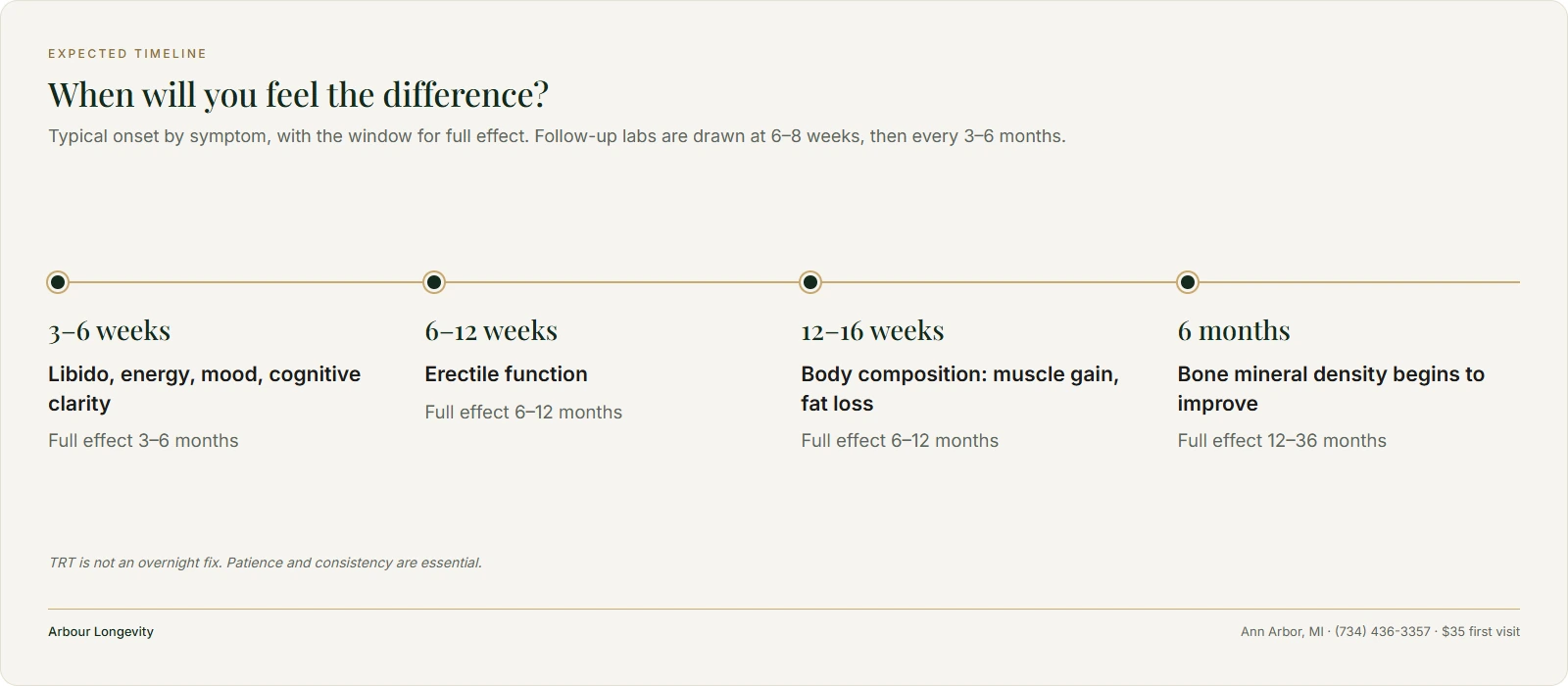
| Improvement | Typical Onset | Full Effect |
|---|---|---|
| Libido and sexual interest | 3-6 weeks | 3-6 months |
| Energy and mood | 3-6 weeks | 3-6 months |
| Erectile function | 6-12 weeks | 6-12 months |
| Body composition (muscle gain, fat loss) | 12-16 weeks | 6-12 months |
| Bone mineral density | 6 months | 12-36 months |
| Cognitive clarity and focus | 3-6 weeks | 3-6 months |
Patience and consistency are essential. We schedule follow-up labs at 6 to 8 weeks after you start, then every 3 to 6 months to fine-tune the dose.
Ongoing Monitoring
Responsible TRT means regular blood work, and it is what separates a precision longevity clinic from a high-volume testosterone mill. The full monitoring schedule, the markers we track and what it costs are set out in TRT cost and what monitoring is included.
What Are the Risks and Side Effects of TRT?
No medical therapy is without risk. Possible side effects include:
- Erythrocytosis (too many red blood cells), the most common lab change. It is managed with a dose change or blood donation.
- Acne or oily skin, usually mild and short-lived
- Testicular shrinkage and lower sperm production. Outside testosterone switches off the brain's signals to the testes. Men who want to keep their fertility may need add-on therapies such as hCG or clomiphene.
- Mood swings, mostly with uneven dosing or levels pushed above the normal range
- Worse sleep apnea in some men who already have it
- Breast tenderness or breast tissue growth, usually from raised estradiol
The TRAVERSE trial also noted more atrial fibrillation, acute kidney injury and pulmonary embolism in the testosterone group. That is why each man's risk is assessed on its own and monitoring continues throughout.
TRT is not appropriate for men with untreated severe sleep apnea, uncontrolled heart failure, a baseline hematocrit above 50%, or active prostate or breast cancer. It is also not appropriate for men trying to conceive unless fertility-preserving add-ons are used.
Frequently Asked Questions
Is TRT the same as anabolic steroids?
No. TRT restores testosterone to a normal range (typically 500 to 900 ng/dL) under medical supervision. Steroid abuse uses doses far above the normal range with no monitoring, and it carries far higher health risks.
Will TRT cause prostate cancer?
Current evidence does not support a causal link between TRT at normal doses and prostate cancer. The TRAVERSE trial found no significant rise in high-grade prostate cancer. We check PSA at baseline and monitor it regularly. Men with active prostate cancer should not receive TRT.
Can I preserve my fertility while on TRT?
Yes, with the right strategy, but tell your clinician before you start, not after. Outside testosterone shuts down the pituitary signals (LH and FSH) that drive sperm production. If fertility matters, we can add hCG alongside TRT. Another option is clomiphene citrate, which raises your own testosterone without stopping sperm production. This is one of the most common things online prescribers never tell men.
Is TRT lifelong? What happens if I stop?
For men with lasting deficiency, TRT is generally a long-term commitment, because the cause does not fix itself. If you stop, your levels return to their old baseline and symptoms usually come back over weeks to months. Starting TRT is a real decision. Make it with a clinician who will walk the long road with you, not one who hands you a vial and disappears.
How much does TRT cost, and do you take insurance?
Arbour Longevity is a cash-pay practice. That allows the depth of care and tailoring that insurance-based medicine cannot. Your first visit is $35, applied toward your treatment plan. We accept HSA and FSA funds and give detailed receipts for possible out-of-network reimbursement. Lab orders go to LabCorp or Quest, where many patients have partial coverage. Full pricing and the monitoring it includes are in TRT cost and monitoring.
Why Choose Arbour Longevity for TRT in Ann Arbor?
Gandhi Bhattarai, FNP-BC, PMHNP-BC is triple board certified in family practice, psychiatric mental health, and anti-aging and functional medicine. She brings deep hormone expertise and a commitment to evidence-based care. Every patient gets a thorough evaluation, a tailored plan and ongoing monitoring. Your protocol is built around your labs, your symptoms and your goals.
We are at 2217 Packard St #15, Ann Arbor, MI 48104, open Thursday through Monday, 10am to 7pm, and closed Tuesday and Wednesday. We serve Ypsilanti, Saline, Dexter, Chelsea and the wider Washtenaw County area, with telehealth follow-up across Michigan. Parking is free and directly outside, with no meters and no parking structure. Suite 15 is down a flight of stairs, so please call ahead if stairs are difficult for you.
If you are a man in Ann Arbor or Washtenaw County with symptoms of low testosterone, we invite you to book your $35 first visit. The fee is applied toward your treatment plan. You can also call or text (734) 436-3357.
Continue Reading in This Series
- Low testosterone symptoms in men: the full symptom picture, physical, sexual and emotional
- Who is and isn't a candidate for TRT, and which symptoms point somewhere else
- Free vs total testosterone: how to read every marker on your lab panel
- Pellets vs injections vs gels: choosing a delivery method
- TRT cost and monitoring: what you pay and what gets tracked
This content is educational and does not constitute medical advice. TRT requires clinical evaluation, lab work and ongoing monitoring by a licensed provider. Individual results vary. Arbour Longevity, 2217 Packard St #15, Ann Arbor MI 48104, (734) 436-3357.

Gandhi Bhattarai, FNP-BC, PMHNP-BC, Anti-Aging/Functional Medicine BC
Triple board-certified nurse practitioner and founder of Arbour Longevity in Ann Arbor. Every article is written from clinic practice and reviewed against current guidelines.
✓ Medically reviewed · Last updated August 21, 2026
How we reviewed this article
Arbour Longevity articles are written by the treating clinician, checked against primary sources (peer-reviewed journals, FDA labeling, Endocrine Society and other specialty guidelines) and re-reviewed when guidance changes. See our editorial policy. Spotted an error? Email info@arbourlongevity.com.
This article is educational and is not a substitute for individualized medical advice. Whether a treatment is appropriate for you is determined during consultation.
Your symptoms have a cause. Let’s find it.
Book a $35 first visit in Ann Arbor. It’s a 30–45 minute consultation with Gandhi Bhattarai, applied toward your plan. Serving Ann Arbor, Ypsilanti, Saline, Dexter, Chelsea, and Michigan by telehealth.






.webp)

