

Low Testosterone Symptoms in Men: Signs You Shouldn't Ignore
Key takeaways
- The first signs of low testosterone are fatigue that sleep does not fix, a fading sex drive, mood changes and lost muscle tone.
- Most guidelines define low T as a total testosterone below 300 ng/dL, but symptoms can appear in the low-normal range.
- Levels fall about 1 to 2% a year from the late 20s, so the decline is slow and easy to dismiss.
- Obesity, sleep apnea, chronic stress and certain medications drive testosterone down and are often part of the cause.
- Diagnosis needs a morning blood panel, not one number, and treatment is tailored and monitored.
This is our main guide to low testosterone symptoms in men. For a specific question, go straight to it:
- Who is and isn't a candidate for TRT, and which symptoms point elsewhere
- Free vs total testosterone and how to read your lab panel
- Testosterone replacement therapy for men in Ann Arbor
- Pellets vs injections vs gels
- What TRT costs and what monitoring is included
Low testosterone (low T) is known medically as male hypogonadism or testosterone deficiency syndrome. It affects millions of men across the United States. Many go years without a diagnosis, because the symptoms build slowly and are easy to dismiss.
If you are a man in your 30s, 40s, 50s or beyond and something feels persistently off, this guide is for you. It explains what low T looks like, what drives it, and what evidence-based care looks like at Arbour Longevity in Ann Arbor, Michigan.
What Is Low Testosterone and Why Does It Matter for Men's Health?

How Testosterone Works in the Male Body
Testosterone is the main male sex hormone, an androgen made mostly in the testes, with small amounts from the adrenal glands. A feedback loop controls it. The hypothalamus and pituitary gland are the brain's hormone control centers. They signal the testes through two messengers, LH and FSH.
Beyond sex and fertility, this hormone runs a surprisingly wide range of jobs in men:
- Muscle protein synthesis and keeping lean body mass
- Bone density and skeletal strength
- Red blood cell production and heart function
- Mood, motivation and mental sharpness
- Fat burning and how well your cells respond to insulin
- Sperm production and male fertility
When T falls below the healthy range, these systems do not fail overnight. They degrade slowly, steadily and often silently, until the combined effect becomes impossible to ignore.
What Is Considered a Low Testosterone Level?
Testosterone is measured with a blood test, usually drawn in the morning when levels are naturally highest. Results are reported as total T, free T and sometimes bioavailable T.
Most guidelines define low T as a total testosterone below 300 ng/dL. But symptoms can appear in men whose levels sit anywhere in the lower third of the normal range. That is especially true when free testosterone (the usable, unbound share) is also held down by high SHBG. SHBG is a protein that grabs hormones in the blood so your tissues cannot use them.
This is why symptoms matter as much as numbers. A man at 320 ng/dL who feels exhausted, depressed and sexually disinterested may be just as undertreated as a man at 180 ng/dL.
How Testosterone Levels Change With Age
Testosterone does not drop off a cliff. It falls slowly, usually from a man's late 20s or early 30s, at roughly 1 to 2% per year. By his 50s or 60s, a man may have lost 30 to 50% of his peak output.
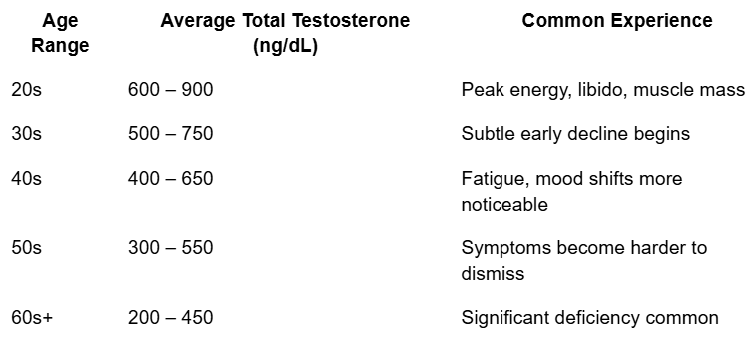
These are averages. The range from man to man is wide, and lifestyle can speed up or slow down this path a great deal.
Primary vs. Secondary Hypogonadism: What Is the Difference?
Knowing the root cause of your low T shapes the treatment plan.
Primary hypogonadism starts in the testes themselves. They are not making enough T despite proper signals from the brain. Causes include injury to the testes, some genetic conditions, or damage from chemotherapy or radiation.
Secondary hypogonadism starts in the brain's control centers. The testes can make T but are not getting enough signal. This type is more common. It is more closely tied to lifestyle, long-term illness, excess weight and age-related hormone changes.
At Arbour Longevity, Gandhi Bhattarai sorts out which of the two you have before recommending any treatment. The right fix depends entirely on the right diagnosis.
Common Low Testosterone Symptoms in Men You Should Not Ignore

Most men notice one or two symptoms first and assume there is a separate explanation for each. Only when the full picture emerges does the hormonal connection become clear. Here is what low T actually looks like across the body, mind and emotions.

Physical Symptoms: What Low T Does to Your Body
The physical changes are often the first to appear, yet the last to be blamed on hormones. Men tend to point to their diet, their workload or their age rather than a measurable hormone shift.
Muscle loss, weight gain and changes in body composition. Testosterone is the main hormone driving muscle building. When levels drop, keeping lean muscle gets much harder, even for men who train hard and often. You may notice:
- Less muscle definition despite no change in your training
- Faster muscle fatigue during workouts that used to feel manageable
- Gradual belly fat gain, mostly around the midsection
- Gynecomastia, mild breast tissue growth driven by the shift toward estrogen
This shift in body composition (how much of your weight is muscle versus fat) is not cosmetic. Deep belly fat is directly linked to insulin resistance, metabolic syndrome and higher heart risk. All of these are also linked to low testosterone. The result is a cycle that gets worse over time without help.
Fatigue, reduced endurance and low motivation. This is the symptom men describe most often, and the one most often brushed off. It is not ordinary tiredness. It is a cellular-level exhaustion that sleep does not fix. Men with low T often describe:
- Waking up unrefreshed no matter how long they slept
- Hitting a wall midday with no obvious cause
- Loss of the drive and ambition that used to come naturally
- Less physical endurance; tasks that were once effortless now feel labored
- A general flatness or disengagement from things that used to matter
This fatigue is not weakness of will. It reflects real changes in how your cells make and use energy. Testosterone helps make red blood cells and supports your mitochondria (the tiny power plants inside your cells).
Sexual and Reproductive Symptoms of Low T
These symptoms are often the most upsetting, and the most likely to finally send a man for a checkup.
Low libido, erectile dysfunction and fertility. Testosterone is the main driver of male sex drive. When levels fall, reduced sex drive is almost universal, and it often arrives well before erectile dysfunction does. What men typically experience:
- Fewer sexual thoughts and less spontaneous interest
- Trouble getting or keeping erections, especially without direct touch
- Lower ejaculate volume and sensation
- Less sperm production, which can affect fertility
- Shrinking testes when the shortfall is long or severe
Erectile dysfunction caused by low T responds differently to drugs like Viagra (PDE5 inhibitors) than ED from blood-vessel causes alone. If low T is the root issue, fixing it often brings a bigger and longer-lasting improvement.
Not sure if this is you?
A 30 to 45 minute consultation and a full morning hormone panel will tell you where your levels stand, with the $35 applied toward your plan.
Book your $35 first visit Call (734) 436-3357
Mental and Emotional Symptoms of Low T
This group is the most often missed. Mood and thinking problems get blamed on stress, work, relationships or depression, and nobody checks the hormones.
Brain fog, depression, anxiety and mood swings. Testosterone has a direct, well-documented effect on brain chemicals, above all dopamine and serotonin. When levels fall, the effects can be large:
- Ongoing low mood or flatness that lifestyle changes do not fully fix
- Irritability and a short temper that feel out of proportion and out of character
- Anxiety, often described as a low-grade, constant tension without a clear trigger
- Brain fog: trouble concentrating, slower recall, less mental sharpness
- Poor motivation and loss of the competitive, goal-driven edge that used to define you
These are not character flaws. They are measurable hormone effects, and they respond well to proper treatment.
Can Low Testosterone Cause Long-Term Mental Health Decline?
This question is worth taking seriously. Research consistently links long-term low testosterone to a higher risk of depression and declining memory and thinking. In older men it is also linked to markers tied to brain diseases of aging.
Untreated low T does not just make you feel bad now. Over years, poor sleep, more body fat, less activity and pulling away from people add up. Together they can harm long-term mental health and quality of life.
Catching and treating it early matters. Not just for how you feel today, but for who you remain in the decades ahead.
What Causes Testosterone to Drop, and Who Is Most at Risk?

Knowing why T falls makes clear both why treatment matters and which habits speed up or slow down the process.
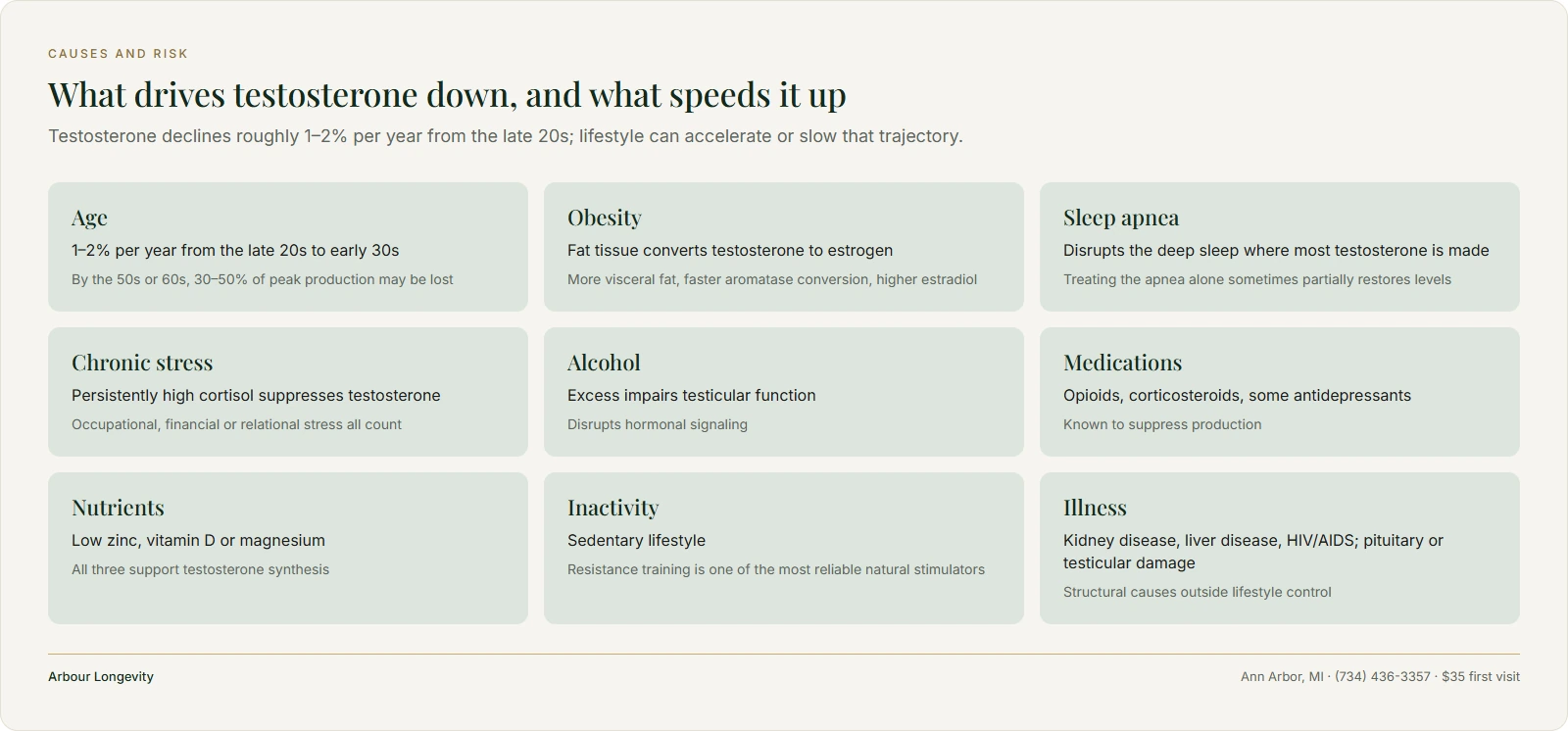
Biological and Age-Related Causes of Low Testosterone
Some causes of low T are physical, and outside lifestyle control:
- Age-related decline: the most common cause; slow and steady from the late 20s onward
- Problems in the brain's control centers that break the signal chain
- Damage to the testes from injury, infection or medical treatment
- Klinefelter syndrome and other genetic conditions that affect how the testes develop
- Long-term illness, including kidney disease, liver disease and HIV/AIDS
- Certain drugs: opioids, steroids and some antidepressants are known to lower T
Lifestyle Factors That Speed Up Testosterone Decline
This is where many men have more control than they realize. That said, lifestyle changes alone are rarely enough once a real shortfall has set in.
- Long-term stress raises cortisol, which directly lowers T output
- Poor or short sleep: most T is made during deep sleep
- Sitting too much: lifting weights is one of the most reliable natural T boosters
- Heavy drinking, which harms the testes and disrupts hormone signals
- Diet gaps, above all zinc, vitamin D and magnesium, which all support T output
How Obesity, Sleep Apnea and Chronic Stress Suppress Testosterone
These three deserve special attention. Each is both a cause and a result of low T, so they feed on themselves in cycles that are hard to break without help.
Obesity speeds the conversion of T to estrogen through aromatase, an enzyme found in fat tissue. The more deep belly fat a man carries, the faster this runs. Free T falls while estradiol rises.
Sleep apnea breaks up the deep sleep when most daily T is made. Men with untreated sleep apnea often have low T, and treating the apnea alone sometimes partly restores levels.
Long-term stress keeps cortisol high. Cortisol and T work against each other: when one stays up, the other falls. Men under long-term work, money or relationship stress often end up with low T as a direct result.
Low Testosterone Diagnosis and Treatment at Arbour Longevity, Ann Arbor
Finding low T is not hard. But it does take a clinician who takes the full picture seriously, not just one number on a lab report.
How Is Low Testosterone Diagnosed?
Diagnosis begins with a thorough conversation. At Arbour Longevity, Gandhi Bhattarai reviews your full symptom history, lifestyle and medical background before ordering any lab work. Symptoms are not dismissed. They are written down, mapped and treated as real clinical data.
A full hormone evaluation typically includes:
- Total testosterone: the standard baseline measure
- Free testosterone: the active share not bound to SHBG
- LH and FSH: to tell whether the problem is primary or secondary
- SHBG: high levels cut usable T even when total looks normal
- Estradiol (E2): to see the balance between T and estrogen
- Metabolic panel and CBC: to rule out other conditions that add to the picture
- Morning draw: T follows a daily rhythm and peaks between 7 and 10 a.m.
This is not a one-number diagnosis. It is a clinical picture, and that difference separates a truly useful workup from a rushed one.
Testosterone Replacement Therapy and Hormone Optimization at Arbour Longevity
Once low T is confirmed by both symptoms and labs, the question becomes: what treatment fits your biology, your goals and your life?
We do not offer one off-the-shelf testosterone protocol. Gandhi builds tailored programs around your full hormone profile, health history and goals. Options include:
- TRT injections: reliable, low cost and easy to adjust
- Testosterone gels: applied daily, with steady absorption
- Testosterone patches: steady delivery with little prep
- Clomiphene citrate: for men who want to keep their own T output and fertility
- hCG therapy: supports the testes alongside TRT when needed
BHRT Program: Clinician-Directed TRT Starting at $299 per Month
Arbour Longevity's BHRT (bioidentical hormone replacement therapy) program starts at $299 per month and includes:
- Full consultation with Gandhi Bhattarai, FNP-BC, PMHNP-BC, Anti-Aging/Functional Medicine BC
- Ongoing management of your medicine
- 4 B12 injections and 4 Lipo shots per year included in the program
- Clinician-directed TRT, BHRT and thyroid support where indicated
- Lab work billed separately for full transparency
This is not a telehealth checkbox service. It is a clinician-led program built on a real relationship. The goal is results that build over time, not a quick fix that fades in three months.
Your first consultation is $35, and that fee is applied directly toward your treatment.
Frequently Asked Questions About Low Testosterone in Men
What are the first signs of low testosterone in men?
The earliest signs are often subtle. They include fatigue that sleep does not fix, a slow drop in sex drive, mild mood changes like irritability or flatness, and a slight loss of muscle tone. Most men notice one of these first and blame stress or age. That is why the average time from first symptom to diagnosis is frustratingly long.
Can low testosterone cause depression and anxiety?
Yes, and the link is well established. Testosterone plays a direct role in dopamine and serotonin. Men with low T often have low mood, low motivation and general anxiety that do not fully respond to standard psychiatric care alone. Fixing the hormone shortfall is often a key part of resolving these symptoms.
What is considered a dangerously low testosterone level?
Any level below 300 ng/dL is a concern. Levels below 200 ng/dL carry bigger health risks, including faster bone loss, higher heart risk, and severe mood and thinking problems. At these levels, a workup and treatment should not wait.
How long does TRT take to work?
Most men notice better energy and mood within 2 to 4 weeks of starting TRT. Sexual function typically improves within 4 to 6 weeks. Muscle gain and fat loss come more slowly, over 3 to 6 months of steady treatment. Full results often take 6 to 12 months as the protocol is fine-tuned to your response.
Can low testosterone be reversed naturally?
Better sleep, lifting weights, weight loss, less stress and a better diet can modestly raise T in men with a mild, lifestyle-driven shortfall. But for men with confirmed hypogonadism, lifestyle alone rarely restores levels to a meaningful range. It works best as support alongside proper treatment.
Does low testosterone affect fertility?
Yes. Testosterone is essential for sperm production. Men with low T often have a lower sperm count and slower sperm, which can affect fertility. Standard TRT can shut down the body's own sperm production. Men who want to keep their fertility should discuss options like clomiphene citrate or hCG with their clinician before starting.
Should I get a testosterone test if I feel fine?
If you are over 35 and have never had your hormones checked, a baseline test is worth doing regardless of how you feel. Many men with clinically low T report feeling "okay". They have simply gotten used to a lower state because the decline was slow. A baseline gives you data to compare against as you age.
The Bottom Line: Low Testosterone Is Not Inevitable. It Is Treatable.
Feeling constantly tired, foggy, flat and weaker is not simply the price of getting older. For millions of men, it is the direct result of a measurable hormone shortfall that responds well to proper treatment.
The symptoms of low testosterone in men are real, they get worse, and when left alone they pile up. They affect your body, your brain, your relationships and your long-term health in ways that reach far beyond the obvious.
At Arbour Longevity in Ann Arbor, Michigan, Gandhi Bhattarai brings triple board certification in family practice, psychiatric mental health, and anti-aging and functional medicine to every hormone consultation. Your testosterone, your mental health, your metabolism and your overall vitality are looked at together, not one at a time.
You do not have to guess. You can know. A single blood test and a 45-minute conversation can tell you exactly where your levels stand and what your options are.
We are at 2217 Packard St #15, Ann Arbor, MI 48104, open Thursday through Monday, 10am to 7pm. Serving Ann Arbor, Dexter, Saline, Plymouth, Ypsilanti, Canton, Northville, and Southeast Michigan.
Your first consultation is $35, applied toward your treatment. Book your $35 first visit or call (734) 436-3357.
This article is educational and does not replace individualized medical advice. Testosterone therapy requires clinical evaluation, lab testing and ongoing monitoring by a licensed provider. Results vary.

Gandhi Bhattarai, FNP-BC, PMHNP-BC, Anti-Aging/Functional Medicine BC
Triple board-certified nurse practitioner and founder of Arbour Longevity in Ann Arbor. Every article is written from clinic practice and reviewed against current guidelines.
✓ Medically reviewed · Last updated August 21, 2026
How we reviewed this article
Arbour Longevity articles are written by the treating clinician, checked against primary sources (peer-reviewed journals, FDA labeling, Endocrine Society and other specialty guidelines) and re-reviewed when guidance changes. See our editorial policy. Spotted an error? Email info@arbourlongevity.com.
This article is educational and is not a substitute for individualized medical advice. Whether a treatment is appropriate for you is determined during consultation.
Your symptoms have a cause. Let’s find it.
Book a $35 first visit in Ann Arbor. It’s a 30–45 minute consultation with Gandhi Bhattarai, applied toward your plan. Serving Ann Arbor, Ypsilanti, Saline, Dexter, Chelsea, and Michigan by telehealth.






.webp)

